Short answer: both are gravity fed filters that need no electricity, but they are built for different jobs. Katadyn is a Swiss brand, founded in 1928, best known for expedition, humanitarian relief, and military water treatment. Its Gravidyn is a compact 10 liter unit built for that world. Berkey is sized for daily household water, with six system sizes from a 1.5 gallon Travel Berkey up to a 6 gallon Crown Berkey, and publishes broader third party lab data across 200+ contaminants. If you want a countertop system that supplies a family's daily drinking water with documented PFAS reduction, Berkey is the better fit. If you want a lighter, field proven unit for a cabin, base camp, or relief kit, the Gravidyn is worth a look.
Berkey is the better fit if you:
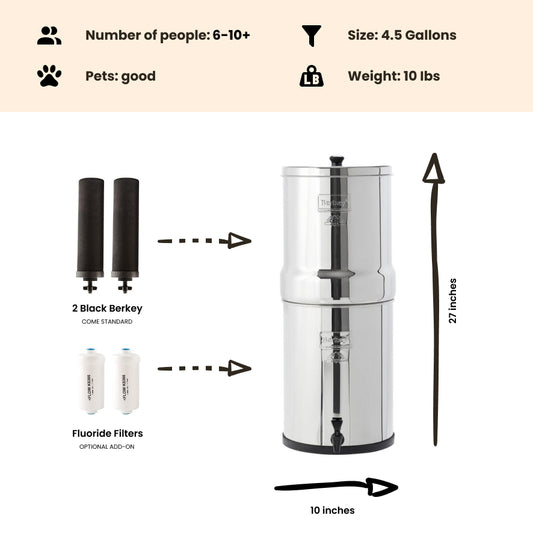
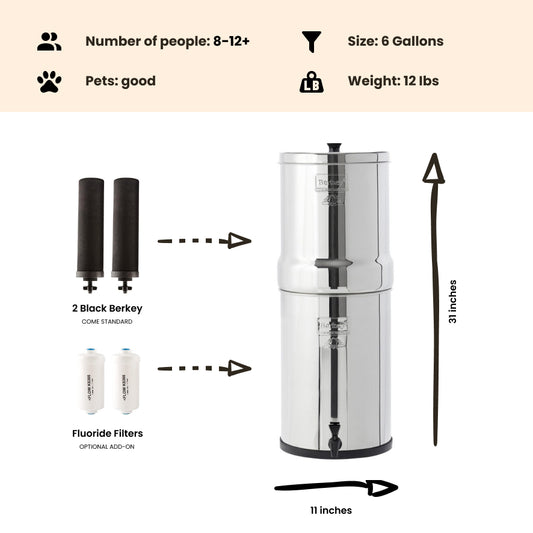
- Want a system sized for daily household drinking water, with six sizes from 1.5 to 6 gallons
- Need documented PFAS reduction data (9 compounds tested, all above 99.9%, PFOA reduced below 2 ppt)
- Want downloadable third party lab reports across 200+ contaminants, including heavy metals, pharmaceuticals, and pesticides
- Plan to add PF-2 filters for fluoride and arsenic reduction
- Value a dealer network and a documented manufacturer testing history going back to the late 1990s
Katadyn Gravidyn may be a better fit if you:
- Want a lighter, more compact unit built for a cabin, RV, base camp, or emergency kit
- Value a brand with a nearly 100 year history in humanitarian, military, and expedition water treatment
- Primarily need chlorine or taste and odor reduction for field and emergency use
- Don't need published PFAS, heavy metal, or pharmaceutical reduction data
- Plan to use it intermittently (camping, relief work, occasional emergencies) rather than as a full time daily household filter
Brand Background
Katadyn was founded in Zug, Switzerland in 1928 by chemist Alexander Kraeg, who developed an electrochemical silver ion water treatment process. Now headquartered near Zurich as Katadyn Group, the company has spent nearly a century supplying water treatment equipment to militaries, humanitarian aid organizations, and outdoor users worldwide. The Gravidyn is part of its Drip series, a free standing gravity filter line built for groups, base camps, cabins, and relief settings rather than daily countertop use in a single household.
Berkey is manufactured by New Millennium Concepts Ltd. (NMCL), which has been producing gravity filtration systems since the late 1990s. BigBerkeyWaterFilters.com is the largest authorized Berkey dealer in the United States. All new Berkey systems ship with Black Berkey Elements as the standard included filter. Black Berkey elements are currently unavailable for individual replacement purchase due to an EPA regulatory matter; the Berkey Phoenix New Millennium Edition, made by the same manufacturer, is the current in-stock replacement for existing system owners and carries NSF/ANSI 42 and NSF/ANSI/CAN 372 certification.
Quick Comparison: Berkey vs. Katadyn Gravidyn
Scroll right to see full table.
| Feature |
Berkey (Black Berkey standard / Phoenix in-stock replacement) |
Katadyn Gravidyn |
| System Capacity |
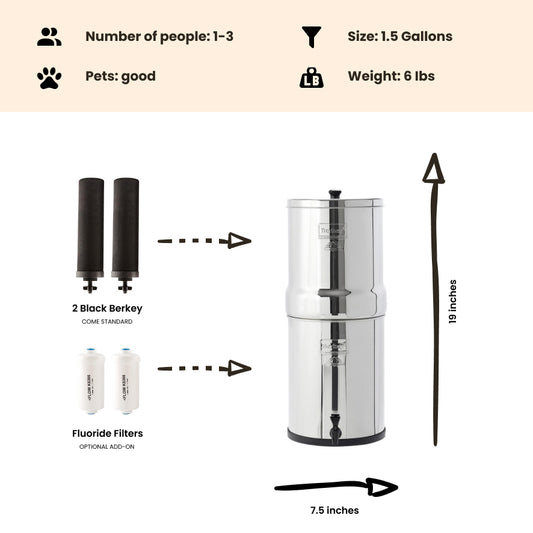
1.5 gal (Travel) to 6 gal (Crown), six sizes |
10 L / 2.6 gal, one size only |
| Filter Type |
Proprietary blend of 6+ media types; four filtration mechanisms (microfiltration, adsorption, absorption, ion exchange) |
Silver-impregnated 0.2 micron ceramic depth filter with an activated carbon core; 3 elements per system |
| Filter Lifespan |
6,000 gal/pair (Black Berkey); 5,500 gal/pair (Phoenix) |
Ceramic rated up to ~39,000 gal per element if field-cleaned, but manufacturer recommends replacing every 6 months regardless, since the carbon core's chlorine/taste capacity depletes on a time basis |
| Testing / Certifications |
Black Berkey: tested by independent EPA-accredited and NSF-accredited labs, not itself NSF certified; Phoenix: NSF/ANSI 42 and NSF/ANSI/CAN 372 certified |
Tested by independent labs Bachema and Spectrum; no NSF certification publicly documented |
| Contaminants Tested |
200+, downloadable lab PDFs |
Chlorine, taste and odor, general organics; no published PFAS, heavy metal, or pharmaceutical panel |
| PFAS Testing |
9 compounds tested, all above 99.9% reduction; PFOA reduced below 2 ppt (below EPA's 4 ppt MCL) |
Not publicly documented |
| Public Lab Reports |
Yes, downloadable PDFs from accredited labs |
Manufacturer fact sheet only; no downloadable broad-spectrum contaminant panel found |
| Filtration Speed |
1.5 to 3 GPH, varies by elements installed |
~1 gal (about 4 L) per hour |
| Fluoride Reduction |
PF-2 add-on filters required, up to 99.75% reduction, $103/pair, 1,000 gal or 1 year, whichever comes first |
Not offered or documented |
| Weight / Portability |
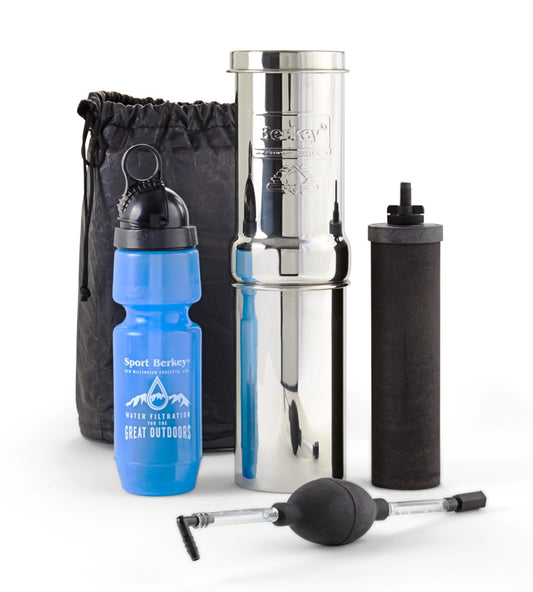
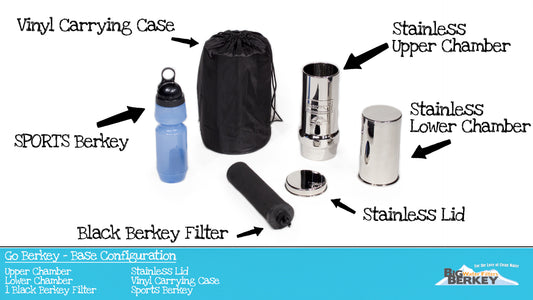
Full systems are countertop units; Travel Berkey and Go Berkey Kit are the portable options |
About 6.9 lbs, 18 in tall, purpose-built for base camps and relief kits |
| System Price |
$234 (Go Berkey Kit) to $478 (Crown Berkey), MAP-controlled pricing |
Roughly $295 to $430 depending on retailer (current 2026 pricing) |
| Verified Media Coverage |
EWG, Food Network, CBS News, LA Times |
No dedicated consumer press page; long-standing use by humanitarian aid organizations and military |
| Brand History |
NMCL, since the late 1990s (25+ years) |
Katadyn Group, founded 1928 in Switzerland (nearly 100 years) |
How Each Filter Works
Both systems rely on gravity instead of water pressure, so neither needs electricity or a plumbing hookup. Berkey systems use Black Berkey filter elements, or the Berkey Phoenix element, the current standalone replacement, inside a two chamber stainless steel design. As water moves from the upper chamber to the lower one, microfiltration, adsorption, and ion exchange work together to reduce a broad range of contaminants. See our full breakdown of how a Berkey works for the mechanics.
The Gravidyn uses three silver-impregnated 0.2 micron ceramic elements, each with an activated carbon core, housed in a single 10 liter container with a spigot at the base. Water passes through the ceramic wall and carbon core before collecting at the bottom. Both designs are field cleanable, meant to be scrubbed and reused rather than swapped after every fill. Katadyn's own fact sheet recommends cleaning the Gravidyn element with the included pad and replacing it every 6 months regardless of usage, since the ceramic can outlast the carbon core's practical chlorine and taste reduction capacity.
Independent Testing and Certifications
Katadyn's own technical fact sheet for the Gravidyn is verified by independent labs Bachema and Spectrum. The carbon core also reduces free chlorine and general organic compounds, pesticides, and detergents, though Katadyn does not publish specific reduction percentages for those categories, and we found no publicly available lab report covering PFAS, heavy metals, or pharmaceuticals for the Gravidyn.
Berkey's Black Berkey and Phoenix elements are independently tested by third party laboratories against a broad published list of contaminant categories, including heavy metals, pharmaceuticals, pesticides, herbicides, VOCs, radiologicals, and PFAS. The Phoenix element carries NSF/ANSI 42 and NSF/ANSI/CAN 372 certification, covering chlorine taste and odor and lead free materials; Black Berkey elements are tested by the same class of accredited labs but do not themselves carry NSF certification. See the independent lab test results and the full contaminant list for exact figures.
In short: Katadyn's published testing is narrower and concentrated on the categories a field and relief-focused filter is built for. Berkey's documented strength is breadth, published data across 200+ contaminant categories including PFAS, heavy metals, and pharmaceuticals, which Katadyn does not publicly test for.
Contaminant Category Comparison
Scroll right to see full table.
| Contaminant Category |
Black Berkey Elements (standard) |
Katadyn Gravidyn |
| PFAS / Forever Chemicals |
9 compounds tested (PFOA, PFOS, PFNA, PFBS, PFHxS, and others), all above 99.9%; PFOA reduced below 2 ppt. Downloadable lab report available. Documented |
No publicly available lab report found |
| Heavy Metals |
20+ metals tested including lead, mercury, and arsenic, mostly above 99%. Downloadable lab report available. Documented |
No published lab report found; ceramic filtration can incidentally reduce some particulate metals but this is not independently documented for the Gravidyn |
| Pharmaceuticals |
17 compounds tested including ibuprofen, acetaminophen, and caffeine, above 99.5%. Downloadable lab report available. Documented |
No claims or testing data found publicly |
| Pesticides and Herbicides |
40+ compounds tested including atrazine and glyphosate, above 99.9% across most. Downloadable lab report available. Documented |
General "organics and pesticides" reduction claimed on the manufacturer fact sheet, no specific compounds or percentages published |
| Radiologicals |
Gross alpha and beta emitters, above 95% to 98.7%. Downloadable lab report available. Documented |
Some retailer listings mention radioactive particle reduction, but no independent lab report with specific percentages was found |
| Chlorine, Taste and Odor |
Free chlorine and chloramines above 99.9%. Both Documented |
Reduces free chlorine and improves taste and odor via activated carbon core. Manufacturer claim, general reduction not independently quantified. Both Documented in principle |
| Fluoride |
Not removed by Black Berkey or Phoenix alone; PF-2 add-on required, up to 99.75% reduction |
Not offered |
Sources: Black Berkey data from independent lab reports available at BigBerkey Test Results. Katadyn data from the manufacturer's Gravidyn fact sheet and current product listings. "No published lab report found" means we could not locate a downloadable third party test report; it does not necessarily mean the filter has no effect on that category.
Berkey's presence in third party editorial coverage is documented and linkable. Every citation on the Berkey Media Coverage page links directly to the original article: the Environmental Working Group (EWG) rated the Travel Berkey "Best Overall" in independent gravity filter PFAS testing, and Berkey has been featured by Food Network, CBS News, and the LA Times.
Katadyn does not maintain a comparable consumer press page. Its credibility comes from a different source: nearly a century of institutional use by humanitarian aid organizations, militaries, and outdoor gear retailers like REI and GearJunkie, which has covered other Katadyn products such as the BeFree line. That is a real form of validation, just not the curated editorial coverage Berkey has assembled.
Feature Comparisons
Filtration Speed
The Gravidyn outputs approximately 1 gallon (about 4 liters) per hour across its 10 liter container. Berkey systems with Black Berkey or Phoenix elements installed typically run 1.5 to 3 GPH depending on water quality and the number of elements installed. Neither system is fast by pressurized filter standards, since both rely purely on gravity.
Fluoride Reduction
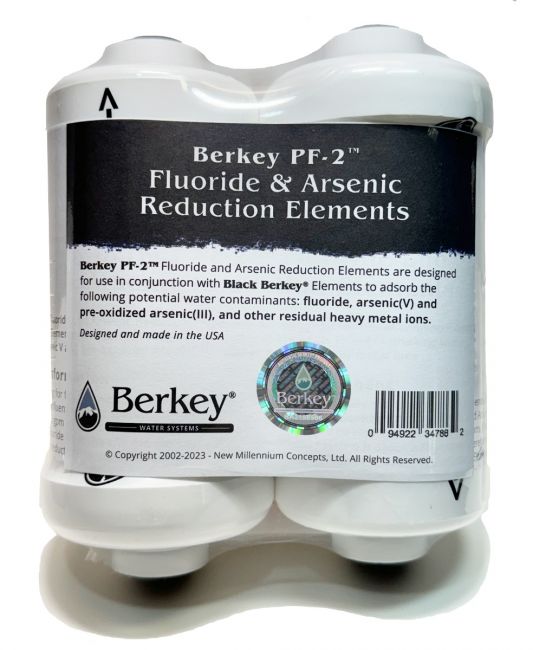
Black Berkey and Phoenix elements do not provide reliable long-term fluoride reduction on their own. Berkey's PF-2 Fluoride and Arsenic Reduction filters ($103/pair) are required for consistent fluoride removal, up to 99.75%, rated for 1,000 gallons or 1 year per pair, whichever comes first. The Gravidyn has no fluoride reduction option.
Capacity and Household Fit
The Gravidyn holds 10 liters, about 2.6 gallons, in one size only. Berkey ranges from the 1.5 gallon Travel Berkey up to the 6 gallon Crown Berkey across six sizes, so it can be matched to household size in a way the single-size Gravidyn cannot. For a household of four or more filtering daily drinking water, Berkey's larger sizes mean fewer refills per day.
Portability
This is where the Gravidyn earns its reputation. At about 6.9 pounds and 18 inches tall, it is purpose-built for base camps, relief work, and group use in the field. Berkey's answer to portability is the Travel Berkey or the Go Berkey Kit, both sized for travel and camping, but a full size Big Berkey or larger is meant to live on a counter. If portability is the top priority, compare the Gravidyn against the Go Berkey Kit rather than a full size system.
Warranty and Durability
Berkey's stainless steel hardware (chambers, lid, spigot components) carries a lifetime limited warranty. Black Berkey and Phoenix elements carry a 2-year prorated warranty; PF-2 filters carry a 6-month warranty. We did not find a publicly stated warranty term for the Gravidyn on Katadyn's own site; buyers should confirm current warranty terms directly with Katadyn or the retailer at time of purchase.
Worth flagging separately: owner reviews on Reddit and Trailspace describe the Gravidyn's ceramic elements as fragile in shipping. More than one buyer has reported an element arriving cracked, and in one case a spare element broke after being dropped while still inside its original packaging. This is a shipping and handling complaint rather than a filtration performance issue, but it means new elements are worth inspecting for hairline cracks before use. Berkey's stainless steel construction does not carry the same fragility risk.
Long-Term Cost Comparison
Filter replacement economics matter more than the sticker price over a multi-year ownership window, and this is the category where household usage pattern changes the answer the most.
Berkey (Phoenix Elements, current in-stock replacement)
~$0.02 per gallon filtered
$120/pair at 5,500 gal = ~$0.022/gal
Black Berkey (when in stock): $166/pair at 6,000 gal = ~$0.028/gal
Add PF-2 for fluoride: $103/pair at 1,000 gal
Katadyn Gravidyn
Cost depends heavily on how often you use it
3 elements at roughly $60 each = ~$180 per replacement set
Manufacturer recommends replacing all 3 every 6 months, regardless of gallons filtered
At 2 gal/day of daily household use (about 365 gal per 6 months), that works out to roughly $0.49/gal
For intermittent use (camping, relief kits, occasional emergencies), the same $180 set can last years, making the effective per-gallon cost far lower
For a household that wants to use a gravity filter as its everyday, full-time drinking water source, Berkey's cost per gallon is meaningfully lower, because its replacement interval is tied to gallons filtered rather than a fixed 6-month calendar clock. The Gravidyn's ceramic core is rated for a very high theoretical capacity (up to roughly 39,000 gallons per element if repeatedly field-cleaned), but Katadyn's own guidance to replace every 6 months regardless means the real-world cost for daily household use is driven by time, not gallons. That tradeoff makes more sense for its intended use case: a unit that sits in a relief kit or cabin and isn't necessarily used every single day.
Frequently Asked Questions
Is the Katadyn Gravidyn a good alternative to a Berkey?
For a cabin, base camp, or emergency kit, yes, it is compact and field-proven for that use. For a household that wants a daily countertop supply of drinking water with published PFAS and heavy metal test data, a Berkey system's larger capacity, size options, and broader contaminant testing make it the better fit.
Does the Katadyn Gravidyn remove PFAS?
We found no publicly available lab report documenting PFAS reduction for the Gravidyn. Its published testing is verified by independent labs Bachema and Spectrum, plus general chlorine and organics reduction via the carbon core. Black Berkey Elements, the standard filter in all new Berkey systems, have been independently tested against 9 PFAS compounds, all above 99.9% reduction, with PFOA reduced below 2 ppt.
What certifications does the Katadyn Gravidyn have?
Katadyn's fact sheet for the Gravidyn is verified by independent labs Bachema and Spectrum. We did not find NSF/ANSI certification publicly documented for the Gravidyn. Berkey Phoenix Elements carry NSF/ANSI 42 and NSF/ANSI/CAN 372 certification.
Can the Gravidyn handle a whole household's daily water?
It can, but its 2.6 gallon capacity and roughly 1 gallon per hour output mean more frequent refills than a larger Berkey system, and its 6-month replacement cycle makes the cost per gallon higher for continuous daily use. It is better suited to intermittent or group use than as a household's sole everyday filter.
Is Katadyn affiliated with Berkey?
No. Katadyn Group is an independent Swiss company founded in 1928, with no corporate relationship to NMCL, the manufacturer of Berkey systems and Black Berkey and Phoenix elements.
Which gravity filter has a longer brand history?
Katadyn, by a wide margin. Katadyn was founded in 1928 and has nearly a century of use in humanitarian, military, and expedition water treatment. Berkey's manufacturer, NMCL, has been producing gravity systems since the late 1990s, a 25+ year track record with an extensive US dealer network and published third party lab testing.
Does Berkey or Katadyn test against more contaminants?
Berkey's Black Berkey and Phoenix elements are tested against a broader published list, including PFAS, heavy metals, pharmaceuticals, pesticides, and radiologicals. Katadyn's published testing for the Gravidyn is narrower and concentrated on the categories a compact field and relief-focused filter is built for.
Verdict: Which Should You Choose?
Choose the Katadyn Gravidyn if you want a compact, field-proven unit from a nearly 100 year old brand, for example a base camp, cabin, or bug out kit, and you don't need documented PFAS, heavy metal, or pharmaceutical reduction. Choose a Berkey system if you want a countertop filter sized for daily household use, a broader published contaminant list including PFAS, the option to add fluoride and arsenic reduction, and a lower cost per gallon for continuous everyday use. Take the 30 second quiz to find the right Berkey size for your household, or browse the full lineup.
Additional Resources


 By
Dan DeBaun
By
Dan DeBaun




From what I understand there really isn't a way to 'filter' out heavy metals... these metals are compounds that can be as small as a water molecule themselves... it would be like trying to filter water from water. However many minerals or metals, are found in molecules that are larger than water molecules and can be 'trapped' by the filter. To be honest, Berkey cannot say they can filter out 100% of heavy metals.
To Filter heavy metals you would have to either let the water sit for a long time and just purify the water on the top, or you could distill the water, like when you leave a pot of boiling water on a stove and come back and the water is gone but there's a film on the bottom of the pot, which is all the impurities in the water.
But if you're drinking well water already with heavy metals, it sure isn't going to hurt to have 95% of those metals being removed.
Best bet is to have the water as pure as it can be before you put it into the filter, as to preserve the life of the filters as long as possible. Strain the water with a cloth (ie a shirt or something), use a home made charcoal filter, anything you have to do to get that water as pure as you can before you put it into the filter and let the filter get the tiny stuff that you can't see!
Hi Me -
It is incorrect that filters cannot remove heavy metals as this is relatively common place in the filtration market. Test results that back up Berkey claims of heavy metal removal can be found here:
https://www.bigberkeywaterfilters.com/studies/la-lab-results
Thanks
Dan
Hi There.
I currently have a Big Berkey and am considering buying a Katadyn Pocket, but am wondering if i really need one since I have a Berkey.
Which filters do you recommend and how long do they last?
Thanks
Doug
Hi Doug -
We believe this would be redundant. If you wanted something smaller and wanted to stick with Berkey, we would recommend the sport berkey or the go berkey kit.
Thanks
Dan
I have been looking for an amazing water filter like this. I love love love that it is made from steel. It's so durable and reliable and the price is right! I want to win one of these. I wish at this time in my life I could afford it but I'm transitioning to another city (new job, home, etc.) so I can't afford to put one in my home for a while :(
I have been searching for the best water purifier, electric or non-electric. The Berkey website says that their Big Berkey removes 95% of heavy metals. To my mind leaving 5% of heavy metals in the water is not satisfactory. Your website here says the Big Berkey removes ALL heavy metals.
I have had my well water lab tested. There is no chlorine or fluoride, but I do have a few metals that are slightly high including iron and manganese.
Please help me determine what the Big Berkey actualy does in terms of removing heavy metals.
Thank you.
Nanci
Hi Nancy -
The black berkeys will remove 95% and above for heavy metals. This number will vary slightly depending on the source water. If the PF-2 filters are added, these also will reduce heavy metals further than what the black berkeys have accomplished.
Thanks
Dan