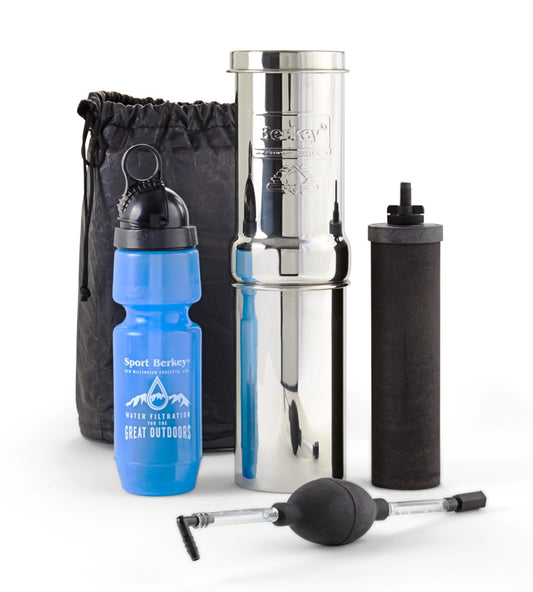
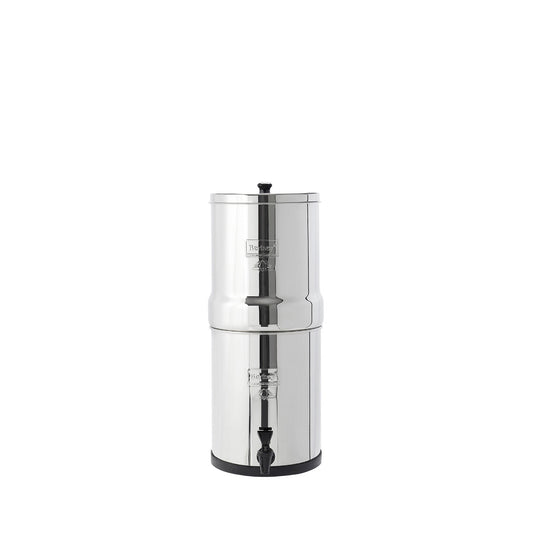
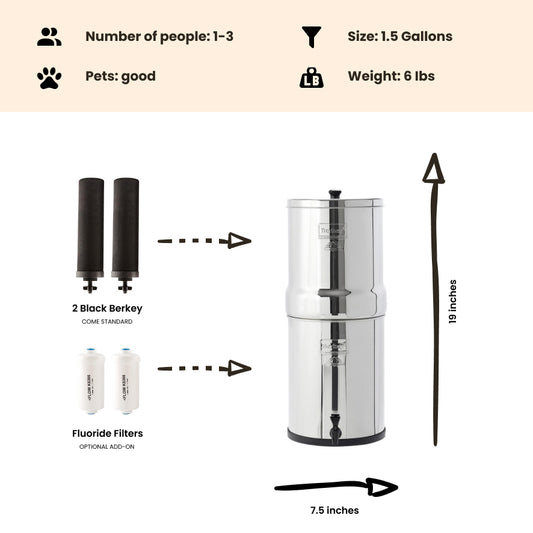
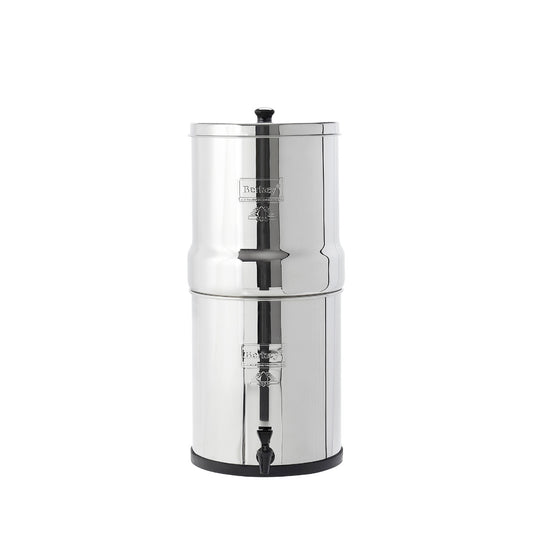
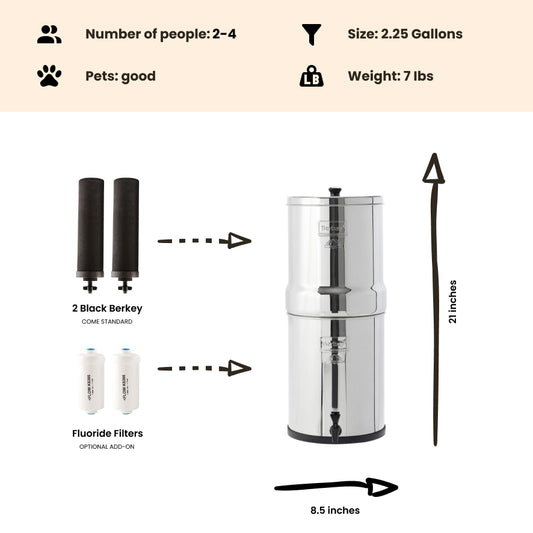
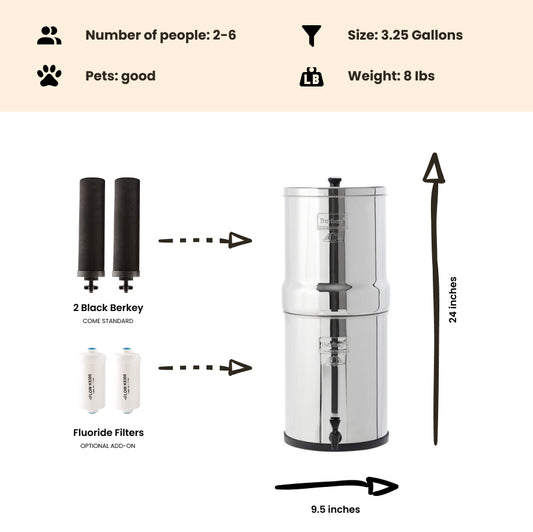
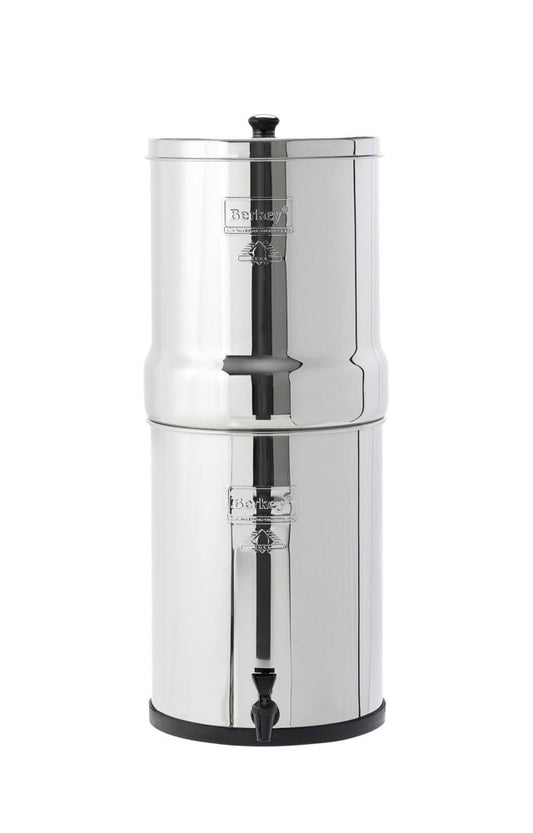
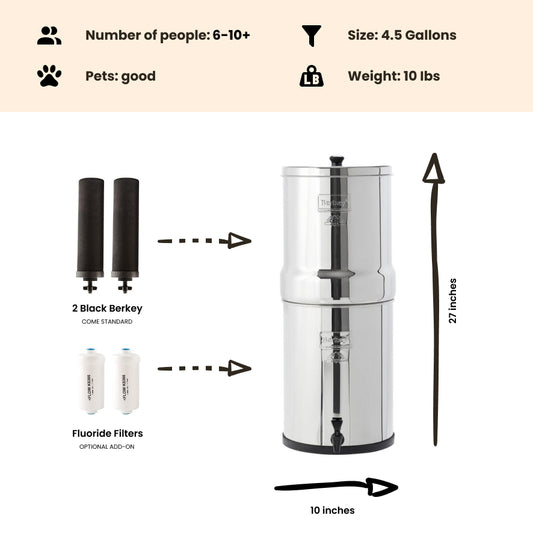
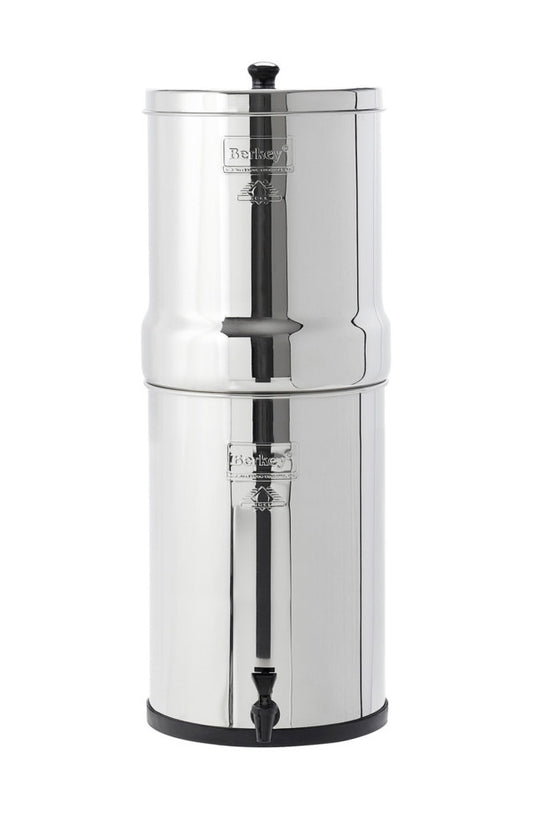
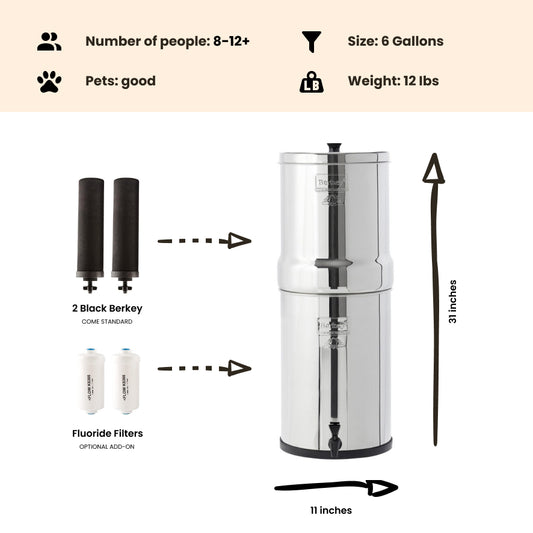
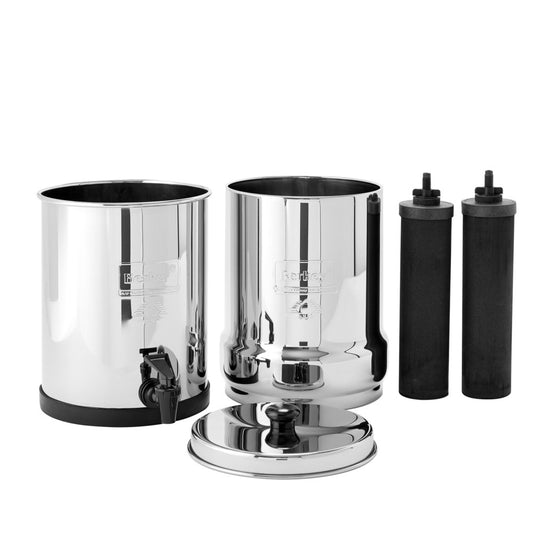
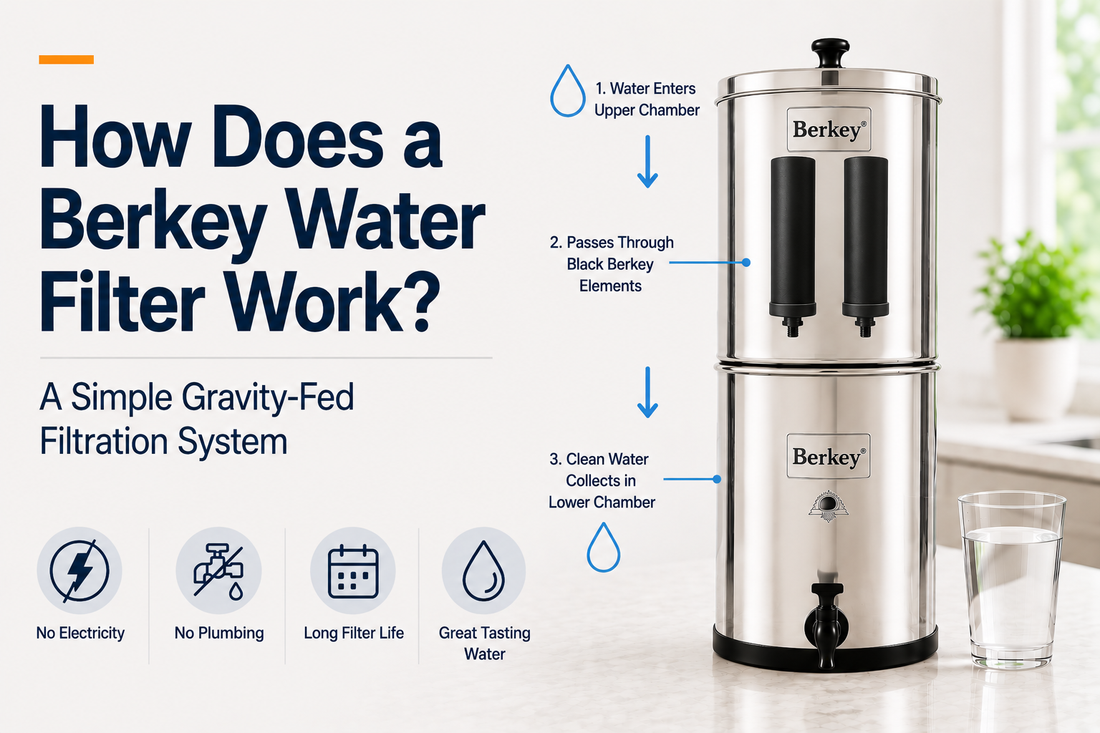
A Berkey water filter works by gravity. You pour water into the upper stainless steel chamber, and it passes down through the filter elements into the lower chamber, with no electricity, no plumbing, and no water pressure required. As the water moves slowly through the elements, the filter media reduces a broad range of contaminants before the filtered water collects in the lower chamber, ready to pour from the spigot.
The short version: A Berkey is a gravity-fed filter. Two stainless chambers, filter elements in between, and gravity doing the work. The slow flow gives the media a long contact time with the water, which is what lets the elements reduce contaminants across categories like heavy metals, chlorine, sediment, and more. No power and no plumbing needed.
How a Berkey Water Filter Works
A Berkey reduces contaminants through four working principles: gravity flow, microfiltration, adsorption and ion exchange, and extended contact time. Here is what each one does.
1. Gravity moves the water
Most water filters rely on line pressure to push water through, which means they need electricity or a pressurized plumbing connection. A Berkey is gravity-fed. You fill the upper chamber by hand, and gravity draws the water down through the elements into the lower chamber. That is what makes the system portable and usable at home, while traveling, or during a power or water outage.
2. Microfiltration through a dense pore matrix
Each Black Berkey element is built from a proprietary blend of more than six media types pressed into a dense matrix containing millions of microscopic pores. Those pores form a long, winding route, often called a tortuous path, with a nominal pore size below 2 microns. Sediment, silt, and fine particulates are physically trapped as the water threads through.
3. Adsorption and ion exchange
Microfiltration alone does not catch dissolved contaminants, so the media also works at the molecular level. Through adsorption, dissolved compounds bind to the surface of the activated carbon and other media. Through ion exchange, dissolved metal ions are attracted to and held by the media. Together, these two mechanisms let the elements reduce contaminants that are far smaller than the pores themselves.
4. Extended contact time
Because the water moves by gravity instead of pressure, it stays in contact with the media far longer than it would in a pressurized system, where water passes through in a fraction of a second. That longer contact time is a big part of why the elements can reduce such a wide range of contaminants. Slower flow, more reduction.
Independent laboratories have tested Berkey elements against more than 200 contaminants across multiple categories. Rather than restate percentages here, we point you to the source data: see the independent lab test results and the Black Berkey complete contaminant list for the specific contaminants, methods, and reduction figures.
What a Berkey Water Filter Reduces
Berkey elements are independently tested to reduce contaminants across several categories, including heavy metals such as lead, arsenic, and mercury; chlorine and chloramines; pharmaceuticals; pesticides and herbicides; volatile organic compounds (VOCs); per- and polyfluoroalkyl substances (PFAS); and sediment. Reduction figures vary by contaminant and by the element tested, so we link the source documents rather than summarize them here.
For the full picture, see the contaminants Berkey filters address, the Black Berkey complete contaminant list, and the Phoenix complete contaminant list.
A note on how to read the figures: many published reduction results are shown as "greater than" a percentage. That is because the filtered sample fell at or below the laboratory's detection limit, so the equipment could not measure any lower. The real reduction may be higher than the number reported.
Black Berkey vs Phoenix Elements
A Berkey system is the stainless housing. The filter elements inside are what do the work, and there are two to know about. Every new Berkey system today ships with Black Berkey Elements. Black Berkey Elements are not currently sold on their own as a standalone replacement in the US, so when you need replacements, the authorized standalone option is the Berkey Phoenix Element.
| Feature |
Black Berkey Elements |
Berkey Phoenix Elements |
| Role in the system |
Ships with every new Berkey system today |
Current standalone replacement element |
| Rated lifespan |
Up to 6,000 gallons per pair |
Up to 5,500 gallons per pair |
| Independent testing |
Tested to NSF/ANSI contaminant-reduction protocols by independent EPA and NSF accredited third-party laboratories |
Tested by NABL accredited third-party laboratories |
| Certifications |
Not formally NSF certified |
NSF/ANSI 42 and NSF/ANSI/CAN 372 |
| Warranty |
2 year pro-rated |
1 year non-prorated |
| US availability |
Included with systems; not sold separately as a standalone replacement right now |
Available now as the standalone replacement |
What the certifications mean: NSF/ANSI 42 covers aesthetic effects such as chlorine taste and odor; NSF/ANSI/CAN 372 confirms the element is built from lead-free materials. Neither standard is a contaminant-reduction or health claim. System-level NSF certification is conditional: a Berkey system is certified to NSF/ANSI 42 and 372 only when fitted with Phoenix Elements. Because systems ship today with Black Berkey Elements, a system as sold is not NSF certified.
How Does a Berkey Water Filter Work: Frequently Asked Questions
Does a Berkey water filter need electricity?
No. A Berkey is gravity-fed. You pour water into the upper chamber and gravity pulls it through the elements into the lower chamber. There is no pump, no electricity, and no plumbing connection, which is why a Berkey keeps working during a power outage.
Does a Berkey need water pressure or plumbing?
No. A Berkey is not connected to a faucet or a water line. It is a standalone countertop system that runs on gravity alone, so it is fully portable and works anywhere you can pour water into the top chamber.
Does a Berkey strip the beneficial minerals out of water?
A Berkey is not a deionizer or a reverse osmosis system, so it does not demineralize water the way those systems do. The elements target contaminants rather than the dissolved calcium and magnesium that give water its mineral content, so most beneficial minerals stay in the filtered water.
How long do Black Berkey elements last?
A pair of Black Berkey Elements is rated for up to 6,000 gallons. For a typical household using a few gallons a day, that is roughly 3 to 6 years before replacement. Berkey Phoenix Elements are rated for up to 5,500 gallons per pair.
How is a Berkey different from a pitcher filter?
Three main ways. A Berkey holds far more water and uses larger, longer-lasting elements, up to 6,000 gallons per pair versus roughly 40 gallons for a typical pitcher cartridge. The gravity flow gives the water much longer contact time with the media. And Berkey elements are independently tested against a broader list of contaminant categories than most pitcher filters address.
What is the difference between Black Berkey and Phoenix elements?
Black Berkey Elements ship with every new system and are rated for up to 6,000 gallons per pair. They are tested to NSF/ANSI contaminant-reduction protocols by independent third-party laboratories but are not formally NSF certified. Phoenix Elements are the current standalone replacement, rated for up to 5,500 gallons per pair, and are certified to NSF/ANSI 42 (aesthetic effects) and NSF/ANSI/CAN 372 (lead-free materials).
See the test data for yourself
Every reduction point above traces back to independent laboratory testing. As the largest authorized US Berkey dealer, we publish the full lab results so you can check the contaminants, methods, and figures directly.
View the Lab Test Results
Or browse the full range of Berkey water filter systems.

 By
Dan DeBaun
By
Dan DeBaun