Updated February 2026: Includes Phoenix Filters & PFAS Data
Berkey and Brita are two of the most recognized names in home water filtration, but they serve fundamentally different purposes. One is a gravity-fed filtration system built to address 200+ contaminants including PFAS, heavy metals, pharmaceuticals, and pesticides. The other is an affordable pitcher filter designed to improve the taste and odor of treated municipal water along with removing a smaller range of contaminants.
This guide breaks down everything, including contaminant removal, independent testing, certifications, long-term cost, and what each filter actually protects against, so you can make an informed decision for your family.
Bottom line: If your goal is better-tasting tap water on a tight budget, Brita works. If your priority is verified protection against a wide range of health-threatening contaminants, including PFAS, heavy metals, pharmaceuticals, and pesticides, at a lower cost per gallon over time, Berkey is the stronger investment.
Brand Background
Berkey
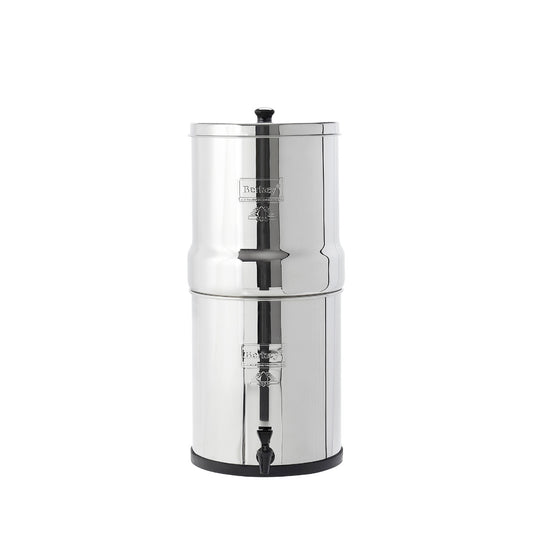
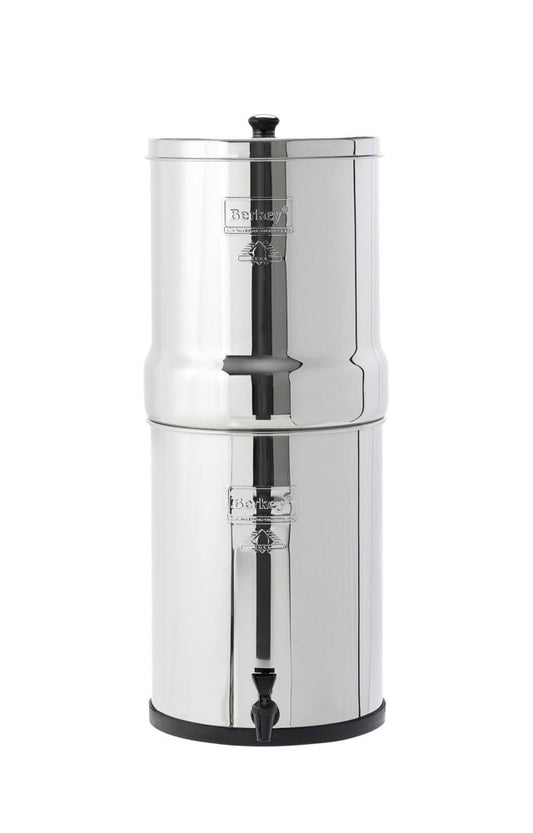
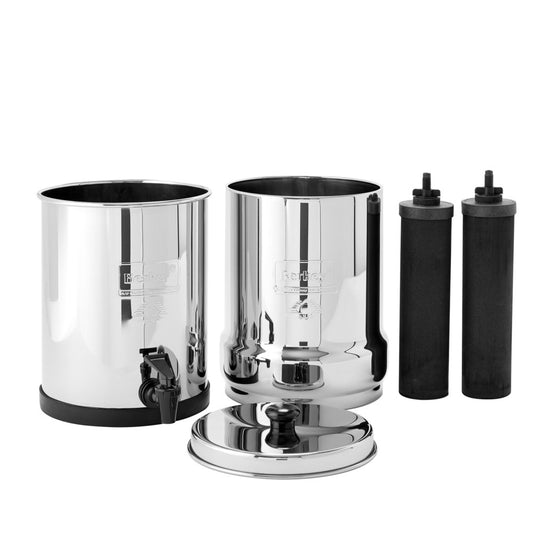
Berkey water filters are manufactured by New Millennium Concepts, Ltd. (NMCL), a U.S.-based company that has been producing gravity-fed water filtration systems for over two decades. Berkey systems ship standard with Black Berkey filter elements, which have been tested against 200+ contaminants. The Berkey Phoenix Gravity New Millennium Edition elements are the current certified replacement option, carrying NSF/ANSI 42 and NSF/ANSI 372 certifications. Both deliver wide-spectrum contaminant reduction without electricity, plumbing, or water pressure. Berkey systems are used globally in homes, apartments, rentals, RVs, second homes, and humanitarian settings.
Brita
Brita is a household name owned by The Clorox Company. Founded in Germany in 1966, Brita popularized the pour-through pitcher filter and remains the top-selling pitcher filter brand in the U.S. Brita's primary product line includes plastic pitcher filters and dispensers using activated carbon and ion-exchange resin cartridges. Their most advanced filter, the Brita Elite, is designed for treated municipal water and carries NSF/ANSI certifications for a limited range of contaminants.
Quick Comparison: Berkey vs Brita at a Glance
Scroll sideways to see full table
| Feature |
Berkey (Big Berkey) |
Brita (Elite Pitcher) |
| Filter Type |
Gravity-fed filtration |
Pour-through pitcher |
| Contaminants Tested |
200+ (with downloadable lab PDFs) |
~30 claimed |
| PFAS Reduction |
PFOA directly tested at 99.9%+ reduction; 8 additional PFAS compounds via surrogate methodology, all at 99.9%+ |
PFOS/PFOA only (Elite filter); standard filter: not certified |
| Fluoride Reduction |
Yes, with optional PF-2 add-on filters
|
No, Brita states filters maintain fluoride levels |
| NSF Certifications |
NSF/ANSI 42 & 372 (Phoenix filters) |
NSF/ANSI 42, 53, 401 (Elite filter) |
| Lab Reports Public |
Yes, downloadable PDFs from accredited labs
|
No, performance data sheets only |
| Filter Lifespan |
6,000 gallons per pair (Black Berkey, ships standard); 5,500 gallons per pair (Phoenix, current certified replacement) |
120 gallons per filter (~6 months) |
| Cost Per Gallon |
~$0.02 |
~$0.13 |
| Holding Capacity |
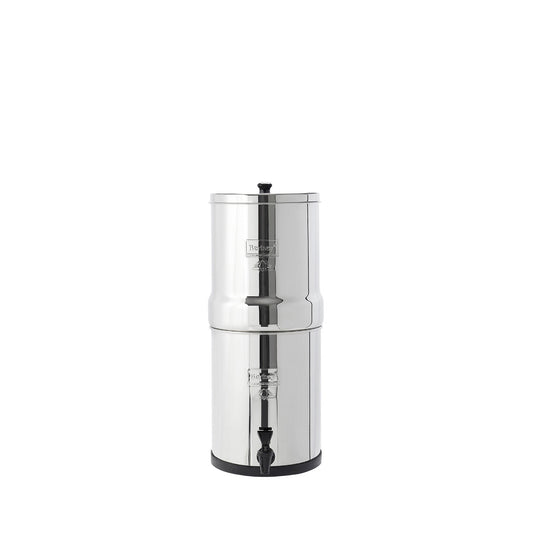
2.25 gallons (Big Berkey) up to 6 gallons (Crown) |
0.625 gallons (10-cup pitcher max) |
| Construction |
304 stainless steel |
BPA-free plastic (polypropylene/SAN) |
| Warranty |
Lifetime (stainless housing) |
Limited manufacturer warranty |
| Electricity Required |
No |
No |
| Media Coverage |
EWG, Food Network, CBS News, LA Times, The Prepared |
General consumer press |
Independent Testing & Certifications
Certifications matter, but so does the depth of testing behind them. Both Berkey and Brita carry NSF certifications, but the scope and transparency of each brand's testing differ significantly.
Berkey's Testing
Black Berkey elements have been tested by independent, EPA-accredited and NSF-accredited third-party laboratories against over 200 contaminants. These include heavy metals (lead, arsenic, mercury, chromium), pesticides, pharmaceuticals, volatile organic compounds (VOCs), and radiologicals. Results are documented in full lab reports available as downloadable PDFs on the Certified Lab Results page.
The Berkey Phoenix Gravity New Millennium Edition filters carry NSF/ANSI 42 and NSF/ANSI 372 certifications, verifiable through NSF's database. Phoenix filter lab results from NABL-accredited ISO/IEC 17025:2017 certified laboratories are also publicly available as downloadable PDFs.
Berkey was specifically tested for PFAS (forever chemicals). PFOA was directly tested at 99.9%+ reduction, and 8 additional PFAS compounds including PFOS, PFNA, PFBS, and PFHxS were evaluated via surrogate methodology, all at 99.9%+. This testing contributed to the Environmental Working Group (EWG) rating the Travel Berkey as "Best Overall" in their guide to PFAS water filters.
Brita's Testing
The Brita Elite filter carries NSF/ANSI 42 (aesthetic effects), NSF/ANSI 53 (health effects, including lead at 99% and PFOA/PFOS), and NSF/ANSI 401 (emerging contaminants, including microplastics). These are real, verifiable certifications.
However, there are important limitations. Brita's certifications cover approximately 30 contaminants. Brita does not provide downloadable lab reports, only performance data sheets summarizing certified claims. The standard Brita filter (non-Elite) is certified only under NSF/ANSI 42, which covers taste and odor but not health-threatening contaminants. Independent testing has shown the standard Brita filter performs poorly on heavy metals and PFAS.
Key difference: Berkey publishes complete lab reports covering 200+ contaminants and provides downloadable PDFs for verification. Brita provides performance data sheets covering approximately 30 contaminants.
Media Recognition
Both Berkey and Brita receive media coverage, but the nature and verifiability of that coverage differs.
Berkey's media coverage is fully documented with direct links to original articles:
-
Environmental Working Group (EWG): Rated Travel Berkey "Best Overall" for PFAS reduction
-
Food Network: Called Big Berkey "the holy grail of filtration systems"
-
CBS News: Covered EWG's PFAS testing featuring Berkey
-
The Prepared: Named Berkey top gravity filter pick
-
The Quality Edit: Called Berkey "worth both the hype and the investment"
-
Los Angeles Times: Called Berkey "the Rolls-Royce of water filters"
Every source listed above links to the original published article on our Media Coverage page.
Brita is widely covered as a consumer brand across mainstream product review sites and retail publications. As the market leader in pitcher filters, Brita receives significant general press coverage.
Feature Comparisons: Where Each Filter Excels
Contaminant Reduction Depth
This is the biggest gap between the two products. Berkey's Black Berkey elements are tested against 200+ contaminants including heavy metals, pesticides, pharmaceuticals, VOCs, and radiologicals. Brita's Elite filter is certified for approximately 30 contaminants, primarily lead, mercury, cadmium, asbestos, benzene, chlorine taste and odor, PFOS, PFOA, and microplastics.
Contaminants that Berkey addresses but Brita does not include: most pharmaceuticals and hormones, most pesticides and herbicides, radiologicals, and the full spectrum of PFAS compounds (Berkey independently tested PFOA directly plus 8 additional PFAS compounds via surrogate methodology; Brita is certified only for PFOS and PFOA).
PFAS (Forever Chemicals)
PFAS contamination is one of the most pressing water quality issues in the U.S. Berkey was independently tested with PFOA directly at 99.9%+ reduction and 8 additional PFAS compounds including PFOS, PFNA, PFBS, and PFHxS via surrogate methodology, all at 99.9%+. This comprehensive testing earned the EWG's "Best Overall" rating. The Brita Elite filter is certified to reduce PFOS and PFOA (two of the most well-known PFAS compounds) but is not tested against the broader family of PFAS chemicals. The standard Brita filter has no PFAS certification. Independent testing by multiple reviewers has shown inconsistent PFAS reduction performance from Brita's standard pitcher filters.
Fluoride Reduction
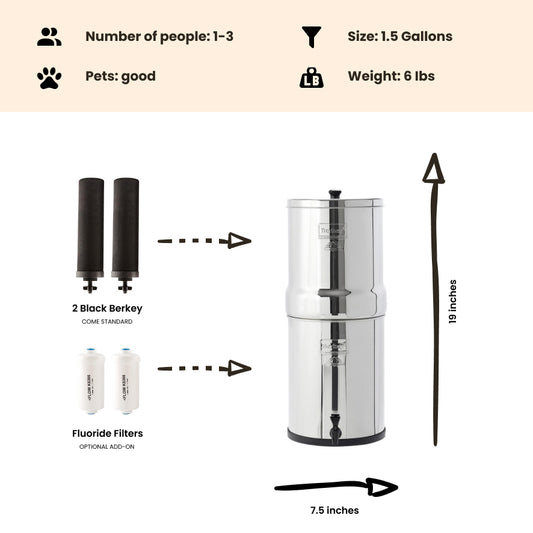
Berkey offers optional PF-2 fluoride and arsenic reduction filters that attach to the Black Berkey or Phoenix elements. Brita explicitly states their filters maintain fluoride levels; they do not reduce fluoride. Independent testing confirmed that fluoride levels remain unchanged after Brita filtration.
Construction & Materials
Berkey systems are constructed from 304 stainless steel and come with a lifetime warranty on the housing. Brita pitchers and dispensers are made from BPA-free plastic (polypropylene and SAN). There is an ongoing and growing consumer concern about storing filtered water in plastic vessels, particularly given the research around microplastics and chemical leaching from plastics over time.
Capacity & Convenience
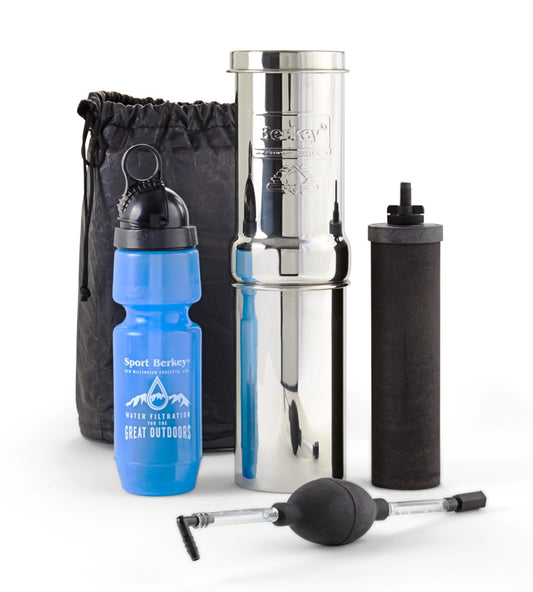
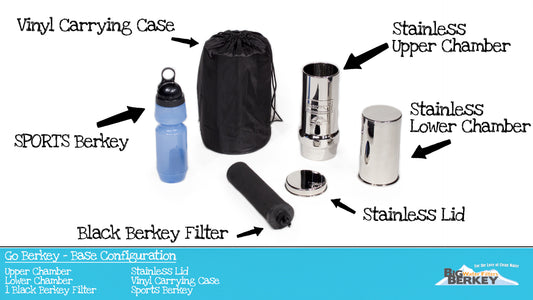
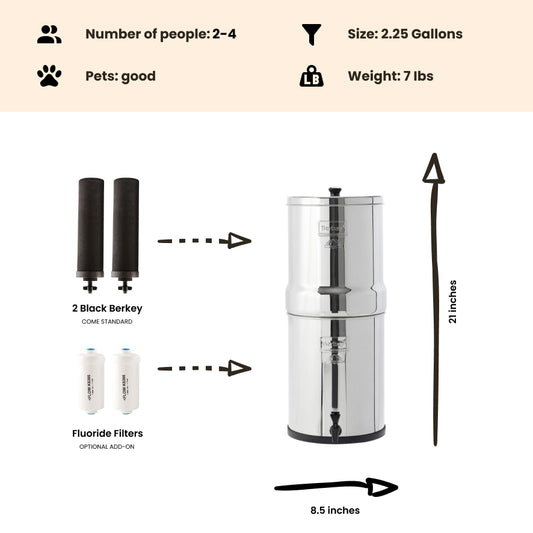
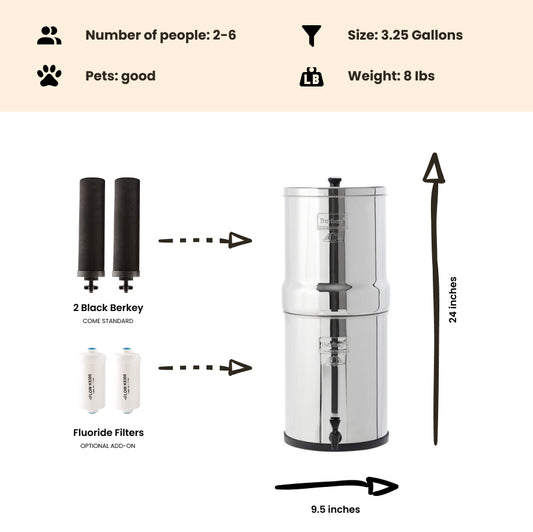
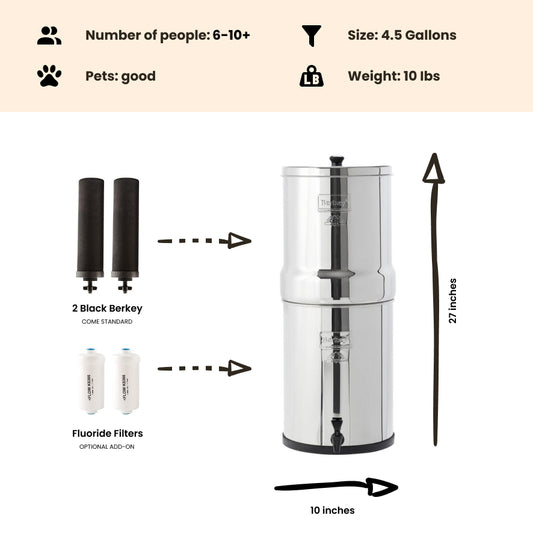
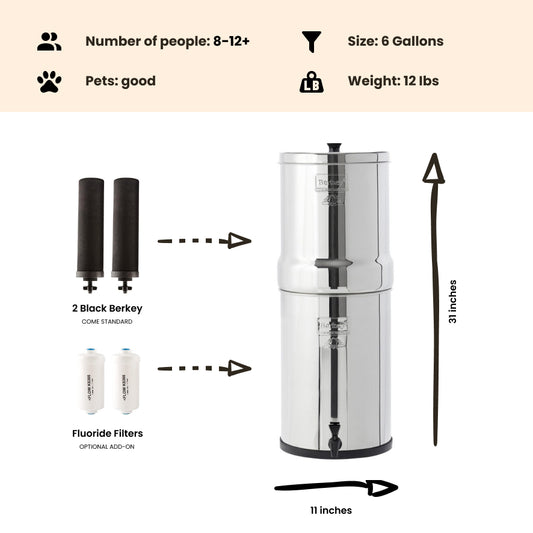
Brita pitchers hold up to 10 cups (0.625 gallons). The Big Berkey holds 2.25 gallons, the Royal Berkey holds 3.25 gallons, and the Crown Berkey holds 6 gallons. For a family of four, a Brita pitcher may need to be refilled 6 to 8 times per day. A Big Berkey typically needs one fill in the morning. Berkey also offers the compact Travel Berkey (1.5 gallons) and the portable Go Berkey Kit for on-the-go use.
Long-Term Value: 5-Year Cost Comparison
The initial sticker price of a Berkey system is higher than a Brita pitcher. But water filtration is an ongoing expense: the real cost is in the filters. Here is what each system actually costs over five years, assuming average family usage of approximately 240 gallons per year (based on Brita's stated average of 11 glasses per day).
Big Berkey (2 Black Berkey Elements)
-
System cost: See current pricing
-
Filter lifespan: 6,000 gallons per pair
-
Replacement filters needed (5 yr): 0 (at 500 gal/yr, you'll use only 2,500 gallons in 5 years)
-
5-year replacement filter cost: $0
- Total 5-year cost: system price only
Cost per gallon: ~$0.02 (filter cost only)
Brita Pitcher (Elite Filters)
-
System cost: ~$36 (10-cup pitcher with 1 Elite filter)
-
Filter lifespan: 120 gallons per filter
-
Replacement filters needed (5 yr): 10 filters (2 per year x 5 years)
-
5-year replacement filter cost: ~$140 (at ~$14/filter)
- Total 5-year cost: ~$176+
At the 5-year mark, Berkey's filters still have thousands of gallons of life remaining. Brita's 10 filters are in a landfill. Over 10 years, the gap becomes significant.
Big Berkey (2 Black Berkey Elements): 10-Year Cost
-
Total gallons used: ~5,000
-
Replacement filters needed: 0
- Total 10-year cost: system price only
Significantly lower per-gallon cost than Brita over 10 years
Brita: 10-Year Cost
-
Total gallons used: ~5,000
-
Replacement filters needed: 42
-
Pitcher replacements: 1-2 (plastic pitchers degrade)
- Total 10-year cost: ~$624 to $660
The Berkey becomes cheaper to own than Brita around the 5-year mark and saves hundreds of dollars over a decade, while still having over 1,000 gallons of filter life remaining. And that is comparing filter costs alone; it does not account for the vastly greater contaminant protection the Berkey provides at every point during that period, along with the reduced hassle of replacing filters.
The math: Every gallon through a Brita Elite costs approximately $0.12 in filter expense. Every gallon through a Berkey costs approximately $0.02. Over the 6,000-gallon lifespan of a single set of Black Berkey elements, you would spend $700 on Brita Elite filters to filter the same volume, compared to $166 for a replacement set of Black Berkey elements. When replacement is needed, Phoenix Gravity New Millennium Edition elements ($120/pair, 5,500 gallons) are the current certified replacement option.
PFAS: Why It Matters More Than Ever in 2026
Per- and polyfluoroalkyl substances (PFAS), commonly known as "forever chemicals," are found in the tap water of an estimated 200+ million Americans. In 2024, the EPA established the first-ever national drinking water standard for PFAS. This has made PFAS filtration one of the top criteria consumers use when choosing a water filter.
Berkey was independently tested with PFOA directly at 99.9%+ reduction and 8 additional PFAS compounds via surrogate methodology, all at 99.9%+. These results were documented by independent labs and contributed to the EWG selecting Berkey as their top-rated gravity filter for PFAS reduction. Full PFAS test results are available on our test results page.
Brita's Elite filter is certified to reduce PFOS and PFOA, two specific PFAS compounds, but the broader PFAS family includes thousands of individual chemicals. The standard Brita filter has no PFAS certification. Independent testing by multiple reviewers has shown inconsistent PFAS reduction performance from Brita's standard pitcher filters.
Frequently Asked Questions
Is Brita as good as Berkey?
For improving the taste and odor of already-treated municipal water, Brita is a functional budget option. For comprehensive contaminant reduction, including PFAS, heavy metals, pharmaceuticals, and pesticides, Berkey provides significantly more protection. Berkey is tested against 200+ contaminants; Brita's Elite is certified for approximately 30.
Does Brita reduce PFAS (forever chemicals)?
The Brita Elite filter is certified to reduce PFOS and PFOA (two specific PFAS compounds). The standard Brita filter is not certified for PFAS. Berkey was independently tested with PFOA directly at 99.9%+ reduction and 8 additional PFAS compounds via surrogate methodology, all at 99.9%+, earning the EWG's "Best Overall" rating for PFAS water filters.
Which gravity filter reduces the most contaminants?
Berkey's Black Berkey filter elements are tested against over 200 contaminants, one of the widest testing scopes in the gravity filtration market. Complete lab results are available as downloadable PDFs on the test results page.
What certifications does Brita have?
The Brita Elite filter is certified under NSF/ANSI 42 (taste and odor), NSF/ANSI 53 (health effects including lead and PFOS/PFOA), and NSF/ANSI 401 (emerging contaminants including microplastics). The standard Brita filter carries only NSF/ANSI 42 certification.
Is Berkey more expensive than Brita?
The upfront cost is higher. However, Berkey's filter elements last 6,000 gallons at a cost of roughly $0.02 per gallon. Brita Elite filters last 120 gallons at approximately $0.12 per gallon. Over 10 years, a Berkey saves hundreds of dollars while providing far greater filtration coverage. See current Berkey system pricing.
Does Brita reduce fluoride?
No. Brita explicitly states their filters maintain a "healthy level of fluoride." Independent testing has confirmed fluoride levels are unchanged after Brita filtration. Berkey offers optional PF-2 add-on filters specifically designed for fluoride and arsenic reduction.
What are the Berkey Phoenix filters?
Verdict: Berkey or Brita?
Choose Brita if: You have treated municipal water, your primary concern is taste and odor, and you want the lowest possible upfront cost. The Brita Elite is the best option in their lineup and does carry legitimate NSF certifications for lead and PFOS/PFOA.
Choose Berkey if: You want comprehensive protection against a wide range of contaminants including PFAS, heavy metals, pharmaceuticals, and pesticides. You want publicly verifiable lab data covering 200+ contaminants. You want lower long-term filter costs. You want stainless steel construction instead of plastic. Or you need a filter that works without electricity or water pressure, for apartments, rentals, RVs, well water, or travel.
Brita solves a convenience problem. Berkey solves a water safety problem. They are fundamentally different products at different levels of protection, and the long-term economics favor Berkey for families committed to clean water.
Related Resources


 By
Dan DeBaun
By
Dan DeBaun