Clean your Berkey system every 1 to 3 months, or sooner if you notice slow flow, visible buildup, or an off taste. The full process takes about 20 minutes and requires only mild dish soap, a soft sponge, and clean water. Regular cleaning keeps flow rate optimal and ensures your filtered water stays fresh and contaminant-free.
This guide covers how to clean the stainless steel chambers, spigot, and Black Berkey filter elements, how to remove rust and mineral buildup, and how to know exactly when each part of your system needs attention.
Quick Summary Clean chambers every 1–3 months with mild soap. Scrub filter elements under cold running water every 2–4 months if their running slowly, never use soap on the elements. Replace Black Berkey filter elements at 6,000 gallons per pair (roughly 3 to 6 years under normal use).
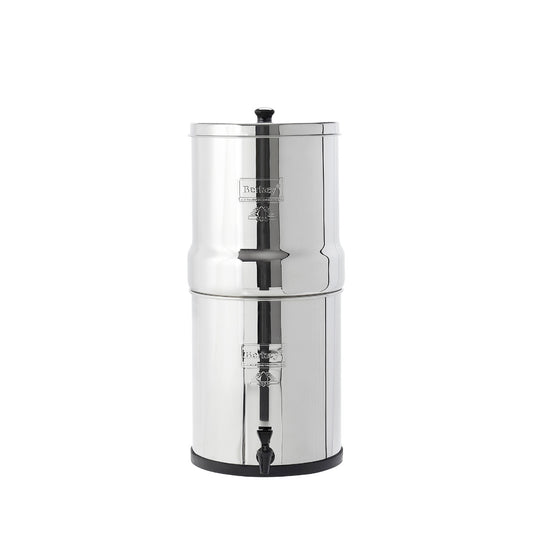
What You'll Need to Clean Your Berkey
You don't need special products; most of what's required is already in your kitchen:
- Mild dish soap (non-abrasive, unscented)
- Soft sponge or cloth
- Soft brush or old toothbrush
- Clean water
- White vinegar (optional, for mineral scale and deep cleaning)
- Baking soda (optional, for rust removal)
- Scotch-Brite pad (soft side only, for scrubbing filter elements)
Avoid steel wool, abrasive pads, and cleaners containing chlorides, bleach, ammonia, or alcohol. These damage both the stainless steel's protective surface layer and the filter element's micropores.
Everything in this guide also applies to Berkey Phoenix filter elements. Phoenix and Black Berkey elements use different filter media, but both are cleaned with the identical process: cold running water only, a soft brush or Scotch-Brite pad, and no soap. Wherever this guide refers to Black Berkey filter elements, the same steps and schedule apply to Phoenix elements.
Step-by-Step: How to Clean Your Berkey Water Filter
-
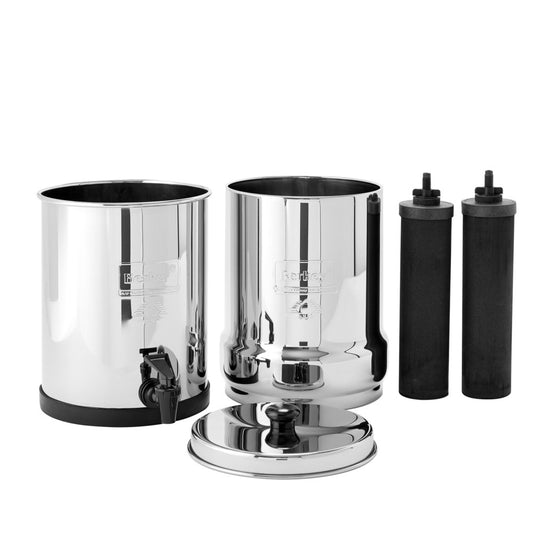
Disassemble the system Remove the lid and set it aside. Lift off the upper chamber and empty any remaining water from both chambers. Remove the Black Berkey filter elements from the upper chamber by unscrewing the wingnuts and washers. Set the filters aside. They're cleaned separately in Step 5.
-
Clean the chambers Wash the inside and outside of both the upper and lower chambers using a soft sponge and mild dish soap. Rinse thoroughly with clean water until no soap residue remains. Do not use steel wool, abrasive scrubbers, or cleaners containing chlorides, ammonia, or alcohol. These damage the stainless steel's protective chromium oxide layer. The stainless steel chambers are also dishwasher-safe, so if it's more convenient, you can run them through a normal dishwasher cycle instead of hand washing.
-
Clean the spigot Remove the spigot from the lower chamber. Disassemble it fully if possible, then clean each part with mild dish soap and a soft brush or toothbrush, paying close attention to the inside of the spigot body where mineral scale and buildup accumulate. Rinse thoroughly and reassemble before reinstalling.
-
Deep clean (optional) If you see white mineral deposits or scale inside the chambers, soak them in a 1:1 mixture of white vinegar and water for 10 minutes. White vinegar's acetic acid dissolves mineral scale and sanitizes surfaces effectively. Rinse thoroughly with clean water before reassembling. Do not use vinegar directly on the Black Berkey filter elements; use cold running water only on the filters.
-
Clean the Black Berkey filter elements Under cold running water, gently scrub the outside surface of each filter element using a soft brush or the soft side of a Scotch-Brite pad, using light circular motions. You'll see dark residue rinse off. That's normal and expected. Do not use soap on the filters. Soap clogs the micropores and permanently reduces filtration performance. Rinse until the water runs clear.
-
Reassemble and test Reinstall the Black Berkey filter elements into the upper chamber and hand-tighten the wingnuts. Reinstall the spigot in the lower chamber. Stack the upper chamber on top of the lower chamber, replace the lid, and fill the upper chamber with water. Let the first batch filter completely through before drinking. This clears any residual debris from cleaning.
Can You Clean Black Berkey Filter Elements?
Yes. Unlike most water filter cartridges, which are sealed and thrown away once they're spent, Black Berkey and Phoenix filter elements are designed to be scrubbed clean and reused for the life of the element. That reusability is a big part of why Berkey systems cost less to run over time than filters you replace every few months.
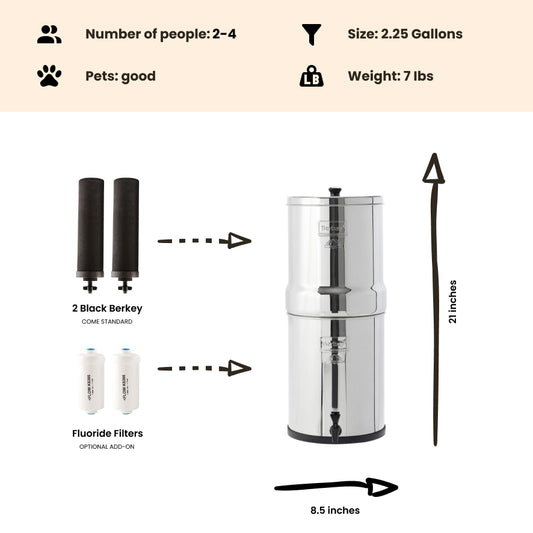
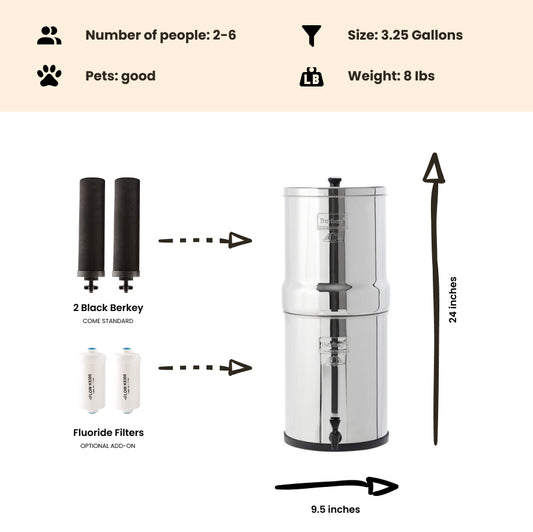
A set of two Black Berkey or Phoenix elements filters at roughly 1 gallon per hour. A four-element setup filters at roughly 2 gallons per hour, close to double. When flow rate drops well below that baseline for your setup, it usually means sediment has built up on the element's outer surface and partially blocked the micropores, and scrubbing (Step 5 above) is what restores it.
Before you scrub, it's worth a quick visual check first. Run your fingers over the element and look for cracks, chips, or worn spots in the outer shell, not just surface residue. Residue scrubs off. Structural damage means the element needs to be replaced rather than cleaned, since a compromised shell can let unfiltered water bypass the filtering media.
The PF-2 fluoride and arsenic post-filters are the exception to all of this. Unlike Black Berkey and Phoenix elements, PF-2 filters cannot be scrubbed clean and should be replaced on schedule instead. See the maintenance table below for PF-2 replacement intervals.
For a hands-on way to check whether your elements still need scrubbing or are ready to be replaced, see the Black Berkey red food coloring test, which includes a video walkthrough of the test.
How Often Should You Clean Your Berkey?
For typical household use, clean the stainless steel chambers every 1–3 months. Scrub the Black Berkey filter elements every 2–4 months (if needed), or immediately when flow rate drops noticeably.
System size affects how often cleaning is needed too. A 2-element setup filters roughly half the daily volume of a 4-element setup, so if you have 4 Black Berkey or Phoenix elements installed, expect to clean chambers and scrub elements somewhat more often than a 2-element system under the same daily usage.
For well water or highly turbid water sources, plan to scrub the filter elements every 4–6 weeks. Sediment-heavy water loads the filter surface faster and reduces flow rate sooner.
Clean sooner if you notice any of the following:
- Visible buildup, slime, or white mineral deposits on chamber walls
- Flow rate has slowed significantly
- Filtered water has an off taste or odor
- The system has sat unused for more than a week
Cleaning Schedule by Household Type
How often you clean depends on water source quality, daily usage volume, and how your system is stored. Here's how cleaning frequency breaks down by common household scenarios:
Municipal tap water, 1–2 people
Clean chambers every 3 months. Scrub filter elements every 3–4 months. Typical lifespan before replacement: 3 to 6 years under normal use.
Municipal tap water, 4+ people
Clean chambers every 4–6 weeks. Scrub filter elements every 6–8 weeks due to higher daily throughput.
Well water or turbid water sources
Scrub filter elements every 4–6 weeks regardless of household size. Sediment loads the filter surface significantly faster than treated water.
Second homes and intermittent use
Clean before storing and immediately upon taking the system back into use. If stored for more than a month, re-prime the filter elements before drinking.
How to Clean Your Berkey Without Running Water
If you're using your Berkey somewhere without a faucet, such as during travel, at a rental, an RV, or a second home, you can still clean the filter elements without running water. The process uses the same soft brush and cold water, just from a container instead of a tap.
-
Fill a bucket or basin with cold water Use the cleanest water source available. About a gallon of cold water is enough to clean two to four filter elements.
-
Scrub each filter element by hand Submerge or dip the filter element and use a soft brush or the soft side of a Scotch-Brite pad to gently scrub the outer surface with light circular motions, the same way you would under a running faucet. Rinse the brush in clean water between elements to avoid transferring residue.
-
Rinse with a fresh pour Once scrubbed, rinse each element by pouring clean water over it from a cup or container until the water running off looks clear. Change your rinse water if it becomes cloudy.
-
Re-prime before reuse Without a faucet's water pressure, use the rubber priming button with a squeeze bottle or hand pump, or simply let the reassembled system filter two or three full batches before drinking. This clears the pores and restores normal flow rate.
The chambers and spigot still clean the same way described above, mild soap and a soft sponge, rinsed thoroughly. Only the filter element rinsing step changes when you don't have access to running water.
How to Remove Rust from Your Berkey System
Berkey systems are made from 304 stainless steel, which resists rust through a thin protective chromium oxide layer. If that layer is scratched or compromised, by abrasive cleaners, steel wool, or prolonged exposure to chlorinated water , surface rust can develop.
The good news: surface rust is cosmetic, does not affect water quality or filtration performance, and the chromium oxide layer is self-healing once the rust is removed correctly.
How to Remove Surface Rust
-
Baking soda paste: Mix baking soda with just enough water to form a paste. Apply to the rusted area and scrub gently with a soft cloth in the direction of the metal grain. Rinse thoroughly with clean water.
-
Bar Keepers Friend (liquid only): Apply the liquid cleanser to a damp soft sponge and rub in the direction of the grain lines. Rinse completely. Do not use the powder version. The grit can scratch the surface and worsen the problem over time.
After rust removal, avoid cleaners containing chlorides, bleach, ammonia, alcohol, or mineral spirits. These strip the chromium oxide layer and accelerate future rust formation.
Mold and Mineral Buildup: What to Do
Beyond rust, the two other issues Berkey owners run into are dark mold-like spots on the filter elements and white mineral residue on the elements, spigot, or lower chamber. Both are common, and both are easy to address.
Mold on the Filter Elements
Dark spots on the outside of a Black Berkey or Phoenix filter element are usually surface mold that's grown on the outer media, not something growing inside the filtered water itself. Scrub the affected area under cold running water with a soft brush or the soft side of a Scotch-Brite pad for two to three minutes, using firm circular motions. If spots remain after scrubbing, let the element air dry completely in indirect sunlight for a few hours; UV exposure helps break down remaining residue. Re-wet the element and inspect it before reinstalling. Do not use bleach, alcohol, or soap on the filter elements to treat mold; these damage the filter media instead of resolving the problem.
White Mineral Residue on the Filter Elements
A chalky white coating on the outside of a filter element is mineral scale from hard water, not a filtration problem. Wipe the element with a damp sponge or soft cloth to remove loose residue, then scrub gently under cold running water with a soft brush. Heavier buildup usually loosens with a slightly longer scrub, 3–4 minutes instead of the usual 1–2. As with mold, avoid soap and vinegar directly on the elements.
White Residue or Scale on the Spigot or Lower Chamber
Mineral scale on the spigot or inside the lower chamber responds well to the vinegar soak described in Step 4 above. For heavier buildup, soak the affected part in a 1:1 white vinegar and water solution for 30 minutes instead of the standard 10, then scrub with a soft brush and rinse thoroughly. Repeat if a chalky film remains.
"The number one thing we see with underperforming Berkey systems is skipped cleanings. A 20-minute clean every couple of months is all it takes to maintain peak flow rate. Most slow-flow complaints we get can be resolved with a cleaning and re-prime, without replacing a single part."
Dan DeBaun, Owner, Big Berkey Water Filters
Berkey Maintenance Schedule
Use this table as your reference for every component of the system. Consistent maintenance is the single biggest factor in long-term system performance and filter lifespan.
← Scroll to see full table
| Component |
Task |
Frequency |
Notes |
| Stainless steel chambers |
Wash with mild dish soap and warm water |
Every 1–3 months |
Soft sponge only, no abrasive scrubbers |
| Black Berkey filter elements (or Phoenix) |
Scrub under cold running water |
Every 2–4 months, or when flow slows |
No soap. Soft brush or Scotch-Brite pad only |
| Black Berkey filter elements (or Phoenix) |
Re-prime if flow does not recover after scrubbing |
As needed |
Use the priming button or PrimeEasy primer at the faucet, 30 to 60 seconds per element |
| Black Berkey filter elements |
Replace at end of rated lifespan |
Every 3,000 gallons per element (6,000 per pair) |
Roughly 3 to 6 years under normal household use |
| Spigot |
Disassemble and wash with soap and brush |
Every 1–3 months |
Clean inside spigot body where deposits collect |
| PF-2 fluoride post-filters (if used) |
Replace; cannot be cleaned |
Every 1,000 gallons or 12 months |
Whichever comes first |
Table 1: Recommended Berkey maintenance intervals for typical household use. Adjust frequency for well water or high-volume use.
Filter Replacement Cost: What to Expect Long-Term
Berkey systems have a low long-term operating cost because filter elements last thousands of gallons. Here's how replacement cost breaks down by daily usage:
← Scroll to see full table
| Daily Usage |
Gallons / Year |
Years Per Set (6,000 gal pair) |
Est. Cost Per Gallon |
Replacement Interval |
| 2 gallons/day |
730 gal |
~8 years |
~$0.02 |
Approximately every 8 years |
| 3 gallons/day |
1,095 gal |
~5.5 years |
~$0.02 |
Approximately every 5 to 6 years |
| 4 gallons/day |
1,460 gal |
~4 years |
~$0.02 |
Approximately every 4 years |
Table 2: Filter replacement intervals based on daily usage. Based on Black Berkey element rating of 3,000 gallons per element (6,000 per pair). Current replacement option: Phoenix Filter Elements (5,500 gallons per pair, NSF/ANSI 42 & 372 certified).
When your Black Berkey elements reach end of life, the current replacement option is the Berkey Phoenix Filter Elements, which carry NSF/ANSI 42 and 372 certifications and are rated at 5,500 gallons per pair. See the full Phoenix lab results for contaminant reduction data.
Common Cleaning Mistakes and What to Do Instead
Most performance issues with Berkey systems trace back to a handful of cleaning errors. Here's what to avoid and why it matters:
-
✗ Wrong: Using dish soap to clean the Black Berkey filter elements. Soap clogs the micropores and permanently reduces filtration capacity. There is no way to reverse soap damage to the filter media.
-
✗ Wrong: Using steel wool or abrasive pads on the stainless steel chambers. These scratch the chromium oxide layer and create conditions for surface rust to develop.
-
✗ Wrong: Cleaning the filter elements in hot water. Hot water can damage the filter media. Always use cold running water when scrubbing elements.
-
✗ Wrong: Skipping the re-prime step after scrubbing elements. If flow rate doesn't recover within a few filtration cycles, re-prime before assuming the elements are damaged.
-
✓ Right: Applying white vinegar only to the stainless steel chambers and spigot, never directly to the filter elements. Vinegar is for the metal components only.
Troubleshooting: Slow Flow After Cleaning
If your Berkey is filtering slowly after a cleaning, the most likely cause is clogged micropores on the filter element surface. Scrubbing under running water clears most buildup, but if flow is still slow after cleaning, the elements need to be re-primed.
How to re-prime Black Berkey filter elements: Attach the rubber priming button to the filter stem, press it firmly against your faucet, and run cold water through the filter for 30 to 60 seconds per element, until water beads visibly form across the entire outer surface. This resets the filter's internal saturation level and typically restores normal flow rate within the next 1–2 filtration cycles.
If flow rate does not recover after scrubbing and re-priming, check the filter's total gallons filtered. At 3,000 gallons per element (6,000 per pair), the element is at end of rated lifespan and should be replaced.
Frequently Asked Questions
1. How often should I clean my Berkey water filter?
Clean the stainless steel chambers every 1–3 months for typical household use. Scrub the Black Berkey filter elements every 2–4 months, or immediately when flow rate drops noticeably. If you use your Berkey with well water or turbid water, clean the filter elements every 4–6 weeks.
2. Can I use soap to clean Black Berkey filter elements?
No. Never use soap on Black Berkey filter elements. Soap penetrates and clogs the microscopic pores in the filter media, permanently reducing filtration performance. Clean filter elements using only cold running water and a soft brush or the soft side of a Scotch-Brite pad.
3. Can I use vinegar to clean my Berkey system?
Yes. White vinegar is safe and effective for cleaning the stainless steel chambers and spigot. A 1:1 mixture of white vinegar and water dissolves mineral scale and sanitizes metal surfaces. Do not use vinegar on Black Berkey filter elements; clean those with cold running water only.
4. How long does it take to clean a Berkey water filter system?
A standard cleaning takes approximately 15–20 minutes. A deep clean with a vinegar soak adds about 10 minutes. Allow additional time for the first full batch to filter through after reassembly before drinking.
5. Why is my Berkey filtering slowly after cleaning?
If flow is still slow after scrubbing the filter elements, re-prime them. Attach the rubber priming button to the filter stem, press it against a faucet, and run cold water through for 30 to 60 seconds per element until water beads appear across the entire outer surface. This resets internal saturation and typically restores full flow rate.
6. When should I replace my Black Berkey filter elements?
Replace Black Berkey filter elements at 3,000 gallons per element, 6,000 gallons per pair, which works out to roughly 3 to 6 years under normal household use. Replace sooner if flow rate does not recover after scrubbing and re-priming. When replacing, the current available option is the Berkey Phoenix Filter Elements, rated at 5,500 gallons per pair with NSF/ANSI 42 and 372 certifications.
7. My Berkey has rust spots, is it still safe to use?
Surface rust on the stainless steel chambers is cosmetic and does not affect filtration performance or water quality. Remove it with a baking soda paste or Bar Keepers Friend liquid cleanser, rubbing gently in the direction of the metal grain. Rinse thoroughly before using the system again. Avoid abrasive cleaners going forward to preserve the protective surface layer.
8. How do I clean my Berkey if it has been sitting unused for several weeks?
If your Berkey has been unused for more than one week, empty any remaining water from both chambers before cleaning. Wash the chambers with mild soap, scrub the filter elements under cold running water, and re-prime the elements at the faucet before refilling. Let the first full batch filter through before drinking to flush any stagnant residue.
Keep Your Berkey Running at Its Best
Browse replacement filter elements, explore independent lab test results, or contact our team with maintenance questions.


 By
Dan DeBaun
By
Dan DeBaun





We have 2 adults in our household. We have the big Berkey water filtration system with two of the black filters and two fluoride filters. You mentioned that with two black filters you’ll get about 6000 gallons before you need to replace your filters. In general, how long does it take to go through 6000 gallons of water?
Hi Katherine -
We say approx 3-5 years, but could even be longer.
Thanks
Dan