Yes, Berkey water filters are worth the investment for most households. Every Berkey system ships with Black Berkey Elements included, tested against 200+ contaminants with a 6,000-gallon lifespan per pair. At roughly $0.02 to $0.03 per gallon over that filter life, the long-term cost undercuts pitcher and faucet filters by a wide margin. That said, five specific factors determine whether a Berkey is the right fit for your home, and this guide explains each one honestly so you can decide with confidence.
Berkey Is a Good Fit If You...
- Want filtration tested against 200+ contaminants including PFAS, lead, and heavy metals
- Need a system that works without electricity or plumbing
- Prioritize long-term cost savings over low upfront cost
- Want a filter that works anywhere there is a countertop, since it needs no electricity or water pressure
- Want lab-verified performance with downloadable test reports
Consider Alternatives If You...
- Need instant high-volume output for commercial or large-group use
- Have very limited counter space with no room for a stand
- Want a hands-free, plumbed-in system
- Are comparing only upfront purchase price, not total cost of ownership
5 Berkey Water Filter Limitations Explained
The five limitations below are real. But context matters: each one is a direct trade-off for a specific advantage that most comparable systems cannot offer. Understanding that trade-off is what separates a confident buying decision from a regrettable one.
A Berkey system costs more at purchase than basic pitcher or faucet filters. A standard Big Berkey with two Black Berkey Elements included runs several hundred dollars, compared to $30 to $50 for a common pitcher filter.
The math reverses over time. Black Berkey Elements filter up to 6,000 gallons per pair, and when replacement elements are needed, Phoenix Elements are the current available option at a comparable cost per gallon. Either way, the per-gallon cost is a fraction of what pitcher filters cost when cartridge replacements every 40 to 60 gallons are factored in, where per-gallon costs typically run $0.15 to $0.25. Over five years, most Berkey households spend 70 to 80% less per gallon than households running a pitcher filter.
Who this matters for: Buyers comparing sticker prices rather than total cost of ownership. If you plan to use your filter for more than two years, the Berkey cost-per-gallon works in your favor.
Verdict: Higher upfront cost, lower lifetime cost per gallon
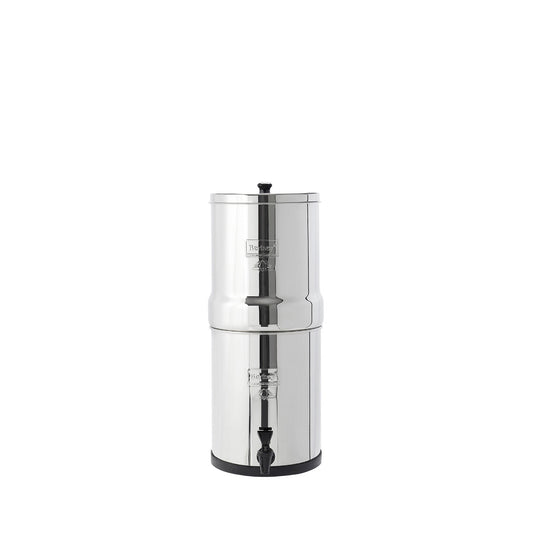
Berkey is a gravity-fed countertop system with no plumbing connection. You pour water into the upper chamber by hand, gravity pulls it through the filter elements, and the filtered water collects in the lower chamber below.
This is also why a Berkey can move from the kitchen counter to a second home, an RV, or a rental without any installation. No electricity, no water pressure, no plumber required. For households that value that flexibility, manual refilling is a feature rather than a drawback.
Who this matters for: Households that want instant access to large, on-demand volume, such as commercial or food-service environments. For most home use, filling the chamber once before bed takes under two minutes and covers the next day's needs.
Verdict: Trade-off for needing no plumbing, power, or installation
Gravity filters work more slowly than pressurized systems. A Big Berkey with the included Black Berkey Elements processes up to 3.5 gallons per hour with two elements, depending on source water quality. Phoenix Elements, the current replacement option, have a similar gravity-fed flow rate.
That slower rate is a direct result of how gravity filtration works: water stays in contact with the filter media long enough for adsorption, absorption, and mechanical filtration to do their job across 200+ contaminants. Water forced through a filter under high pressure spends far less contact time with the media, which limits what it can capture.
The practical fix: refill before bed, keep the lower chamber topped up, and you will rarely wait for filtered water. Adding a second pair of elements, if your system supports it, doubles the flow rate.
Who this matters for: Large households drawing more than three to four gallons per hour will want to top up more frequently or opt for a larger model such as the Royal or Crown Berkey.
Verdict: Slower rate, higher contaminant reduction
If you notice flow slowing down, a quick scrub of the filter elements under running water almost always restores full speed. See the
Berkey cleaning guide for step-by-step instructions.
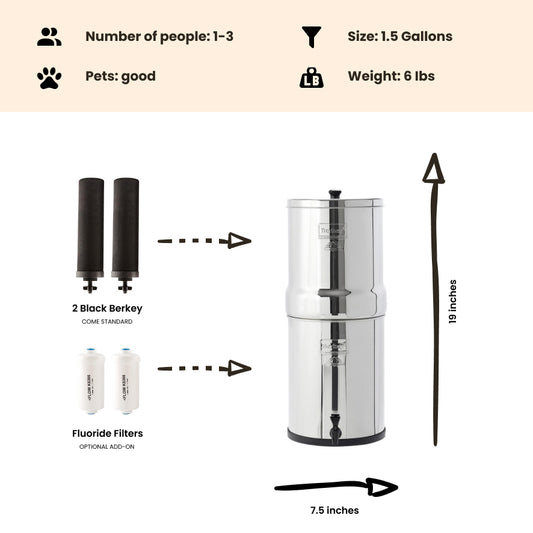
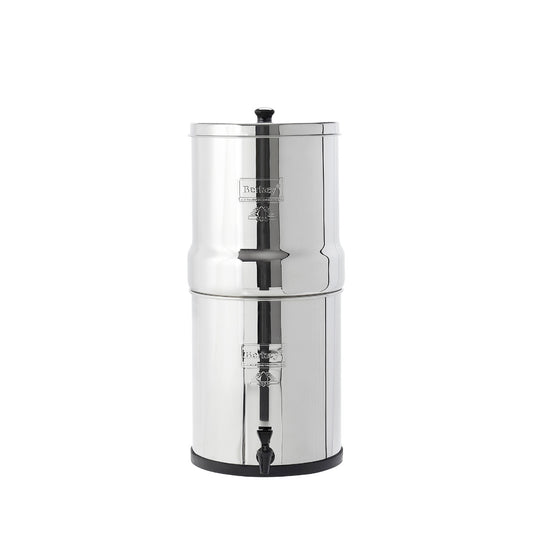
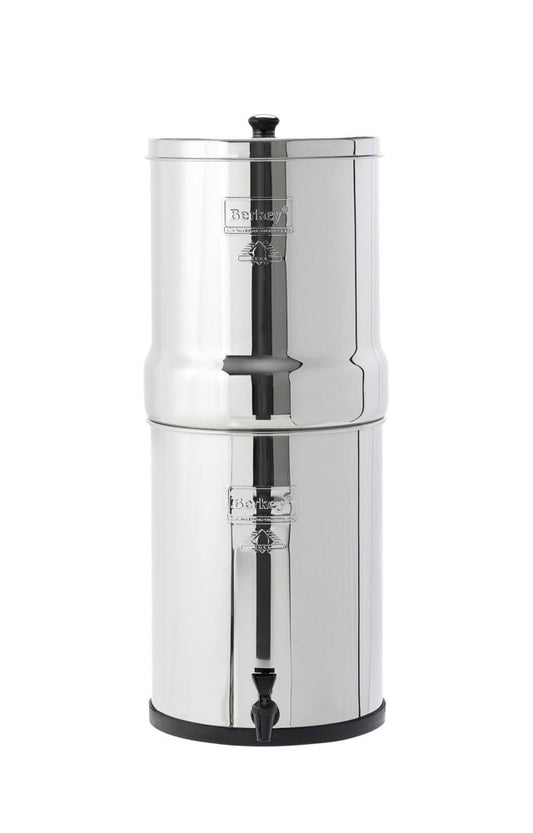
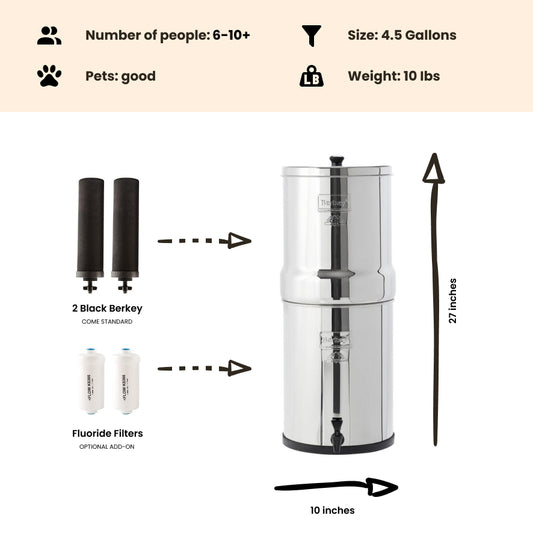
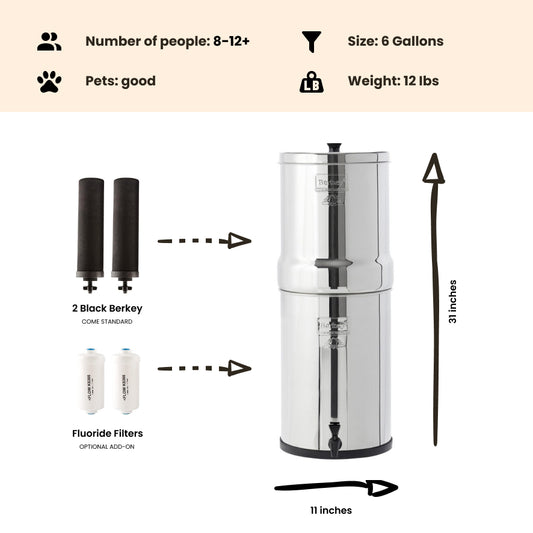
Berkey systems sit on the counter. The Big Berkey stands 19.25 inches tall. The Crown Berkey reaches 30 inches, which puts it above standard cabinet clearance in many kitchens.
The system comes in six sizes, from the compact Travel Berkey at 1.5 gallons to the Crown Berkey at 6 gallons. Choosing the model sized to your counter height and household eliminates this as a practical issue. A Berkey stand also raises the unit 6 to 8 inches, moves it to a corner, and frees usable counter space below the spigot.
Who this matters for: Small kitchens with limited counter depth and low cabinet clearance. The Travel Berkey and Big Berkey are the most counter-friendly options.
Verdict: Model selection and a stand solve the space question
To get a glass under the Berkey spigot, the system needs to sit at the counter edge or be elevated. Positioning it flush against the wall leaves the spigot inaccessible.
The most common fix is a Berkey stand, which raises the system to a comfortable height and frees the counter surface below. Many customers also place the unit on a small wooden board at the counter edge. Either approach adds minimal footprint and solves the clearance issue permanently at one-time cost of under $40.
Who this matters for: Counters with no overhang clearance or kitchens with island layouts where edge space is limited. Rarely a dealbreaker once a stand is added.
Verdict: Solved with a stand in most kitchens
How Berkey Compares to Other Filtration Systems
Berkey outperforms most pitcher, faucet, and gravity alternatives in contaminant range, filter lifespan, and total cost of ownership. Below is the direct comparison across the factors buyers weigh most.
Swipe table to see all columns
| Feature |
Berkey Gravity Systems |
Pitcher Filters |
Faucet Filters |
Reverse Osmosis |
| Contaminants Reduced |
200+ (PFAS, heavy metals, pharmaceuticals, pesticides, chlorine)* |
10 to 30 (mainly chlorine and taste) |
30 to 60 (varies by brand) |
90 to 99% (broad spectrum including dissolved solids) |
| Filter Lifespan |
6,000 gal/pair (included elements)* |
40 to 60 gal |
100 to 200 gal |
400 to 1,000 gal |
| Cost Per Gallon |
~$0.02 to $0.03 |
$0.15 to $0.25 |
$0.10 to $0.20 |
$0.05 to $0.15 |
| Power Required |
None |
None |
None |
Yes (electric pump) |
| Water Waste |
None |
None |
None |
2 to 4 gallons waste per 1 gallon filtered |
| Portability |
High (no plumbing, no power) |
Medium |
Fixed to faucet |
Fixed (installed) |
| Works Without Power or Plumbing |
Yes |
No |
No |
No |
| Lab Reports Publicly Available |
Yes, downloadable PDFs |
Varies by brand |
Varies by brand |
Varies by brand |
* Every Berkey system ships with Black Berkey Elements (6,000 gal/pair, tested against 200+ contaminants). When replacement elements are needed, Phoenix Elements are the current available option at 5,500 gal/pair, NSF/ANSI 42 and 372 certified. NSF/ANSI 42 covers aesthetic contaminants including chlorine taste and odor; NSF/ANSI 372 confirms lead-free materials throughout the filter components.
Reverse osmosis systems offer broad reduction of dissolved solids but require installation, waste several gallons per gallon filtered, depend on water pressure and electricity, and stop functioning during outages. Pitcher and faucet filters carry a low sticker price but require monthly cartridge changes and address a narrow range of contaminants. Berkey covers the most health-significant contaminants, including PFAS and heavy metals, with no plumbing or electrical dependency and publicly downloadable lab reports.
What 5 Years of Water Filtration Actually Costs
Most buyers anchor on the purchase price. The more relevant number is the total five-year cost, including filter replacements and consumables. Here is how the systems compare for a household using approximately 1,000 gallons per year.
Big Berkey 5-Year Total
~$367
Big Berkey purchase price. Black Berkey Elements are included and last up to 6,000 gallons, covering 5+ years at typical household use. No replacement cost within the window.
Pitcher Filter 5-Year Total
~$400
Unit plus monthly cartridge replacements. $0.15 to $0.25 per gallon. Narrower contaminant range.
Faucet Filter 5-Year Total
~$300
Unit plus bi-monthly replacements. Lower cost, but significantly narrower contaminant coverage.
Reverse Osmosis 5-Year Total
~$700+
Installation plus annual filter sets and membrane replacement. Broader dissolved solids reduction.
At typical household consumption, the total five-year cost of a Berkey lands close to competing pitcher filter costs, despite the higher purchase price, while delivering significantly broader contaminant reduction, zero monthly filter waste, and no dependence on plumbing or electricity.
Berkey Maintenance: What Actually Needs Regular Attention
Berkey maintenance is simpler than most people expect. The chambers and spigot benefit from a monthly wipe-down, but filter element scrubbing is only needed if the flow rate slows down noticeably. Mineral and sediment buildup on the element surface is what causes slowdown, and a quick scrub under running water restores normal flow. You do not need to scrub on a calendar schedule if your flow rate is fine.
Swipe to see full table
| Maintenance Task |
Frequency |
Time Required |
| Wipe down stainless steel chambers |
Monthly |
5 minutes |
| Clean spigot (remove and soak in warm water) |
Monthly |
5 minutes |
| Scrub filter elements under running water |
Only if flow rate slows noticeably |
10 minutes |
| Replace Black Berkey Elements (included with system) |
Every 6,000 gallons per pair |
15 minutes |
| Replace Phoenix Elements (current replacement option) |
Every 5,500 gallons per pair |
15 minutes |
| Replace PF-2 fluoride filters (if applicable) |
Every 1,000 gallons |
5 minutes |
Who Are Berkey Water Filters Best For?
Despite the five limitations above, Berkey excels where most alternatives fall short. These systems are a strong fit for:
-
Families in urban or suburban homes who need consistent wide-spectrum contaminant reduction from tap or well water without plumbing modifications.
-
Apartments, rentals, RVs, and second homes that want a filter that works on tap or well water without any plumbing or electrical hookup.
-
Second homes, RVs, and renters who want a durable system that moves with them and needs no installation, on tap or well water.
-
Health-focused households prioritizing PFAS, lead, and heavy metal reduction with independent lab documentation to back up the claims.
See the Full Berkey Lineup
Compare sizes, review lab-verified test results, and find the right system for your household.
Are Berkey Water Filters Worth the Investment?
Yes, for most households. The case rests on three things: independent lab testing covering 200+ contaminants with publicly available downloadable reports, a cost-per-gallon that beats most alternatives over time, and a system that operates without electricity, plumbing, or any ongoing infrastructure requirement.
The five limitations in this guide are real trade-offs, not dealbreakers. Each one maps to a specific advantage. The higher upfront cost leads to a lower lifetime cost. Manual refilling is what lets it run with no plumbing or power. Slower flow is a product of longer contact time with the filter media. The counter space and spigot constraints are both solved with a stand.
Where Berkey stands out among gravity filters is in the depth of third-party verification. Lab reports from independent, EPA-accredited laboratories (Black Berkey) and NABL-accredited ISO/IEC 17025:2017 certified laboratories (Phoenix) are publicly downloadable. Media coverage from EWG, Food Network, CBS News, and the LA Times is fully documented and linked from our Media Coverage page. For buyers who want proof to back the claims, the documentation is there.
FAQs
Are Berkey water filters worth the money?
Yes. Every Berkey system ships with Black Berkey Elements, tested against 200+ contaminants with a 6,000-gallon lifespan per pair. When replacement elements are needed, Phoenix Elements are the current available option at approximately $0.02 per gallon over their 5,500-gallon lifespan. Either way, the five-year total cost is comparable to a pitcher filter while delivering significantly broader contaminant reduction and no monthly cartridge waste.
What are the biggest limitations of a Berkey water filter?
The five most common limitations are: higher upfront cost compared to pitcher filters, manual refilling with no plumbing connection, a slower gravity-based filtration rate, counter space requirement, and spigot clearance at the counter edge. Each has a direct workaround. The cost math favors Berkey long-term. A stand resolves the spigot and space constraints. Refilling before bed eliminates most wait time.
How long do Berkey filter elements last?
Black Berkey Elements, which ship with every new Berkey system, last up to 6,000 gallons per pair. When replacement elements are needed, Phoenix Elements last up to 5,500 gallons per pair. For a household using approximately three gallons per day, either element type lasts roughly four to six years before replacement is needed. Filter life depends on source water quality: harder or sediment-heavy water may reduce lifespan. If flow slows noticeably, scrubbing the elements under running water restores performance and extends their life.
Does Berkey reduce PFAS?
Yes. Independent lab testing shows Black Berkey Elements, which ship with every new Berkey system, reduce PFOA directly at 99.9%+ reduction and 8 additional PFAS compounds via surrogate methodology, all at 99.9%+. Phoenix Elements, the current replacement option, are also independently lab tested. Results are publicly available for download on the Phoenix Elements lab results page and the full test results library. The current EPA maximum contaminant level for PFOA and PFOS is 4 parts per trillion, set in April 2024.
Why is my Berkey filtering slowly?
Slow filtration is almost always caused by mineral or sediment buildup on the outer surface of the filter elements, which restricts the pores over time. If your flow rate slows noticeably, gently scrubbing the elements under running water with a clean scrub pad restores flow rate in most cases. You do not need to scrub on a set schedule if flow is normal. Adding a second pair of elements, if your system supports four, also doubles the flow rate proportionally.
Is a Berkey better than a reverse osmosis system?
It depends on your priorities. Reverse osmosis reduces a broader range of dissolved solids and is more effective at certain dissolved minerals. However, RO systems require installation, waste two to four gallons per gallon filtered, rely on water pressure and electricity, and stop functioning during power outages. Berkey covers the most health-significant contaminants including PFAS, lead, chlorine, and heavy metals, with no plumbing, no power, and no water waste. For households that also want a filter that works without plumbing or electricity, in apartments, rentals, RVs, or second homes, Berkey is the stronger choice.
What is the cost per gallon for a Berkey filter?
Approximately $0.02 to $0.03 per gallon, depending on which element you are calculating. Black Berkey Elements, which ship with every new system, cost approximately $0.03 per gallon over a 6,000-gallon filter life. Phoenix Elements, the current replacement option, run approximately $0.02 per gallon over a 5,500-gallon filter life. Both are significantly lower than pitcher filters, which average $0.15 to $0.25 per gallon when cartridge replacement costs are included.
Which Berkey system is best for a family of four?
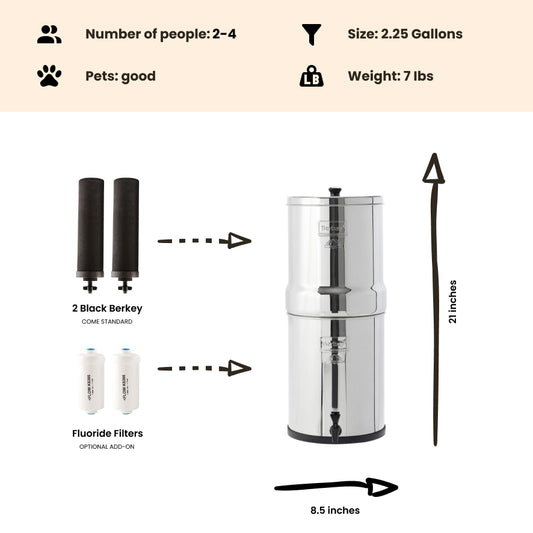
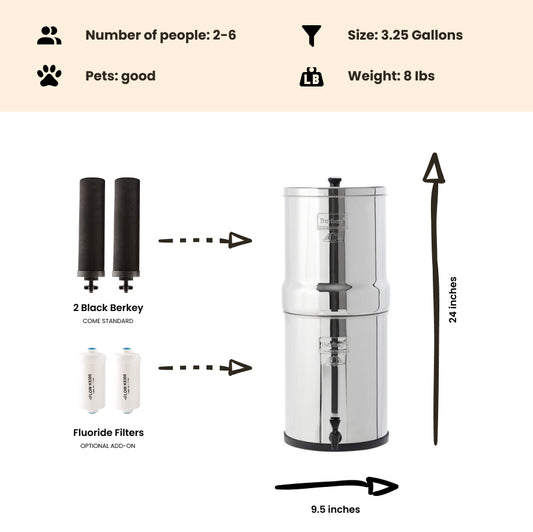
The Big Berkey (2.25 gallons) or Royal Berkey (3.25 gallons) are the most common choices for a four-person household. The Big Berkey handles typical daily consumption with regular refills. The Royal Berkey provides more reserve capacity for higher daily use or for households that prefer to refill less frequently.
How often do you have to refill a Berkey?
Most households refill the upper chamber once or twice per day. Filling takes under two minutes. The lower chamber of the Big Berkey holds 2.25 gallons, which covers the drinking and cooking needs of most two to four person households for a full day before refilling is needed.
Who should not buy a Berkey water filter?
Berkey is not the best fit for buyers who need instant high-volume output for commercial or large-group use, who want a completely hands-free plumbed-in system, or who have very limited counter space with no room for a stand. For everyday household use, including apartments, rentals, RVs, and homes with no room for a plumbed-in unit, it is one of the most capable and cost-effective gravity filter options available.
Find Your Berkey System
From the compact Travel Berkey to the family-sized Crown Berkey, explore the full lineup and lab-verified filtration data.


 By
Dan DeBaun
By
Dan DeBaun





Hi. We have been using our Berkey water filter since the Coronavirus outbreak with no complaints. However, in the last month we noticed RUST forming in the underside of the lid. What do I do? Thank you.
Hi Seilor -
Yes, rust can happen for some customers depending on their water source; typically those who have higher sodium levels in their water. However, this can be cleaned and removed. Please see the end of this article for tips on cleaning this rust from you Berkey system.
https://www.bigberkeywaterfilters.com/blog/how-to-clean-berkey-systems
Thanks
Dan
I want to buy replacement black filters for my Berkey but Berkey says they are out of stock. It’s been a really long time. Where can I buy them.
Hi Rose -
They are still unavailable while we sue the EPA. They are only available with new systems as this is still permissible. Any black berkey replacements being sold are most likely counterfeits, especially on sites like Amazon, Walmart or Ebay, so buyer beware.
Until this is resolved and as a stop-gap filter, we have the newly approved Ultra Serasyl Ceramic filters available as a replacement option. They are similar in performance and approx half the price. They just need to be replaced more often (approx once per year).
https://www.bigberkeywaterfilters.com/replacement-filters.html
Thanks
Dan
First...I love my Berkey.
Second, I am short on patience, but when I need to fill my Berkey, it really doesn't take all that long and I remind myself how much I appreciate what it is doing for me and I do it either before bed or early enough to not need it yet.
Last, as far as taking up space and the spigot hanging over...I purchased a wooden plant stand that is the type that looks like dowels in a x, adjustable to the size of planter to be placed in it and I love it! I can even use the space under it, where I just have a cute little dish with a plant, placed just where the spigot may drip (sometimes I don't get it tight enough). My Berkey is probably the best thing I have ever purchased.
How can I tell when my black filters and fluoride filters need changing. I purchased my system around 2017ish but did not prime and use the system right away. The water that's filtered still tastes good and it is clear. Sometimes when I clean the filters water is filtered out slowly. It other times there's a steady flow of water filtered. I am really pleased with this system.
Hi Shirley -
The fluoride filters need to be replaced once a year or 1000 gallons, whichever comes first, so these should be replaced. The black berkeys are good for appox 6000 gallons, and one can perform a red food coloring test on them at any time to verify that they are working to design specs.
Thanks
Dan
In what way are you an authorized Berkley dealer? You are not on their list of dealers. You appear to be an Amazon affiliate. That does not make you sellable to be an authorized dealer, Amazon is.
Hi Ron -
We are the largest dealer for the manufacturer and we do not sell on Amazon We also have an authorized dealer logo on the bottom of the webpage. The manufacturer at berkeywater.com can also be contacted if you would like additional confirmation.
Thanks
Dan