Quick Verdict
These two gravity filters are closer than most comparisons admit. AquaRain says its parts are made in the USA, and its ceramic elements go in without priming. Berkey offers five system sizes, a faster published flow rate, an optional fluoride filter, NSF/ANSI certified Phoenix Elements, and a larger set of public lab reports for chemical contaminants such as PFAS, chlorine, and chloramine.
On price, Berkey systems that ship with Phoenix Elements now cost less up front than the AquaRain 303: $267 for a Big Berkey and $308 for a Royal Berkey, versus about $360. Pick AquaRain if US-made parts matter most to you. Pick Berkey if you want published chemical test data, certified elements, fluoride reduction, a lower starting price, or a size other than 3 gallons.
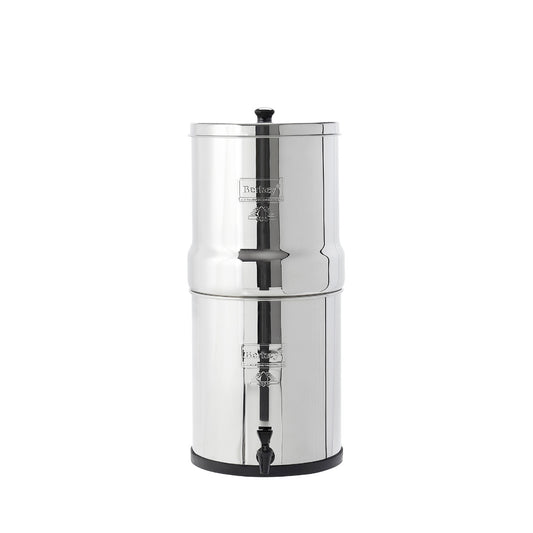
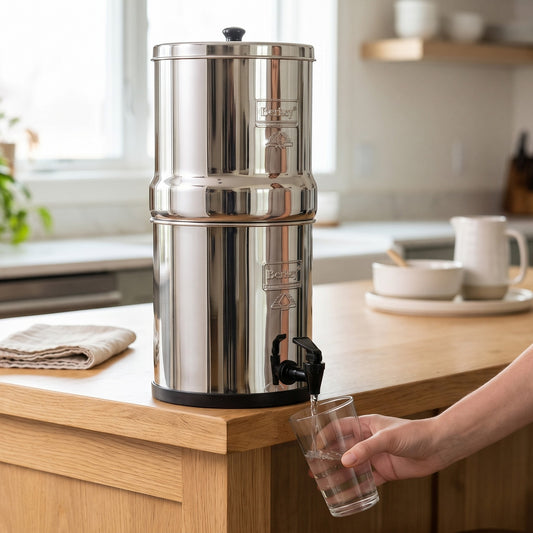
Berkey and AquaRain are both countertop gravity filters with stainless steel chambers. You pour tap water into the top chamber, it drips through the filter elements, and filtered water collects in the bottom chamber. Neither needs plumbing or electricity.
The differences are in the filter elements, the published test data, the sizes, and the upkeep. This guide compares the most similar models, the Royal Berkey (3.25 gallons) and the AquaRain 303 (3 gallons), and also covers the smaller Big Berkey (2.25 gallons) with Phoenix Elements as the lower-cost Berkey option. It uses current prices and each company's own published information.
Disclosure: we are an authorized Berkey dealer and we do not sell AquaRain. We have tried to describe AquaRain fairly and to say plainly where it comes out ahead. AquaRain details come from AquaRain's own product descriptions and its retailers as of October 2026.
Key takeaways
-
Upfront cost: the AquaRain 303 lists at about $360. Berkey systems with Phoenix Elements cost less: $267 for a Big Berkey and $308 for a Royal Berkey. A Royal Berkey with Black Berkey Elements is $408.
-
Filter replacement: AquaRain gives no gallon rating, and its guidance ranges from yearly replacement (its FAQ) to 5 to 10 years (owner reports on its support page). A set of three costs about $170 to $180. A $120 pair of Phoenix Elements is rated by the maker for 5,500 gallons, about 3 to 5 years for a typical household.
-
Published test data: Berkey publishes independent lab reports on more than 200 contaminants. We could not find a current public lab report with chemical reduction figures for AquaRain.
-
Upkeep: close. Both brands' elements are scrubbed when flow slows. AquaRain needs no priming; Berkey elements are primed at setup. AquaRain's included gauge measures ceramic wear, not how much carbon capacity is left.
-
Fluoride: Berkey offers an add-on PF-2 fluoride filter. We found no fluoride option for AquaRain.
-
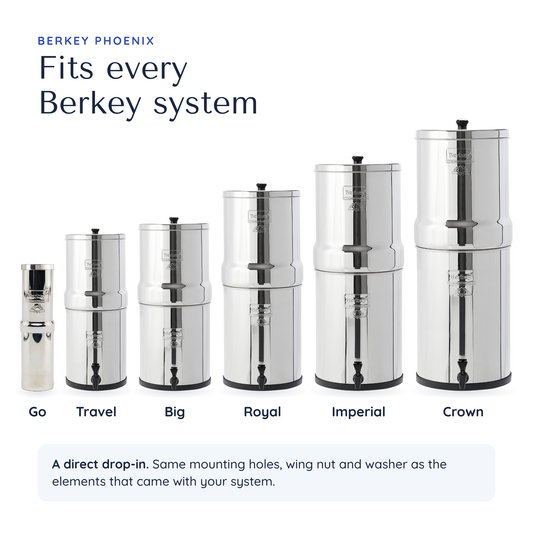
Sizes: Berkey makes five stainless systems from 1.5 to 6 gallons. AquaRain currently sells one countertop model (3 gallons).
What Are the Main Differences Between Berkey and AquaRain?
The biggest differences are the filter material, the amount of published test data, and maintenance. Berkey uses carbon-based filter elements backed by public lab reports. AquaRain uses a ceramic shell filled with activated carbon.
| Feature |
Royal Berkey |
AquaRain 303 |
| Capacity |
3.25 gallons (upper chamber) |
3 gallons |
| Price |
$308 with 2 Phoenix Elements; $408 with 2 Black Berkey Elements (Big Berkey with Phoenix: $267) |
About $360 at US retailers ($359.99) with 3 elements; AquaRain's own store lists $429.99; often out of stock or on backorder |
| Filter type |
Berkey Phoenix Elements or Black Berkey Elements, depending on the system you buy: carbon-based media |
Ceramic shell with granular activated carbon and silver inside (per AquaRain) |
| Rated filter life |
6,000 gal per pair (Black Berkey); 5,500 gal per pair (Phoenix) |
No gallon rating from AquaRain ("lasts for thousands of gallons"); one retailer lists up to 10,000 gal for a set of 3 |
| Replacement cost |
$120 per pair (Phoenix) |
About $60 per element; about $170 to $180 for 3 |
| Published flow rate |
Up to 4.2 gal/hr per pair of Phoenix Elements (max rating, full upper chamber) |
About 1 gal/hr with the top chamber kept full (AquaRain); a retailer lists 0.5 gal/hr |
| Certification |
Phoenix Elements, and systems equipped with them: NSF/ANSI 42 and NSF/ANSI/CAN 372 |
AquaRain says it meets NSF standards; we found no public NSF listing |
| Fluoride option |
Yes, PF-2 add-on filters |
None found |
| Wear gauge |
No |
Yes, measures ceramic wall thickness only |
| Cleaning |
Scrub with a soft pad when flow slows |
Scrub with the included pad when flow slows |
| Priming |
Yes, 5 to 10 minutes at setup |
No priming step; AquaRain says new dry elements need several gallons run through to reach full flow |
| Sizes available |
5 systems, 1.5 to 6 gallons |
1 current countertop model (3 gallons) |
| Where made |
Black Berkey Elements made in the USA; stainless housings sourced from India; Phoenix Elements made in India |
AquaRain says all components are made in the USA |
Prices checked October 2026. Berkey prices are minimum advertised prices; AquaRain prices vary by retailer.
How Do the Filter Elements Differ?
Berkey elements are solid carbon-based filters that are replaced when they reach their rated gallons. AquaRain elements are ceramic tubes with activated carbon packed inside. Both are scrubbed on the outside when sediment slows the flow. In both cases, scrubbing only clears the surface so water moves again. It does not restore the carbon's ability to capture chemicals, which runs down with use no matter how often the element is cleaned.
Berkey elements
New Big Berkey and Royal Berkey systems come with Berkey Phoenix Elements or, while supplies last, Black Berkey Elements. Travel, Imperial and Crown come with Black Berkey Elements. Black Berkey media is a proprietary blend of several media types, including carbon. Black Berkey Elements are not sold as standalone replacements because of an EPA regulatory matter. The Berkey Phoenix Element is the authorized replacement and the element that ships in the Phoenix-equipped systems. It uses CTC-60 coconut shell carbon and is certified to NSF/ANSI 42 and NSF/ANSI/CAN 372.
AquaRain elements
AquaRain describes its elements as patented sub-micron ceramic shells that hold a bed of granular activated carbon with silver added. The ceramic does the fine physical filtering, and the carbon inside handles chlorine, taste, and odor. Retailers list each element at about 8 inches long and 2 inches wide, and the 303 holds three of them.
Which System Has More Published Test Data?
Berkey has far more public test data for chemical contaminants. Berkey filter elements have been tested by independent labs against more than 200 contaminants, and the full reports are posted on our lab test results page. AquaRain lists the contaminants it addresses, but we could not find a current public lab report showing how much of each one it reduces.
What Berkey has published
- Berkey Phoenix Elements are certified to NSF/ANSI 42, which covers chlorine taste and odor, and NSF/ANSI/CAN 372, which covers lead-free materials. Learn what those certifications mean.
- Independent lab results for Phoenix Elements show free chlorine and chloramine reduced by more than 99.9%, seven PFAS compounds reduced by 99.8% or more at the start of testing, and PFOA and PFOS below detection limits through 1,500 liters.
- Black Berkey Elements have their own independent reports covering metals, PFAS, VOCs, pesticides, and pharmaceuticals. See the Phoenix contaminant list and the Black Berkey contaminant list.
What AquaRain has published
AquaRain and its retailers say the filter reduces chlorine, MTBE, pesticides, herbicides, lead, iron, and hydrogen sulfide, and AquaRain says it meets NSF standards. AquaRain's own contaminant sheet gives reduction figures but names no lab or test date. We found no NSF listing and no lab report with a lab name and date as of October 2026. That does not mean the testing was never done. It means a buyer cannot easily check it. If AquaRain publishes a current report, we will update this comparison.
AquaRain also markets its filter for water sources beyond tap water and makes claims about microorganisms. Berkey makes no such claims, so this comparison covers treated city water and tested well water only.
The fair way to read this: both filters use activated carbon, so both should improve chlorine taste and odor. The difference is that Berkey lets you look up the numbers for specific chemicals, and AquaRain asks you to take its list on trust.
Can Either System Reduce Fluoride?
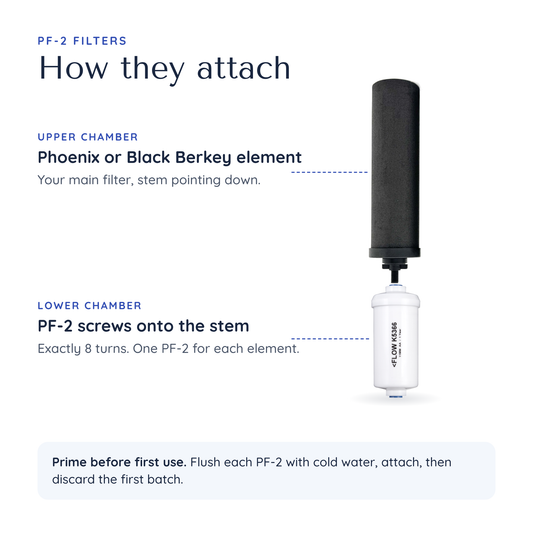
Only Berkey offers a fluoride option. Carbon and ceramic filters on their own do not reduce fluoride much. Berkey sells PF-2 fluoride and arsenic filters ($103 per pair) that screw onto the bottom of the elements. They last 1,000 gallons or one year, whichever comes first, so most households replace them once a year. We found no fluoride add-on for AquaRain.
Which Filter Is Faster?
Berkey is likely faster, but the two brands do not measure flow the same way. Berkey lists up to 4.2 gallons per hour for each pair of Phoenix Elements with the top chamber full. The Royal Berkey can hold up to four elements for faster filtering. AquaRain says the 303 makes about 1 gallon an hour when the top chamber is kept full, and about 1.5 gallons overnight from a single fill.
Every gravity filter slows down as the top chamber empties, so real-world output is lower than the peak numbers for both. Both brands' elements also slow down as sediment builds up, and scrubbing them brings the flow back. For one or two people, either system keeps up. For a large family, the faster flow and four-element option on the Royal Berkey are worth noticing.
What Does Each System Cost Over Time?
With Phoenix Elements, Berkey now costs less up front. A Royal Berkey with Phoenix Elements is $308 and a Big Berkey with Phoenix Elements is $267, while the AquaRain 303 lists at about $360. Filter costs over time depend on which AquaRain guidance you follow.
| Cost factor |
Royal Berkey (Phoenix) |
AquaRain 303 |
| System price |
$308 (Big Berkey with Phoenix: $267; Royal with Black Berkey: $408) |
About $360 |
| Replacement filters |
$120 per pair of Phoenix Elements |
About $170 to $180 for 3 elements |
| Replacement guidance |
5,500 gallons per pair, about 3 to 5 years for a typical household |
AquaRain FAQ: once a year for carbon capacity. Owners on its support page: 5 to 10 years. Retailer: up to 10,000 gallons per set |
| Filter cost per year |
About $24 to $40 (one $120 pair every 3 to 5 years) |
About $170 to $180 if replaced yearly, as AquaRain's FAQ recommends; about $17 to $36 if a set lasts 5 to 10 years, as owners report |
| Filter cost per gallon |
About 2.2 cents ($120 / 5,500 gallons) |
About 1.7 to 1.8 cents if a set reaches the retailer's 10,000 gallons; AquaRain publishes no gallon rating |
| 5 year cost at 1 gallon a day |
$308 (no replacement needed for 1,825 gallons) |
About $1,040 to $1,080 with yearly replacement ($360 + 4 sets at $170 to $180); about $360 if the original set lasts 5 years |
| Fluoride add-on |
PF-2, $103 per pair per year |
Not offered |
AquaRain's figures point two ways. Its FAQ recommends replacing the elements once a year for full carbon capacity, and followed that way AquaRain is the more expensive system to run. Its support page quotes owners getting about 5 years, and in one case 10, from a set, and a retailer lists up to 10,000 gallons; if a set lasts that long, its filter cost is close to Berkey's and can be slightly lower. Berkey's 5,500 gallon rating comes from the maker, so its cost is easier to plan.
Which Is Easier to Maintain?
Upkeep is closer than it first looks. Both brands' elements are scrubbed by hand when flow slows, and in both cases that only clears sediment from the surface. AquaRain's real convenience is that its elements need no priming step, though AquaRain says new dry elements need several gallons run through them before they reach full flow.
AquaRain also includes a plastic gauge. AquaRain says to replace an element when the included gauge fits over the ceramic, which happens after repeated scrubbing has worn the wall thin. That tells you about the ceramic shell, not the carbon inside it. AquaRain's FAQ says the carbon's life depends on your water and recommends replacing the elements once a year for full carbon capacity, while its support page quotes owners using a set for 5 to 10 years. Treat the gauge as a check on physical wear, not as a signal that the filter is still reducing chemicals.
Berkey elements must be primed before first use, which takes about 5 to 10 minutes, and again only if flow stays slow after cleaning. There is no gauge, so you track gallons filtered against the rated life. Berkey owners can check that their elements are sealed and seated correctly with the red food coloring test. Both systems need the stainless chambers washed with mild soap about once a month. Our guide on how to use a Berkey covers setup step by step.
How Do Sizes, Build Quality, and Manufacturing Compare?
Berkey offers more sizes, and AquaRain has the stronger made-in-USA story. Both use stainless steel chambers.
-
Berkey sizes: Travel (1.5 gallons), Big (2.25), Royal (3.25), Imperial (4.5), and Crown (6). Not sure which fits your household? Our system selector quiz takes about a minute.
-
AquaRain sizes: the 303 is the current countertop model. AquaRain's current lineup names only the 303; older models such as the 201, 202, 402 and 404 are no longer sold new.
-
Manufacturing: AquaRain, Inc. is based in Nevada, Missouri, and says its systems use "All American-Made Components" and are assembled by hand there. A retailer lists the elements as made in Washington, the stainless steel from Wisconsin, and the faucets from Ohio. Black Berkey Elements are made in the USA. Berkey's stainless housings are sourced from India, and Phoenix Elements are made in India.
What Warranty and Support Come With Each?
The Berkey manufacturer covers chambers and lids for 1 year, and Berkey systems bought from BigBerkeyWaterFilters.com add a lifetime warranty on the stainless steel chambers and hardware. Phoenix Elements carry a 1 year warranty, and Black Berkey Elements carry a 2 year prorated warranty. AquaRain's written warranty covers the housing and hardware for 3 years from purchase and excludes the ceramic filter elements.
Who Should Choose AquaRain?
AquaRain is the better fit if you:
- Do not want to prime filters
- Place a high value on US-made components
- Mainly care about chlorine taste and odor and do not need published chemical test data
Who Should Choose Berkey?
Berkey is the better fit if you:
- Want to read independent lab reports for specific chemicals such as PFAS, lead, chlorine, and chloramine before you buy
- Want to reduce fluoride with an add-on filter
- Need a size other than 3 gallons, or faster flow for a larger household
- Want a lower starting price, with Phoenix Elements certified to NSF/ANSI 42 and NSF/ANSI/CAN 372 included
- Want a lifetime warranty on the stainless chambers and hardware
The Bottom Line
AquaRain is a well-built gravity filter with US-made parts and no priming step. Its main weakness is transparency: it is hard to find current, public test results for the chemicals it says it reduces, and it gives no gallon rating for its elements. Berkey needs priming at setup, but its Phoenix-equipped systems cost less up front, and it gives you published lab data, NSF certified elements, a fluoride option, and five sizes to choose from.
If you want to verify what your filter reduces before you buy, Berkey is easier to check. If US manufacturing matters most to you, AquaRain is a reasonable choice.
Frequently Asked Questions: Berkey vs. AquaRain
Is Berkey better than AquaRain?
It depends on what you value. Berkey publishes independent lab reports on more than 200 contaminants, offers a fluoride add-on, and comes in five sizes. Berkey systems with Phoenix Elements also cost less up front. AquaRain needs no priming and uses US-made parts. Buyers who want published chemical test data usually choose Berkey; buyers who put US manufacturing first often choose AquaRain.
Is AquaRain NSF certified?
AquaRain says its filter meets NSF standards, but as of October 2026 we could not find a public NSF listing for AquaRain elements. Berkey Phoenix Elements are certified to NSF/ANSI 42 for chlorine taste and odor and NSF/ANSI/CAN 372 for lead-free materials.
How long do AquaRain filters last compared to Berkey filters?
AquaRain publishes no gallon rating. Its FAQ recommends replacing the elements once a year for full carbon capacity, while its support page quotes owners getting about 5 to 10 years from a set, and one retailer lists up to 10,000 gallons for a set of three. Black Berkey Elements are rated for 6,000 gallons per pair and Berkey Phoenix Elements for 5,500 gallons per pair, which is about 3 to 5 years for a typical household.
Which costs less, Berkey or AquaRain?
Berkey costs less up front when you choose Phoenix Elements: $267 for a Big Berkey and $308 for a Royal Berkey, versus about $360 for the AquaRain 303. Over time, it depends on how often you replace the filters. A $120 pair of Phoenix Elements is rated for 5,500 gallons, about 3 to 5 years for a typical household. Three AquaRain elements cost about $170 to $180. AquaRain publishes no gallon rating, but if a set reaches the 10,000 gallons one retailer lists, it works out to about 1.7 to 1.8 cents per gallon versus about 2.2 cents for Phoenix. Followed as AquaRain's FAQ recommends, yearly replacement makes AquaRain the more expensive system to run. At 1 gallon a day, a Phoenix pair lasts well past 5 years.
Does AquaRain reduce fluoride?
We found no fluoride option for AquaRain. Carbon and ceramic filters on their own do little for fluoride. Berkey offers PF-2 fluoride and arsenic filters for $103 per pair, which last 1,000 gallons or one year, whichever comes first.
Does the AquaRain gauge tell you when the filter stops working?
Not for chemicals. The gauge measures how thin the ceramic shell has worn from scrubbing. It does not measure the carbon inside, which AquaRain's FAQ says has a finite life that depends on your water; the FAQ recommends replacing the elements once a year for that reason. AquaRain elements do skip priming, while Berkey elements are primed at setup in about 5 to 10 minutes.

 By
Dan DeBaun


 Out of stock

 Out of stockRegular price From $308.00Regular priceUnit price per





Can the Berkley filters be used in the AquaRain system? Is there way to adapt filters to fit either container?
Yes, the filters can be used in an aquarain.
Thanks
Dan
Hi Jimmie -
Yes, the black berkeys will fit inside this Aquarain system.
Thanks
Dan