
Berkey vs. Aquasana Water Filters – Which System Is Better in 2026?
Last updated: August 18, 2026 By
Dan DeBaun
By
Dan DeBaun
Table of Contents
- Berkey vs Aquasana: Side-by-Side Comparison
- How Does Gravity Filtration Compare to Pressure Filtration?
- How Do the Filtration Technologies Differ?
- Which System Removes More Contaminants?
- Filter Lifespan and Long-Term Value
- Physical Design and Durability
- Which System Is Better for Emergency Preparedness?
- How Do Testing Standards and Certifications Compare?
- Warranty and Maintenance
- Which Water Filter System Should You Choose?
- The Bottom Line
- Frequently Asked Questions
Quick Verdict
Berkey is an outperforming filtration system for most buyers. The Big Berkey with Black Berkey or Phoenix Gravity New Millennium Edition™ elements reduces over 200 contaminants, lasts up to 6,000 gallons per pair (Black Berkey) or 5,500 gallons per pair (Phoenix), costs roughly 2 cents per gallon, and works without electricity or plumbing. The Phoenix elements are officially endorsed by New Millennium Concepts, Ltd. and are a popular replacement option for Black Berkey filters and other compatible gravity systems.
Aquasana's Claryum Countertop system is a solid municipal-water filter certified for 78 contaminants, but its 450-gallon filter lifespan means higher ongoing costs and zero emergency capability.
For households that need a filter capable of handling both treated and untreated water, emergency scenarios, and long-term cost efficiency, the Berkey's specifications make the stronger case. For households that only filter municipal water and prioritize instant flow with minimal maintenance, Aquasana's pressure-driven design addresses that use case.
In this article, we’ll explore why and how Berkey gravity systems outperform Aquasana in filtration depth, filter lifespan, long-term value, and versatility.
Berkey vs Aquasana: Side-by-Side Comparison
|
Feature |
Big Berkey (Phoenix Elements) |
Aquasana Claryum Countertop (AQ-4000) |
|
Filtration Method |
Gravity-fed (no electricity or plumbing required) |
Pressure-driven (connects to kitchen faucet) |
|
Contaminants Reduced |
200+ (tested by EPA-accredited labs) |
78 (NSF certified) |
|
Filter Capacity (per pair) |
5,500 gallons (Phoenix) |
450 gallons |
|
Replacement Frequency |
Every 3–5 years (typical household use) |
Every 6 months |
|
Cost Per Gallon |
~$0.02/gallon |
~$0.11–$0.13/gallon |
|
Flow Rate (2-element setup) |
~4.2 gallons/hour (Phoenix) / |
~30 gallons/hour (0.5 GPM using water pressure) |
|
Housing Material |
Polished AISI 304 stainless steel |
Plastic |
|
Emergency / Off-Grid Use |
Yes, no power or plumbing needed |
No, requires water pressure |
|
Fluoride Removal |
Yes, with optional PF-2 add-on filters |
No |
|
NSF Certifications |
NSF/ANSI 42, NSF/ANSI/CAN 372 (Phoenix Filters) |
NSF/ANSI 42, 53, 401, P473 |
|
Independent Lab Testing |
NABL/ISO 17025 accredited labs, EPA protocols |
NSF International, WQA |
|
Mineral Retention |
Yes, retains calcium, magnesium, potassium |
Yes, retains calcium, magnesium, potassium |
|
System Warranty |
Lifetime warranty on stainless and parts (BigBerkeyWaterFilters.com exclusive). |
1-year limited warranty (housing only) |
|
Filter Warranty |
1-year (Phoenix) |
Filters not covered (classified as consumables) |
How Does Gravity Filtration Compare to Pressure Filtration?
The fundamental difference between Berkey and Aquasana comes down to how water moves through the filter media.
Think of it as the difference between a slow-drip pour-over coffee maker and an espresso machine; one relies on natural forces, the other on mechanical pressure. Both produce filtered water, but the process and results differ significantly.
Berkey systems use gravity to pull water through the filter elements in the upper chamber. Water passes slowly through a dense microfiltration structure, spending more time in contact with the media. This extended contact time is what allows the system to address such a broad spectrum of contaminants. No electricity, no plumbing, no water pressure required. You pour water into the top, and gravity does the rest.
Aquasana's Claryum Countertop system connects to your kitchen faucet via a diverter valve and uses existing household water pressure to force water through the filter media rapidly. This delivers a much faster flow rate: approximately 0.5 gallons per minute compared to the Big Berkey's 4.2 gallons per hour. You get instant filtered water on demand, but the trade-off is shorter contact time with the filtration media and a system that is entirely dependent on your plumbing working.
Practical note
The Big Berkey's slower gravity-fed pace requires planning ahead, but the trade-off is measurable. Slower filtration means more contact time between water and filter media, which directly supports broader contaminant reduction. Keeping the upper chamber topped off ensures filtered water is always available in the lower chamber.
How Do the Filtration Technologies Differ?
Berkey Phoenix New Millennium Edition Element
The Phoenix Gravity New Millennium Edition™ Filter Element is the latest gravity filtration technology, officially endorsed by New Millennium Concepts, Ltd. (NMCL), the owner of the Berkey brand.
This element uses an advanced carbon block and nanofiber composite engineered to reduce over 200 contaminants, including PFAS ("forever chemicals"), heavy metals like lead and mercury, pharmaceuticals, pesticides, and volatile organic compounds.
Each set of two Phoenix elements provides a filtration capacity of 5,500 gallons. Before first use, you prime the filters using the included PrimeEasy tool to clear air from the internal structure. Once running, you can verify the system is assembled correctly and filtering properly using the red food coloring test, a simple reliability check that has been a hallmark of Berkey systems for decades.
Phoenix elements hold NSF/ANSI 42 certification (aesthetic effects like chlorine and taste) and NSF/ANSI/CAN 372 certification (lead content compliance). Beyond those formal certifications, Phoenix filters are independently tested by NABL and ISO 17025 accredited laboratories (CVR Labs and RAYNU Analytical Labs) using EPA guidelines and ANSI/NSF protocols.
This dual approach (official certifications combined with extensive independent lab data) provides a deep level of performance transparency.
Aquasana Claryum Technology
Aquasana's Claryum technology uses a multi-stage process combining activated carbon, catalytic carbon, ion-exchange media, and sub-micron mechanical filtration. This solid block design is engineered to reduce 78 contaminants from municipally treated water, including chloramines, volatile organic compounds, pesticides, PFOA/PFOS, pharmaceuticals, and heavy metals like lead and mercury.
The Claryum system uses selective filtration, meaning it targets harmful contaminants while allowing beneficial minerals like calcium, magnesium, and potassium to pass through. Aquasana holds certifications from NSF/ANSI Standards 42, 53 (including P473 for PFOA/PFOS), and 401 (emerging contaminants like pharmaceuticals and BPA). Standards 53 and 401 require rigorous testing for health-related contaminant reduction; these are meaningful certifications in the water filtration industry.
The key limitation is scope. Claryum filters are designed and certified only for water that has already been municipally treated. They cannot handle the unknown threats, heavy sediment, or microbial contamination present in untreated water sources.

Which System Removes More Contaminants?
Berkey systems address a broader contaminant spectrum. Independent testing from EPA-accredited laboratories shows Black Berkey elements reduce heavy metals at greater than 99.9%, often to undetectable levels. The Phoenix elements continue this tradition with extensive third-party lab testing against over 200 contaminants, including PFAS, heavy metals, pharmaceuticals, volatile organic compounds, pesticides, herbicides, and petroleum products.
Aquasana's Claryum system is certified to reduce 78 specific contaminants. Its certifications to NSF/ANSI Standards 53 and 401 provide third-party validation for lead, cysts (Cryptosporidium and Giardia), mercury, asbestos, pesticides, pharmaceuticals, and PFOA/PFOS. This is a strong performance for a municipal water filter.
A good starting point for any household is reviewing the local Consumer Confidence Report before choosing a system. If the only concern is improving city tap water quality, both systems deliver credible performance. But for broad-spectrum protection against the widest possible range of known and emerging contaminants (or for well water and untreated water), Berkey is the only option between these two.
Heavy Metals and Pharmaceuticals
Both systems reduce lead, mercury, and pharmaceutical residues effectively. The difference is depth and verification.
Black Berkey and Berkey Phoenix elements are independently tested against an extensive list of heavy metals and chemical compounds, with lab results publicly available.
Aquasana's testing focuses on its certified list of 78 contaminants, which covers the most common regulated pollutants but is narrower in scope.
Fluoride and Arsenic
This is a clear differentiator. Standard Aquasana Claryum systems do not remove fluoride. The carbon-based filters leave fluoride in the treated water.
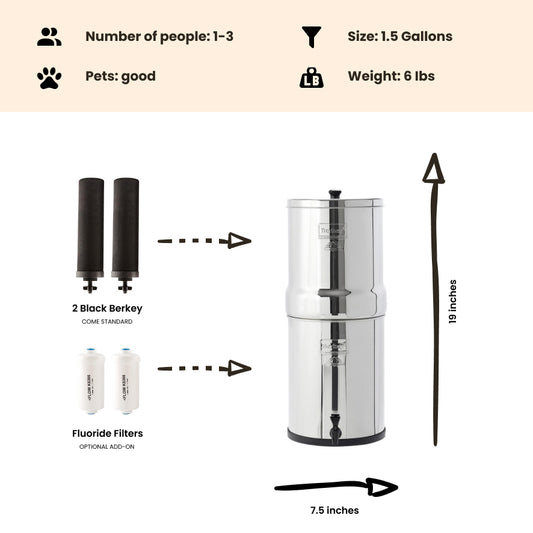
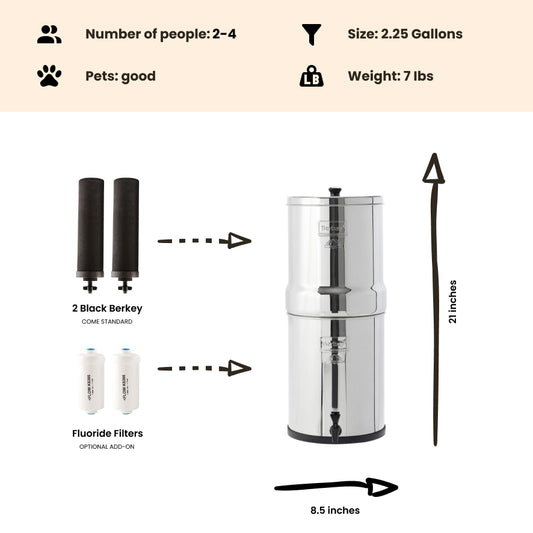
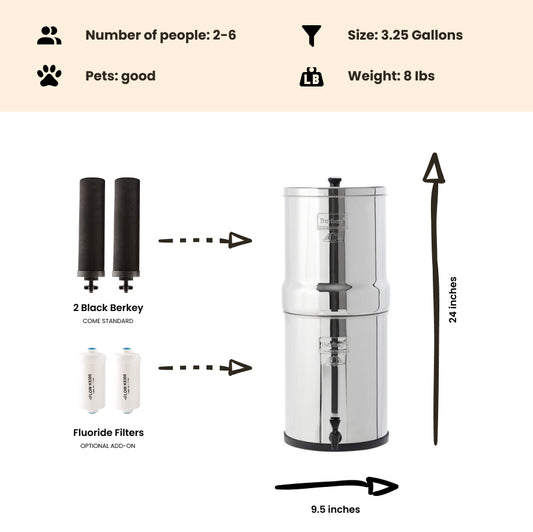
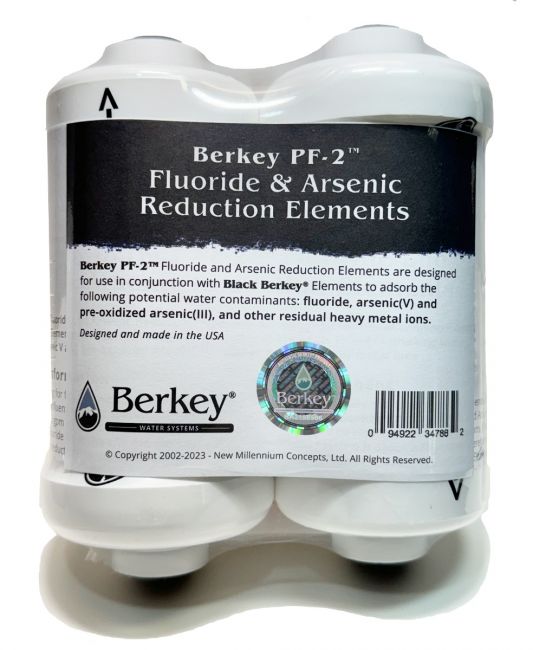
Berkey systems offer an add-on solution: PF-2 Fluoride and Arsenic Reduction Filters. These elements attach to the stems of the primary filters in the lower chamber and use activated alumina to target fluoride and arsenic ions. While Phoenix elements can contribute to measurable fluoride reduction in some conditions, PF-2 Fluoride & Arsenic Reduction Filters are recommended for consistent, long-term fluoride removal.
Filter Lifespan and Long-Term Value
Filter lifespan is where the economic case for Berkey becomes overwhelming. The numbers are stark:
Berkey Phoenix elements last up to 5,500 gallons per set of two. At a typical household consumption of 2 gallons per day, that works out to roughly 7–8 years of use before replacement is needed. Black Berkey elements push this even further at 6,000 gallons per pair. Either way, the replacement cycle is measured in years, not months.
Aquasana Claryum Countertop replacement filters are rated for 450 gallons, with a recommended replacement every 6 months. The newer Aquasana Clean Water Machine model has an even shorter lifespan at just 300 gallons.
To put this in perspective: you would need approximately 12 sets of Aquasana replacement filters to match the total output of a single set of Berkey Phoenix elements. That means 12 separate purchases, 12 filter swaps, and 12 sets of used cartridges going into the trash.
When you run the numbers over a 5-year period, the cost difference is significant.
Aquasana replacement filters run approximately $50–$80 per set. Replacing them twice a year over 5 years means $500–$800 in filter costs alone.
Berkey owners buy one set of Phoenix elements and are set for the same period, or longer.

Long-term convenience
Beyond the cost savings, Berkey's extended filter lifespan eliminates the recurring maintenance cycle entirely. Filtration becomes a background part of the household: no calendar reminders, no reordering cartridges every 6 months, no disposal of used filter sets multiple times per year. For households that prioritize low-maintenance solutions, the difference between a 6-month replacement cycle and a multi-year replacement cycle is significant.
Physical Design and Durability
Stainless Steel vs Plastic Housings
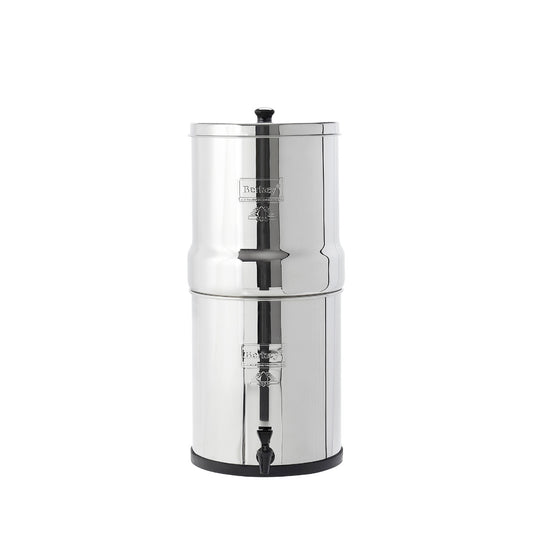
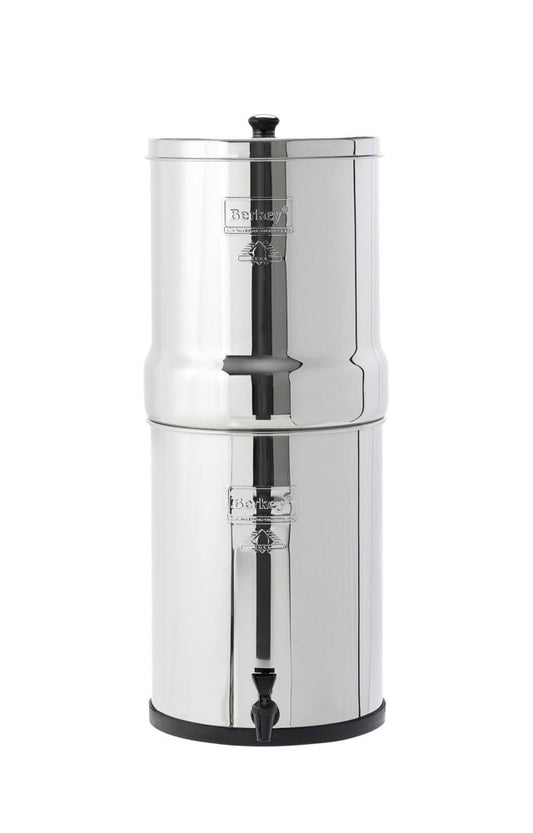
The Big Berkey uses a highly polished AISI 304 stainless steel housing, the same grade used in food-grade kitchen equipment. Stainless steel does not degrade under UV light, does not leach chemicals, and does not crack or discolor over time. The polished, non-porous surface is easy to clean, resists staining and corrosion, and blocks UV light penetration that can promote algae growth in transparent containers. Stainless steel construction is widely considered the premium standard for countertop water filtration housings because it preserves the natural taste of filtered water without introducing odors or chemical residues.
Aquasana's Claryum Countertop system uses plastic housing components. While functional and lighter weight, plastic housings can eventually crack, discolor, or degrade with UV exposure. When the housing fails, the entire unit needs replacement, not just the filters.
Flow Rate and Daily Use
Aquasana has the clear advantage on speed. At approximately 0.5 gallons per minute using household water pressure, the Claryum Countertop delivers filtered water on demand with virtually no wait. This is convenient for filling a glass quickly or cooking.
The Big Berkey with two Phoenix elements produces approximately 4.2 gallons per hour: enough for most household needs, but you need to plan ahead. The system works best when you keep the upper chamber topped off so filtered water is always ready in the lower chamber. For larger households, expanding to four elements significantly increases flow rates. Berkey systems with four Black Berkey elements can produce up to 7 gallons per hour.
The slower speed is a direct consequence of gravity-fed filtration's core mechanism: extended contact time between water and filtration media, which enables broader contaminant reduction across a wider range of substances.
Which System Is Better for Emergency Preparedness?
Berkey holds a decisive advantage in emergency preparedness due to its independence from infrastructure.
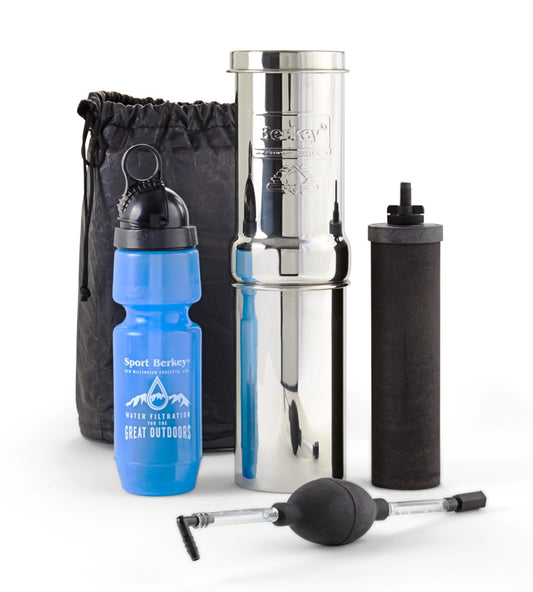
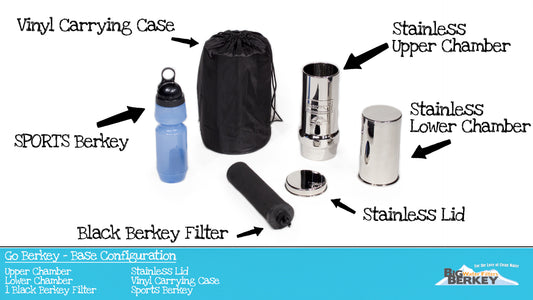
As a gravity-fed system, the Big Berkey functions without electricity, plumbing, or water pressure. During power outages, infrastructure failures, or natural disasters, you can pour water from any available freshwater source into the upper chamber and have filtered water flowing. The Travel Berkey and Go Berkey Kit provide portable options small enough for evacuation or mobile use.
Aquasana systems are entirely dependent on household water pressure. If the municipal water supply fails, or if a power outage shuts down the pumps that maintain water pressure, the Aquasana becomes inoperable. It cannot function without a pressurized water line, and it is not designed to treat untreated water from alternative sources.
Households in areas prone to severe weather, power outages, or infrastructure disruptions benefit significantly from having a filtration system that operates independently of municipal services.
How Do Testing Standards and Certifications Compare?
Both brands validate performance through third-party testing, but their approaches differ.
Berkey Phoenix elements hold NSF/ANSI 42 and NSF/ANSI/CAN 372 certifications. But the Berkey approach goes beyond formal certification by publishing extensive independent lab data from NABL and ISO 17025 accredited laboratories. This testing covers over 200 contaminants using EPA guidelines and ANSI/NSF protocols, providing a depth of performance data that exceeds what formal NSF certification alone requires.
Aquasana leans heavily on formal NSF certifications. The Claryum Countertop system carries NSF/ANSI 42 (aesthetic effects), NSF/ANSI 53 (health effects including lead and Cryptosporidium), NSF/ANSI 401 (emerging contaminants), and NSF P473 (PFOA/PFOS). These certifications are rigorous and well-respected in the water filtration industry. Standard 53 in particular proves that the filter reduces specific health-related contaminants, not just taste and odor.
Both approaches have merit. Aquasana's certifications provide standardized, easily understood performance guarantees for municipal water. Berkey's combination of formal certification plus extensive independent testing provides broader performance transparency, especially for the wider range of contaminants and water sources the system addresses.
Warranty and Maintenance
Berkey systems purchased from bigberkeywaterfilters.com include an exclusive lifetime warranty on the stainless steel housing components (chambers, spigots, washers, wing nuts).
Phoenix filter elements carry a 1-year warranty. Black Berkey elements have a 2-year prorated warranty counted in 6-month intervals. Notably, Berkey's warranty covers the filter elements, not just the housing.
Aquasana offers a 1-year limited warranty on the hardware unit. Replacement filters are explicitly excluded from warranty coverage and classified as disposable consumables. This means if a filter is defective, it is not covered.
Maintenance routines also differ. Berkey elements require hands-on care: priming before initial use, periodic scrubbing with a Scotch-Brite pad under running water to remove sediment buildup, and occasional verification using the red food coloring test.
Aquasana maintenance is simpler: discard the old filters, twist in new ones every 6 months. No cleaning, no priming.
The maintenance trade-off breaks down clearly. Aquasana offers convenience through disposable filters with zero maintenance. Berkey offers longevity and lower long-term cost through cleanable, high-capacity elements that require occasional hands-on attention.
Which Water Filter System Should You Choose?
Choose the Big Berkey if you:
- Want the broadest possible contaminant reduction
- Need a system that works with any freshwater source
- Value long-term cost savings
- Want a stainless steel system built to last a lifetime, or need emergency preparedness capability.
The Berkey with Black Berkey or Phoenix elements is designed for families, homeowners, off-grid living, and households that prioritize comprehensive filtration and infrastructure independence.
Choose Aquasana if you:
- Only filter municipally treated city water
- Want instant on-demand flow with no waiting
- Prefer the simplicity of disposable filter replacements with zero maintenance
- Are renting and need a portable system that attaches to your faucet with no permanent installation
- Have a lower upfront budget and are comfortable with higher ongoing filter replacement costs.
The Bottom Line
The Big Berkey with Phoenix filter elements costs roughly 2 cents per gallon, reduces 200+ contaminants, lasts 3–5 years per filter set, works without electricity or plumbing, and is backed by a lifetime housing warranty. Aquasana filters municipal water effectively at a lower entry price, but its 450-gallon filter life and dependence on water pressure result in higher long-term costs and limited versatility.
Both systems retain healthy minerals, and both are legitimate water filtration solutions backed by third-party testing. The data shows that the Big Berkey delivers broader contaminant coverage, longer filter life, lower cost per gallon, and greater versatility across water sources and use scenarios.
Frequently Asked Questions
Is Berkey better than Aquasana?
For most households, yes. The Big Berkey with Phoenix elements reduces over 200 contaminants, lasts up to 5,500 gallons per set (about 7 to 8 years at 2 gallons per day), costs roughly 2 cents per gallon, and works without electricity or plumbing. Aquasana's Claryum Countertop is certified for 78 contaminants, lasts 450 gallons per filter set, needs replacement every 6 months, and costs about 11 to 13 cents per gallon. Aquasana has the advantage for households that only filter municipal water and want instant, on demand flow.
How does Berkey's gravity filtration compare to Aquasana's pressure filtration?
Berkey uses gravity to pull water slowly through dense filter media in the upper chamber, creating extended contact time between the water and the filter elements. This extended contact time is what lets the system address a broad range of contaminants without electricity or plumbing. Aquasana's Claryum Countertop connects to a kitchen faucet and uses household water pressure to force water through the filter media quickly, delivering about 0.5 gallons per minute, but the system depends on a working plumbing connection at all times.
How long do Aquasana filters last compared to Berkey filters?
Aquasana Claryum Countertop replacement filters are rated for 450 gallons and are recommended for replacement every 6 months. Berkey Phoenix elements last up to 5,500 gallons per set, and Black Berkey elements last up to 6,000 gallons per set, which works out to roughly 7 to 8 years for a typical household using 2 gallons per day. You would need approximately 12 sets of Aquasana replacement filters to match the total output of one set of Berkey Phoenix elements.
What contaminants does Aquasana remove compared to Berkey?
Aquasana's Claryum system is NSF certified to reduce 78 contaminants, including lead, chloramines, PFOA/PFOS, pharmaceuticals, and cysts, from municipally treated water. Berkey Phoenix elements are independently tested against more than 200 contaminants, including PFAS, heavy metals, pharmaceuticals, pesticides, volatile organic compounds, and petroleum products, from both treated and untreated water. Aquasana's Claryum system is designed and certified only for water that has already been municipally treated, so it is not built to handle untreated well water or emergency water sources.
Does Aquasana remove fluoride?
No. Standard Aquasana Claryum systems do not remove fluoride, since the carbon-based filters leave fluoride in the treated water. Berkey offers an optional add-on, the PF-2 Fluoride and Arsenic Reduction Filters, which attach to the stems of the primary filter elements and use activated alumina to target fluoride and arsenic ions.
Which costs less over time, Berkey or Aquasana?
Berkey costs significantly less per gallon over time. Berkey Phoenix elements cost roughly 2 cents per gallon over their 5,500 gallon lifespan. Aquasana replacement filters cost about 11 to 13 cents per gallon, with filter sets running $50 to $80 and needing replacement twice a year. Over five years, Aquasana filter costs alone add up to $500 to $800, while a single set of Berkey Phoenix elements covers the same period or longer.
Is Berkey or Aquasana better for emergency preparedness?
Berkey has a clear advantage here. As a gravity-fed system, the Big Berkey works without electricity, plumbing, or water pressure, so during a power outage or infrastructure failure you can pour water from any available freshwater source into the upper chamber and get filtered water. Aquasana's Claryum Countertop depends entirely on household water pressure. If the municipal water supply fails or a power outage shuts down the pumps that maintain pressure, the Aquasana cannot function.
What NSF certifications does Aquasana have compared to Berkey?
Aquasana holds NSF/ANSI 42, 53, 401, and P473 certifications, covering aesthetic effects, health effects such as lead and cysts, emerging contaminants, and PFOA/PFOS. Berkey Phoenix elements hold NSF/ANSI 42 and NSF/ANSI/CAN 372 certifications and are additionally tested by NABL and ISO 17025 accredited laboratories across more than 200 contaminants using EPA guidelines and NSF/ANSI protocols, with lab results made publicly available.
Sources:

Dan DeBaun
-
Regular price $234.00 USDRegular priceUnit price per
-
Regular price $327.00 USDRegular priceUnit price per
-
Regular price From $367.00 USDRegular priceUnit price per
-
Regular price From $408.00 USDRegular priceUnit price per
-
Regular price From $451.00 USDRegular priceUnit price per
-
Regular price From $478.00 USDRegular priceUnit price per
-
Regular price $436.00 USDRegular priceUnit price per
$511.00 USDSale price $436.00 USDSale