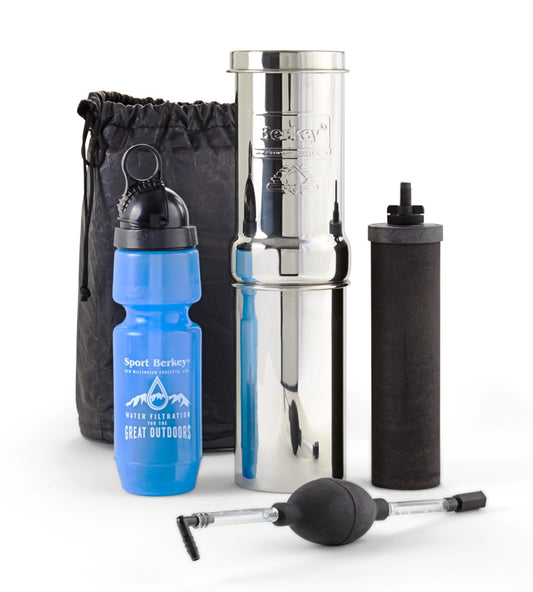
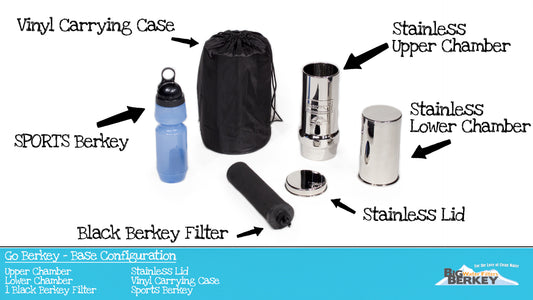
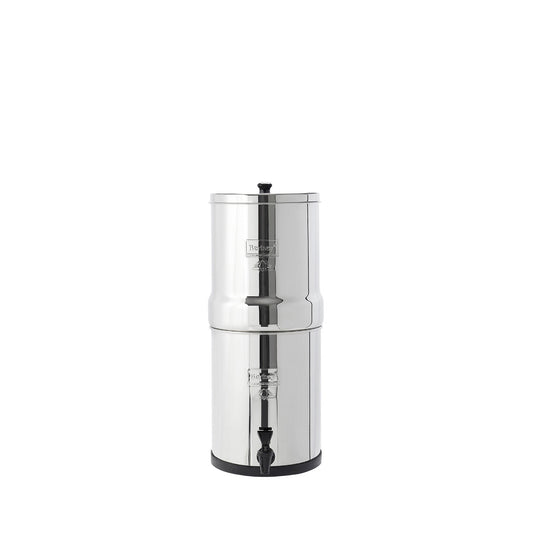
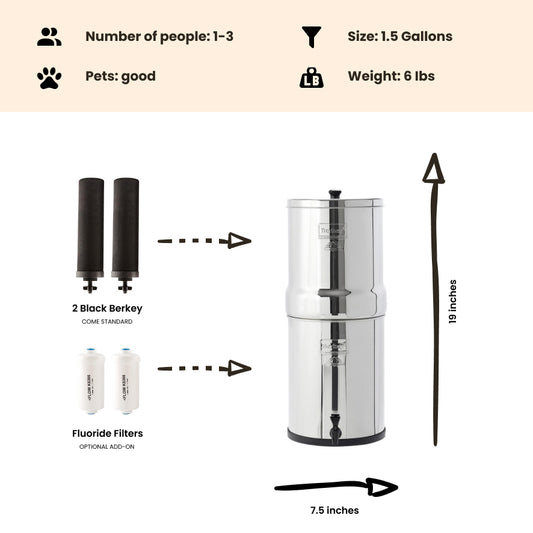
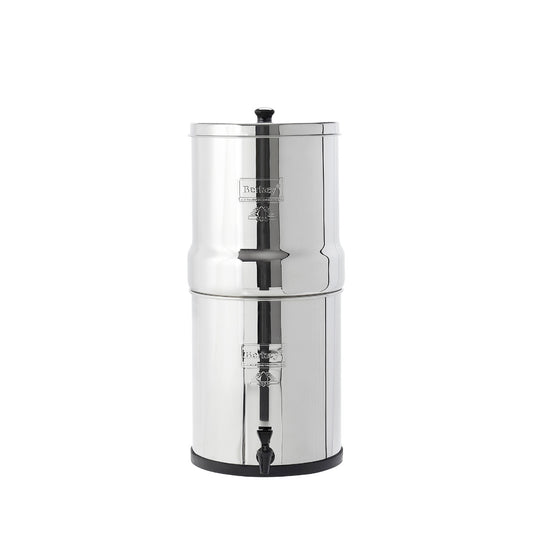
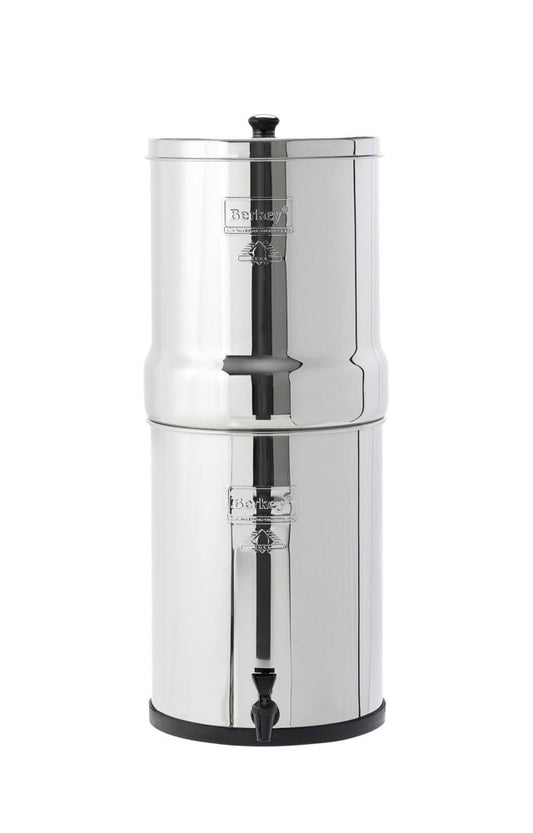
Berkey gravity systems ship standard with Black Berkey filter elements, which are tested by independent EPA-accredited labs to NSF/ANSI standards across 200+ contaminants with publicly available downloadable PDFs. The current replacement element, the Phoenix Gravity New Millennium Edition, carries NSF/ANSI 42 and 372 certifications from NABL-accredited laboratories and is also tested across 200+ contaminants. Culligan MaxClear is a newer gravity system built on the ProOne filter platform that Culligan acquired, with IAPMO certifications to NSF/ANSI 42, 53, and 401 for 14 certified reductions across 13 named contaminants, per Culligan's product page. Both are stainless steel countertop systems with no plumbing or electricity required. The key differences are filter lifespan (6,000 gallons per pair for Black Berkey vs. 150 gallons maximum for MaxClear with three filters), cost per gallon ($0.02 vs. $1.05 to $1.38, per Culligan's product page), and the scope of independent testing documentation available to buyers.
This comparison covers testing credentials, certifications, filter lifespan, long-term cost, and what each system's lab documentation actually shows, so you can evaluate the claims both brands make.
Quick Verdict
Berkey is the stronger choice for most households based on filter lifespan, cost per gallon, and depth of independent lab documentation. Black Berkey Elements, the standard included filter, are tested across 200+ contaminants by EPA-accredited labs with public downloadable PDFs. Phoenix Elements, the current replacement option, are NSF/ANSI 42 and 372 certified and also tested across 200+ contaminants.
Culligan MaxClear holds IAPMO certifications to NSF/ANSI 53 for lead and total PFAS, and NSF/ANSI 401 for microplastics and specific emerging contaminants, a genuine certification advantage for buyers who want a formal certification body stamp on those specific claims.
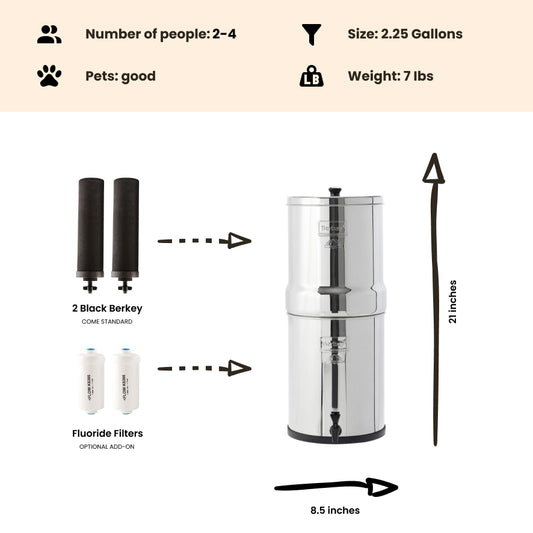
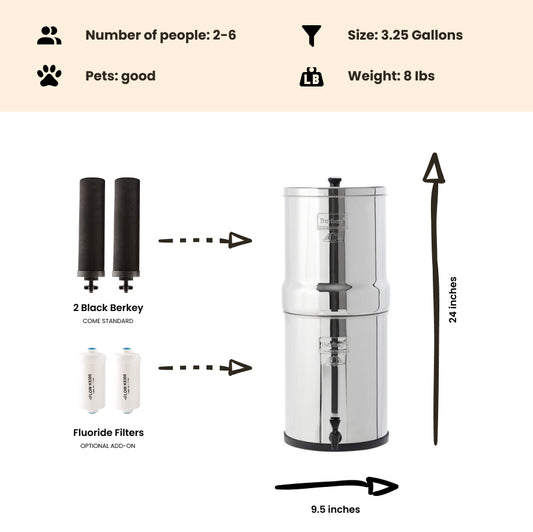
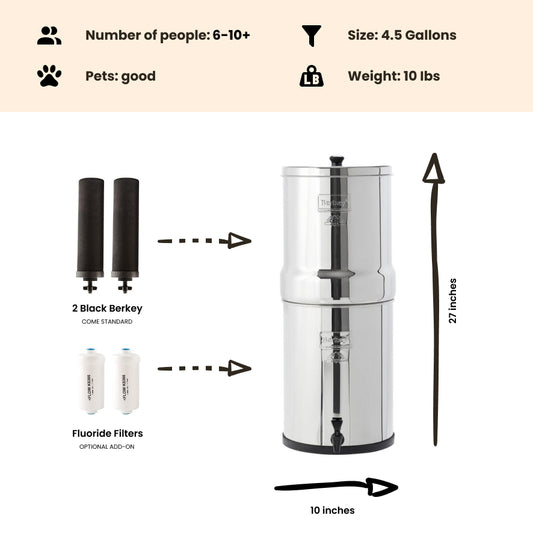
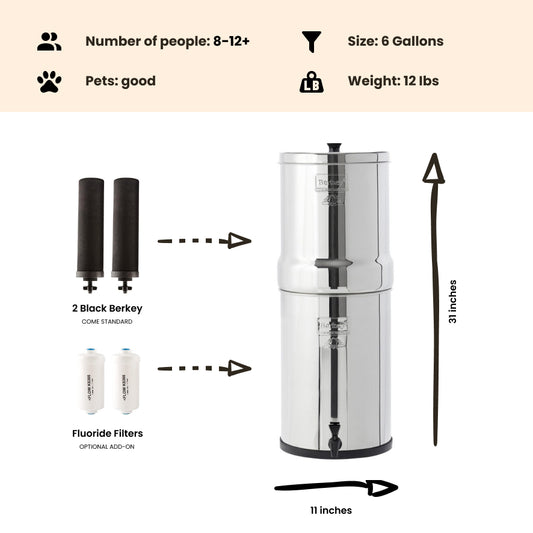
The tradeoff: MaxClear filter replacement costs run $1.05 to $1.38 per gallon, per Culligan's product page, vs. approximately $0.02 per gallon for Berkey. On system sizing, the Culligan Scout (2.25 gal) is a direct match for the Big Berkey (2.25 gal), and the Venture (3 gal) is comparable to the Royal Berkey (3.25 gal).
Brand Background: Who Makes Each System
Berkey gravity filters have been manufactured and distributed by New Millennium Concepts Ltd. (NMCL) since 1998. The systems have built a long-standing presence in the gravity filtration category, with independent testing spanning multiple decades and a public documentation library that includes downloadable lab reports from EPA-accredited third-party facilities. Current filter elements, the Phoenix Gravity New Millennium Edition, are tested and certified through NABL-accredited, ISO/IEC 17025:2017 laboratories.
Culligan is a water treatment company founded in 1936, primarily known for whole-home water softeners and water delivery. The MaxClear gravity filter product line is built on the ProOne filter platform, specifically the ProOne G3.0 filter line that Culligan acquired. If you've researched ProOne filters or Propur (ProOne's earlier name), the MaxClear filter is the same platform relaunched under Culligan's brand with additional certifications added. Propur was a former authorized Berkey dealer who left to launch their own competing gravity filter brand. We covered the original system in our Berkey vs. ProOne comparison.
Culligan also sells ZeroWater pitcher and dispenser products under the Culligan brand following their ZeroWater acquisition, and a legacy pitcher line. Those products are a different category entirely from the MaxClear gravity system, aimed at pitcher buyers rather than countertop gravity system buyers. We compared those products in our Berkey vs. Culligan ZeroWater and Legacy Pitchers article. Culligan's own website positions MaxClear as a direct Berkey alternative, including a dedicated comparison page targeting Berkey customers. Their core claim is that MaxClear holds formal IAPMO certifications where Berkey does not. That claim is partially accurate and worth examining in detail.
Quick Comparison: Berkey vs. Culligan MaxClear
Scroll right to see full comparison ->
| Feature |
Berkey (Black Berkey Standard) |
Culligan MaxClear |
| Filter Lifespan |
6,000 gal/pair (Black Berkey, standard); 5,500 gal/pair (Phoenix, current replacement) |
50 gal/filter to maintain certified performance; 6 months regardless of use; 150 gal max with 3 filters |
| Cost Per Gallon |
~$0.02 |
$1.05 (6-pack pricing) to $1.38 (single-filter pricing), per Culligan's product page |
| Replacement Filter Price |
Black Berkey: $166/pair (legacy, unavailable); Phoenix: $120/pair (current replacement) |
$69/single; $314/6-pack ($52.33 each), per Culligan's product page |
| System Pricing |
Big Berkey (2.25 gal) from $367; Royal Berkey (3.25 gal) from $408; see all systems
|
Scout (2.25 gal): $175 Starter Pack with 1 filter; Venture (3 gal): $199 Starter Pack with 1 filter, per Culligan's product page |
| Certifications |
Black Berkey: tested to NSF/ANSI standards by EPA-accredited labs (not certified); Phoenix: NSF/ANSI 42 and 372 (NABL-accredited) |
IAPMO: NSF/ANSI 42, 53, 401 and 372 |
| Certified Contaminant Scope |
Black Berkey: tested across 200+ contaminants (not formally certified); Phoenix certified: chlorine, taste/odor, lead-free materials |
14 certified reductions across 13 named contaminants plus a particulates class, per Culligan's product page |
| Independent Testing Scope |
200+ contaminants (both filter lines); public downloadable PDFs |
Certifications report; no full raw lab PDF library |
| PFAS Testing |
Black Berkey: PFOA directly tested at 99.9%+ reduction (below 2 ppt, below EPA's 4 ppt MCL); 8 additional PFAS compounds via surrogate methodology, all at 99.9%+; downloadable PDFs. Phoenix: 7 PFAS compounds independently tested at 99.8%+ (PFOA, PFOS, PFNA, PFDA, PFHxS, PFHpA, PFBS); PFOA and PFOS sustained through 1,500 liters of continuous testing; downloadable PDFs. |
NSF/ANSI 53 certified for total PFAS reduction |
| Microplastics |
Not independently certified to NSF 401 |
NSF/ANSI 401 certified (96.5% reduction) |
| Filter Media |
Black Berkey: proprietary blend of 6+ media types; four mechanisms (microfiltration, adsorption, absorption, ion exchange). Phoenix: CTC-60 coconut shell GAC, solid carbon block with nanofiber composite |
Ceramic shell + carbon block + GAC |
| Fluoride Reduction |
With optional PF-2 fluoride add-on filters (up to 99.75% reduction) |
Not certified; removed in independent lab testing |
| Flow Rate |
Up to 3.5 GPH when upper chamber stays full; full batch approximately 2-2.5 hours |
0.3 GPH (3 filters, independent Tap Score testing); full batch approximately 8 hours. Culligan's manual rates the system's service flow at 4.0 gallons per day. |
| System Warranty |
Manufacturer warranty; contact dealer |
5 years on stainless steel system components; filter elements and their performance are not covered, per Culligan's manual |
| Filter Priming Required |
Yes (approximately 5-10 min first use) |
No priming or soaking; Culligan's manual recommends running three cycles of cool water through a new filter and discarding each before use |
Independent Testing and Certifications: What Each Brand Actually Has
Culligan says MaxClear is certified and Berkey is not. That's partially true, but it leaves out important context. There's a meaningful difference between a product being formally certified by an outside organization and a product being independently tested by an accredited lab to the exact same standards. Both matter. They're just different things.
What Culligan MaxClear Is Certified For
MaxClear holds IAPMO certifications to four NSF/ANSI standards:
NSF/ANSI 42 NSF/ANSI 53 NSF/ANSI 401 NSF/ANSI 372
Here is what each certification actually covers in plain terms. NSF 42 covers taste, odor, and chlorine reduction. NSF 53 is the health standard; it covers lead and PFAS (forever chemicals). NSF 401 covers specific emerging contaminants; MaxClear's certification under this standard applies to four pharmaceutical compounds and three pesticides by name, not the full pharmaceutical or pesticide categories. NSF 372 confirms the system itself does not leach lead into your water. Across all four standards, Culligan's product page lists 14 certified reductions covering 13 named contaminants plus a particulates class. Certified reduction rates include chlorine at 99.4%, chloramine at 99.6%, particulates (Class I) at 96.5%, lead at 99.1% to 99.2% depending on water pH, and total PFAS at 99.6%.
Culligan markets this as certified reduction of "pharmaceuticals and pesticides." That description is accurate for those specific seven compounds. It does not represent certification across the full pharmaceutical or pesticide categories.
What Berkey Has: Testing vs. Certification
Think of it this way. Certification means an outside organization like IAPMO or NSF formally tested the product, keeps tabs on it over time, and puts their name on the result. Independent lab testing means a separate accredited lab ran the same tests using the same standards, but without an organization formally certifying and monitoring the product on an ongoing basis. The test methodology can be identical. The difference is whether a certifying body is officially vouching for it.
Here is where each Berkey filter line stands:
Black Berkey Elements: Every new Berkey system ships with Black Berkey Elements while supplies last. Black Berkey Elements are not sold as standalone replacements; the authorized replacement is the Berkey Phoenix Element. Black Berkey Elements were tested by independent EPA-accredited third-party laboratories to NSF/ANSI standards, the same methodology the certification bodies use, with results covering 200+ contaminants, including PFOA directly tested at 99.9%+ reduction and 8 additional PFAS compounds via surrogate methodology, all at 99.9%+. That independent testing documentation is available as downloadable PDFs at our test results page.
Phoenix Gravity New Millennium Edition Elements are the filter that ships in Berkey systems today. They are formally certified to NSF/ANSI 42 and NSF/ANSI 372 through internationally accredited laboratories, meaning the certifications meet rigorous global lab standards. Phoenix Elements are also independently tested across 200+ contaminants with full results available as downloadable PDFs on our Phoenix lab results page. Additional independent testing is currently underway, with expanded results expected soon.
When Culligan states that "Berkey lacks transparent testing," the opposite is arguably true. Berkey publishes full contaminant-by-contaminant lab results as free downloadable PDFs covering 200+ contaminants, tested by accredited independent facilities. MaxClear links to a certifications report page. The distinction here is not transparency. It is the difference between formal certification by a third-party body and independently accredited lab testing with every result publicly documented.
MaxClear is certified for 14 specific reductions across 13 named contaminants by IAPMO, a legitimate third-party certification body. Both Berkey filter lines have been independently tested across 200+ contaminants, with all results available as free downloadable PDFs. Phoenix Elements also carry formal NSF/ANSI 42 and 372 certifications. The bottom line: MaxClear has a narrower but formally certified scope. Berkey has a much broader testing record that is publicly documented.
PFAS Testing: Certified vs. Documented
MaxClear holds NSF/ANSI 53 IAPMO certification for total PFAS reduction. That is a genuine credential and one that neither Phoenix nor Black Berkey Elements match at the formal certification level.
What both Berkey filter lines do have is independently documented PFAS testing that goes well beyond MaxClear's certified scope. Black Berkey Elements were independently tested with PFOA directly at 99.9%+ reduction (below 2 ppt, below the EPA's 4 ppt MCL), and 8 additional PFAS compounds including PFOS, PFNA, PFBS, and PFHxS evaluated via surrogate methodology, all at 99.9%+. Full results are published as downloadable PDFs. Phoenix Elements carry their own independent PFAS test documentation covering 7 compounds (PFOA, PFOS, PFNA, PFDA, PFHxS, PFHpA, and PFBS) at 99.8%+ initial reduction, plus a dedicated 1,500-liter PFAS endurance test for PFOA and PFOS conducted by NABL-accredited RAYNU Lab showing sustained reduction with output below the 0.005 µg/L detection limit at every checkpoint. Results are available as downloadable PDFs. MaxClear's certification covers total PFAS as a category but does not publish equivalent compound-by-compound lab reports showing tested concentrations and reduction percentages across a defined list. Buyers who want a formal certification stamp will find MaxClear has it. Buyers who want to see the full contaminant-level lab documentation will find Berkey's published record runs deeper.
Third-Party Media Recognition
Berkey's coverage in independent media is documented and verifiable. The Environmental Working Group rated the Travel Berkey "Best Overall" in their PFAS water filter guide. Food Network featured Berkey in their water filter review. CBS News covered Berkey in connection with EWG's PFAS testing work. The Prepared, Quality Edit, and LA Times have each covered or referenced Berkey systems. Every source links back to the original article on our Media Coverage page.
Culligan's MaxClear product line is newer, launched under the Culligan brand in 2024-2025 following the ProOne acquisition. Independent media reviews of MaxClear exist, though Culligan does not display the same depth of third-party editorial coverage for MaxClear specifically as Berkey has accumulated over 25 years.
Feature Comparisons
Filter Lifespan
This is the most consequential practical difference between the two systems.
Black Berkey Elements are rated for 6,000 gallons per pair. Phoenix Elements, the current replacement, are rated for 5,500 gallons per pair. For a household using one gallon of filtered water per day, a single pair of Phoenix Elements covers more than 15 years of use before replacement.
MaxClear filters have two replacement rules: replace after 50 gallons, or after 6 months, whichever comes first. Per Culligan's product pages, the Scout Starter Pack ships with one filter and the system is certified for use with up to two filters (100 gallons maximum), while the Venture Starter Pack also ships with one filter and the system is certified for up to three filters (150 gallons maximum). The 50-gallon number is the one that matters most if certifications are the reason you chose MaxClear. That's the point at which Culligan's certified performance claims apply. Beyond 50 gallons, the filter may still work, but you're no longer within the tested and certified conditions for PFAS, lead, and microplastics removal. If you replaced at 6 months but used less than 50 gallons, you're fine on certification. If you push past 50 gallons to try to stretch filter life, you've left the certified window. For a household using one gallon per day, 50 gallons runs out in about 50 days, so the 6-month mark never comes into play anyway. Lighter users filtering less than a third of a gallon per day will hit the 6-month mark first.
The lifespan gap is not marginal. One pair of Black Berkey elements covers roughly the same volume as 120 MaxClear filters. Even Phoenix Elements at 5,500 gallons cover the equivalent of 110 MaxClear filters.
Flow Rate
Independent Tap Score certified laboratory testing published in early 2026 recorded MaxClear at 0.3 GPH with all three filters installed, meaning a full upper chamber takes approximately 8 hours to filter through. That testing noted it was among the slowest flow rates of any gravity filter evaluated in that category.
Berkey's rated flow of up to 3.5 GPH applies when the upper chamber stays continuously full. For an apples-to-apples full-batch comparison, a Big Berkey with two Black Berkey elements filters a full load in approximately 2 to 2.5 hours, compared to approximately 8 hours for the Venture with three MaxClear filters. For households that refill frequently or need filtered water on demand, that difference is significant.
Fluoride Reduction
Neither system reduces fluoride as a standard configuration. Berkey offers optional PF-2 fluoride reduction filters as an add-on. MaxClear does not have a fluoride add-on option. Independent Tap Score certified laboratory testing did find that MaxClear removed 100% fluoride in the specific tap water sample tested, but this is not a certified claim and results will vary by water source.
Filter Media
This is where Black Berkey Elements stand apart from most gravity filters on the market, including MaxClear. Most gravity filters use a single filtration mechanism. Black Berkey Elements use four simultaneously.
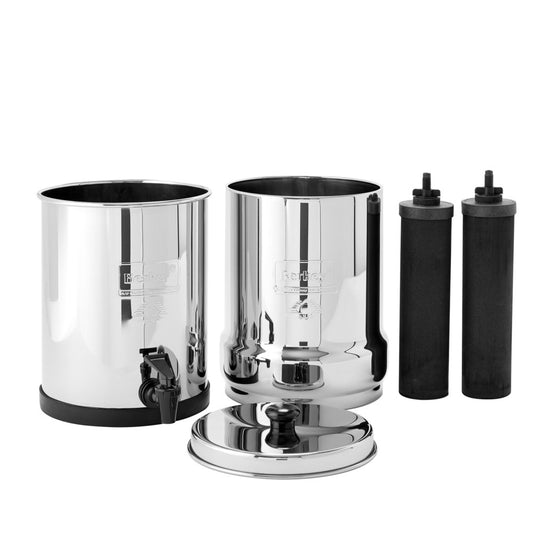
Water passing through a Black Berkey element moves through a proprietary blend of more than six different media types packed into a dense matrix with millions of microscopic pores. As it travels that tortuous path, four things happen at once. Microfiltration physically blocks particulates, sediment, and colloids that cannot pass through the pores. Adsorption causes the activated carbon component to chemically bond with and extract organic contaminants including chlorine, chloramines, VOCs, PFAS, pharmaceuticals, pesticides, and herbicides. Absorption draws certain contaminants into the body of the media itself rather than just trapping them on the surface. Ion exchange electrochemically bonds heavy metal ions like lead, mercury, and arsenic to the media, pulling them out of the water. The filter also incorporates silver as a preservative within the media itself.
Berkey does not publish the exact media formula because it is proprietary. What they do publish is the output: independent lab testing across 200+ contaminants, with results documented in downloadable PDFs.
Phoenix Gravity New Millennium Edition Elements use a different construction: CTC-60 coconut shell granular activated carbon in a solid carbon block with a nanofiber composite. The solid block design keeps internal pores consistent and maintains reliable flow. Phoenix carries a 1-micron nominal particle rating and NSF/ANSI 42 and 372 certifications. It performs closely to Black Berkey in everyday gravity use while being the currently available filter.
MaxClear uses a three-layer approach: a ceramic outer shell, a high-flow carbon block core, and granular activated carbon. The ceramic layer handles mechanical filtration of particulates and microplastics. The carbon layers handle chemical contaminant reduction. It is a solid, well-designed filter media stack. The key difference from Black Berkey is that MaxClear's ceramic construction operates on two mechanisms (mechanical filtration plus carbon adsorption) where Black Berkey's proprietary multi-media blend operates on four.
Setup and Maintenance
MaxClear filters require no priming or soaking. Culligan's manual instructs running three cycles of cool water through a new filter, discarding each cycle, before regular use. That is a genuine convenience advantage over Berkey, which requires approximately 5-10 minutes of priming for new filter elements.
MaxClear's ceramic outer shell can be scrubbed clean when flow slows, a standard maintenance step for ceramic-based gravity filters. Berkey elements are also cleanable by scrubbing under running water with a ScotchBrite pad.
Long-Term Value: The 5-Year Cost Comparison
Upfront system prices are only part of the cost picture for gravity filters. Because filter replacement is the ongoing expense, the cost-per-gallon calculation over time is the number that actually matters.
The figures below are based on one gallon of filtered water per day, where the 50-gallon certified performance limit is the binding replacement trigger. At that usage level, filters exhaust their certified capacity roughly every 50 days. For lighter-use households where the 6-month schedule drives replacement instead, annual filter costs are lower: approximately $209-$276 per year for the Scout and $314-$414 per year for the Venture. Keep in mind that stretching beyond 50 gallons means operating outside the certified performance window, which matters if certifications were your reason for choosing MaxClear in the first place. The cards below reflect the 1 gal/day scenario.
Scout (2.25 gal) vs. Big Berkey (2.25 gal)
Big Berkey
5-year total (system + filters, 1 gal/day)
$367 to $487
System upfront (with 2 Black Berkey elements)$367
Black Berkey lifespan6,000 gal/pair
Years before replacement at 1 gal/day16+ years
5-year filter cost$0 to $120
Cost per gallon~$0.02
Culligan MaxClear Scout
5-year total (system + filters, 1 gal/day)
~$2,085 to $2,694
System upfront (Starter Pack, includes 1 filter)$175
Filter lifespan50 gal each OR 6 months; 100 gal max with 2 filters
Replacements/year at 1 gal/day (gallon limit)~7 single filters
Replacements/year at 6-month schedule4 filters (2 sets)
Filter cost at 1 gal/day (6-pack)~$382/year
Filter cost at 6-month schedule (6-pack)~$209/year
5-year filter cost (1 gal/day)~$1,910 to $2,519
Cost per gallon$1.05 to $1.38
Venture (3 gal) vs. Royal Berkey (3.25 gal)
Royal Berkey
5-year total (system + filters, 1 gal/day)
$408 to $528
System upfront (with 2 Black Berkey elements)$408
Black Berkey lifespan6,000 gal/pair
Years before replacement at 1 gal/day16+ years
5-year filter cost$0 to $120
Cost per gallon~$0.02
Culligan MaxClear Venture
5-year total (system + filters, 1 gal/day)
~$2,109 to $2,718
System upfront (Starter Pack, includes 1 filter)$199
Filter lifespan50 gal each OR 6 months; 150 gal max with 3 filters
Replacements/year at 1 gal/day (gallon limit)~7 single filters
Replacements/year at 6-month schedule6 filters (2 sets)
Filter cost at 1 gal/day (6-pack)~$382/year
Filter cost at 6-month schedule (6-pack)~$314/year
5-year filter cost (1 gal/day)~$1,910 to $2,519
Cost per gallon$1.05 to $1.38
At best-case MaxClear filter pricing (6-pack at $52.33 per filter, per Culligan's product page), five years of filter costs at one gallon per day comes to approximately $1,910. At single-filter pricing of $69 each, that same period runs approximately $2,519. Neither MaxClear system requires a replacement during the first year, but the 50-gallon-per-filter capacity means filter expenses accumulate quickly regardless of system size. The Venture runs the same filter cost as the Scout since the per-filter lifespan and price are identical.
The Big Berkey at $367 and Royal Berkey at $408 both ship with Black Berkey elements rated for 6,000 gallons per pair. At one gallon per day, that pair lasts over 16 years before replacement is needed. The 5-year ownership cost assumes one Phoenix replacement pair ($120) as the ceiling. The 5-year total is $367 to $487 for the Big Berkey and $408 to $528 for the Royal Berkey, vs. $2,085 to $2,694 for the Scout and $2,109 to $2,718 for the Venture.
Frequently Asked Questions
Is Culligan MaxClear as good as Berkey?
MaxClear and Berkey are both legitimate gravity filtration systems, but they differ significantly in filter lifespan, cost per gallon, and testing depth. MaxClear holds IAPMO certifications to NSF/ANSI 53 (lead and PFAS) and NSF/ANSI 401 (microplastics and specific emerging contaminants) that Phoenix Elements do not currently match at the certification level. Berkey's filter documentation covers 200+ contaminants across publicly available lab PDFs from accredited independent labs, a broader testing record than MaxClear's 14 certified reductions across 13 named contaminants. For most households, the filter lifespan and cost difference (5,500 gallons per pair vs. 50 gallons per filter, and $0.02/gal vs. $1.05 to $1.38/gal, per Culligan's product page) is the decisive factor.
Is Culligan MaxClear NSF certified?
Yes. Culligan MaxClear filters are IAPMO certified to NSF/ANSI 42 (chlorine, taste/odor, particulates), NSF/ANSI 53 (lead and total PFAS), NSF/ANSI 401 (specific emerging contaminants including microplastics), and NSF/ANSI 372 (lead-free materials). The NSF 401 certification covers 7 specific compounds: four pharmaceuticals and three pesticides, not the full pharmaceutical or pesticide categories. Total certified contaminant scope is 14 certified reductions across 13 named contaminants, per Culligan's product page.
Is Berkey NSF certified?
Black Berkey Elements are not formally certified by a certification body, but were independently tested by EPA-accredited third-party laboratories to NSF/ANSI standards with results covering 200+ contaminants, including PFOA directly tested at 99.9%+ reduction and 8 additional PFAS compounds via surrogate methodology, all at 99.9%+, with those reports publicly available for download. Phoenix Gravity New Millennium Edition Elements, the current shipping standard, are NSF/ANSI 42 and NSF/ANSI/CAN 372 certified through NABL-accredited ISO/IEC 17025:2017 laboratories and are also independently tested across 200+ contaminants.
How long do Culligan MaxClear filters last?
Each MaxClear filter is rated for 50 gallons. The Venture system supports up to three filters for a maximum of 150 gallons before full replacement. Culligan recommends replacing filters every six months. At one gallon per day of household use, a single filter lasts approximately 50 days. By comparison, Phoenix Elements are rated for 5,500 gallons per pair, roughly the equivalent of 110 MaxClear filters.
What is the cost per gallon for Culligan MaxClear vs. Berkey?
MaxClear's cost per gallon ranges from $1.05 (6-pack pricing at $52.33 per filter) to $1.38 (single filter at $69), per Culligan's product page. Berkey Black Berkey elements and Phoenix Elements both cost approximately $0.02 per gallon. At one gallon per day for five years, MaxClear filter costs total $1,910 to $2,519. Berkey filter costs for that same period are $0 to $120, assuming up to one Phoenix replacement pair ($120) over five years. At one gallon per day, neither Black Berkey (6,000 gal) nor Phoenix (5,500 gal) elements require replacement during a five-year window.
Does Culligan MaxClear remove PFAS?
Yes. MaxClear filters are IAPMO certified to NSF/ANSI 53 for total PFAS reduction. Culligan states 99.6% total PFAS reduction. Black Berkey Elements were independently tested with PFOA directly at 99.9%+ reduction and 8 additional PFAS compounds via surrogate methodology, all at 99.9%+, with results documented in publicly available lab PDFs. Phoenix Elements also carry independent PFAS test documentation covering 7 compounds (PFOA, PFOS, PFNA, PFDA, PFHxS, PFHpA, and PFBS) at 99.8%+ initial reduction, plus a 1,500-liter sustained capacity test for PFOA and PFOS, with downloadable PDFs on the Phoenix lab results page.
What happened to ProOne, and is MaxClear the same filter?
Culligan acquired ProOne (formerly Propur), a Michigan-based gravity filter manufacturer. Propur was a former authorized Berkey dealer who left to launch their own independent gravity filter brand. The MaxClear Technology line is built on that ProOne filter platform, with additional IAPMO certifications added under Culligan's ownership. Per Culligan's ProOne FAQ page, ProOne products are being sold only while current inventory lasts, with MaxClear as the replacement product going forward. If you previously used ProOne filters in a ProOne system or a compatible gravity housing including Berkey, MaxClear filters are designed as the direct replacement. We compared ProOne and Berkey in detail in our Berkey vs. ProOne article.
How We Evaluated These Systems
This comparison is based on direct analysis of publicly available documentation from both brands, independent third-party lab testing, and published certification records. Here is what we examined.
Certifications: We verified Culligan MaxClear's IAPMO certifications directly against the NSF/ANSI standards they claim, including the specific contaminant scope of each standard. We verified Phoenix Elements' NSF/ANSI 42 and 372 certifications through NABL-accredited laboratory records. We confirmed Black Berkey testing was conducted by EPA-accredited third-party labs to the same NSF/ANSI methodology.
Lab documentation: We reviewed publicly available PDF lab reports for both Berkey filter lines at bigberkeywaterfilters.com, and reviewed Culligan's certifications report page. We assessed the number of contaminants tested, the accreditation level of the labs, and whether reports are downloadable by consumers.
Cost analysis: Filter costs were calculated using Culligan's published pricing for single filters ($69) and 6-pack pricing ($314), verified against Culligan's product page and replacement filter page as of September 2026. Berkey system pricing sourced from bigberkeywaterfilters.com. Cost-per-gallon figures use manufacturer-stated filter lifespan ratings at standard household usage of one gallon per day.
Independent review data: Flow rate and lab testing anomaly data referenced from independent Tap Score certified laboratory analysis conducted on Culligan's own Venture system with MaxClear filters installed, published in early 2026.
What we did not test: We did not conduct our own in-home filtration tests. All performance data is sourced from manufacturer documentation, certified lab reports, and published third-party reviews. Buyers who want additional independent verification can access all referenced Berkey lab reports at our test results page.
Verdict: Which Gravity Filter Is Right for You
MaxClear is a well-made system with real credentials. The IAPMO certifications for PFAS and microplastics are legitimate, the stainless steel construction is solid, and the no-priming setup is genuinely convenient. If your primary concern is having a formal certification body stamp on PFAS and microplastics reduction in a gravity system, and you're comfortable with the ongoing filter replacement cost, MaxClear delivers on those specific claims.
For most buyers, the filter economics are the deciding factor. At $1.05 to $1.38 per gallon, per Culligan's product page, vs. $0.02 per gallon, the cost difference compounds quickly. A household using one gallon per day pays approximately $1,910 to $2,519 in MaxClear filter costs over five years. The same household on Berkey pays $0 to $120 in filter costs over five years, assuming up to one Phoenix replacement pair as the ceiling. Neither filter line requires replacement at one gallon per day within a five-year window, making the real-world cost closer to $0 for most households.
Berkey's independent testing record also covers substantially more ground: 200+ contaminants across publicly downloadable PDFs, compared to MaxClear's 14 certified reductions across 13 named contaminants. For buyers who want to see exactly what a filter does and does not reduce across a wide range of compounds, the documentation depth matters.
The one area where MaxClear holds a genuine technical edge over current Berkey offerings is the combination of NSF/ANSI 53 PFAS certification and NSF/ANSI 401 microplastics certification in a gravity system. Phoenix Elements do not currently carry NSF 53. If those specific certifications are a hard requirement for your purchasing decision, MaxClear is the only gravity system currently certified for both.
For everyone else, Berkey's cost-per-gallon advantage of roughly 50 to 69 times, deeper testing documentation, and longer-established independent lab record make it the stronger choice.
Ready to Compare for Yourself?
Review Black Berkey and Phoenix Elements lab results and independent test documentation, then decide.


 By
Dan DeBaun
By
Dan DeBaun