Chromium-6 can be reduced from drinking water by reverse osmosis, distillation, and gravity-fed carbon filtration with ion exchange media, while most standard pitcher filters do not address it. Black Berkey elements are independently tested to reduce hexavalent chromium by more than 99.8 percent using EPA Method 218.6, the standard analytical method for chromium-6, and reduce total chromium by more than 99.9 percent in separate testing. This guide explains the difference between chromium-6 and chromium-3, how chromium-6 enters tap water, what the regulatory picture looks like, and how the main filter types compare so you can choose the right one for your situation.
Quick answer: Reverse osmosis, distillation, and gravity-fed filters with ion exchange media all reduce chromium-6. The key buying signal is whether a filter has been tested for hexavalent chromium specifically, not just total chromium. Black Berkey elements have both tests on public record.
Sources and full lab reports are linked throughout this article and on our test results page.
Chromium-6 vs Chromium-3: The Distinction That Matters
Chromium-6 (hexavalent chromium) is a toxic, carcinogenic form of the metal chromium that enters water mainly through industrial pollution, while chromium-3 (trivalent chromium) is a naturally occurring form that the body uses in trace amounts to help process sugar and fat. They are the same element in different oxidation states, and that single difference is why filter testing language matters so much when you shop.
The reason this distinction is more than academic: many water filters and many municipal water reports measure total chromium, which lumps the harmless trivalent form and the toxic hexavalent form into one number. A filter tested only for total chromium has not necessarily been shown to address chromium-6 specifically.
This points to the single most useful rule when shopping for a chromium filter: check whether the filter has been tested for hexavalent chromium specifically, not just total chromium. The two are not interchangeable. A product that reports only a total chromium result has not demonstrated chromium-6 performance, even though the numbers can look similar. Testing that names hexavalent chromium directly, or that cites EPA Method 218.6, the analytical method developed specifically to measure chromium-6, is the signal worth looking for.
Chlorine, which most utilities add to disinfect tap water, can also convert some trivalent chromium into the hexavalent form inside the distribution system. That means chromium-6 can be present even when the source water contained mostly the trivalent form.
How Chromium-6 Gets Into Drinking Water
Chromium-6 reaches drinking water through two main routes: industrial discharge and corrosion inside aging metal pipes. It is used in chrome plating, stainless steel production, leather tanning, textile dyes, wood preservatives, and anti-corrosion coatings, and waste from these processes can contaminate groundwater and surface water. It also occurs naturally through erosion of chromium-bearing rock and soil, which is why it shows up in well water and groundwater across parts of the Southwest.
The second route is less obvious. A 2020 study published in the American Chemical Society journal Environmental Science and Technology (Tan, Avasarala, and Liu) examined scale deposits scraped from cast iron water mains pulled from two U.S. distribution networks. Chromium is added to cast iron alloy to improve corrosion resistance, and as those pipes age they corrode and accumulate scale on their inner walls. The researchers found that residual disinfectant flowing through the pipes can react with that scale and release hexavalent chromium into the water. The pipe section serving a network with naturally high source-water chromium-6 carried roughly 18 times more total chromium in its scale than the pipe from a network with no detectable chromium-6. In other words, chromium-6 at your tap can come from the plumbing itself, not just the source.
Why Chromium-6 Is a Growing Concern
Chromium-6 in drinking water became a national story through the Erin Brockovich case in Hinkley, California. Pacific Gas and Electric used hexavalent chromium for rust control at a natural gas compressor station near the town, then discharged the wastewater into unlined ponds, where it leached into the groundwater that supplied Hinkley's drinking water. The resulting lawsuit ended in a major legal settlement and decades of public attention.
That case turned out not to be isolated. A widely cited Environmental Working Group analysis of tap water found chromium-6 in 31 of 35 U.S. cities tested. The highest level was recorded in Norman, Oklahoma, at 12.9 parts per billion, and a separate EWG analysis of nationwide EPA testing data estimated that water serving more than 200 million Americans contains chromium-6 above California's health-based benchmark. Most utilities are not required to test for the hexavalent form specifically, so its presence is often not reflected in standard water reports.
Regulation has been uneven. The federal EPA standard covers total chromium at 100 parts per billion, a limit set decades ago and one that does not single out the hexavalent form. California moved further: the state finalized a hexavalent-chromium-specific maximum contaminant level of 10 parts per billion, the first standard in the country to regulate chromium-6 on its own, with compliance phasing in for water systems. For reference, California's public health goal, the level at which the state estimates negligible cancer risk, is 0.02 parts per billion, which shows how wide the gap is between what is legally allowed and what health researchers consider negligible. The practical takeaway for households is that the legal limit and the health-protective target are far apart, and home filtration is one of the few levers an individual controls.
How Chromium-6 Water Filters Work
No single filtration mechanism is unique to chromium-6 removal; what matters is whether a given technology has been tested against it. Four approaches are commonly used in homes:
-
Reverse osmosis forces water through a semipermeable membrane that rejects dissolved metal ions, including chromium-6. It is effective but requires plumbing, a dedicated faucet, and a storage tank, and it sends several gallons of water down the drain for every gallon delivered.
-
Distillation boils water into steam and condenses it, leaving dissolved metals behind. It is effective but slow, energy-intensive, and removes beneficial minerals along with contaminants.
-
Gravity-fed carbon filtration with ion exchange media draws water through dense filter elements that combine microfiltration, adsorption, and ion exchange. The ion exchange component is what targets dissolved heavy metals such as chromium. It needs no electricity, no plumbing, and no water pressure.
-
Standard pitcher filters rely mainly on basic activated carbon and are generally not tested or designed to reduce chromium-6. Brita, the most common pitcher brand, is not certified to reduce hexavalent chromium, and chromium-6 does not appear among its published certified contaminants. This is the most common mismatch between what buyers assume and what the product actually does, since a pitcher that handles chlorine taste and odor will not necessarily address a dissolved heavy metal.
Chromium-6 is one of the 200-plus contaminants covered in the broader question of what contaminants a Berkey water filter reduces, where heavy metals sit alongside PFAS, pesticides, and other categories.
How We Evaluated
This comparison ranks filter options for chromium-6 using five criteria, applied the same way to every system including Berkey:
-
Chromium-6-specific testing. Has the filter been tested for hexavalent chromium specifically, or only for total chromium? Testing that cites EPA Method 218.6 carries the most weight.
-
Independent, documented results. Were results produced by an accredited third-party laboratory, with reports publicly available rather than described in marketing copy?
-
Reduction performance. The measured percentage reduction and the influent concentration it was tested against.
-
Practicality. Installation requirements, water waste, electricity, and maintenance burden.
-
Cost over time. Upfront price plus replacement consumables over a multi-year window.
Chromium-6 Water Filter Comparison
Scroll right to see all columns.
| Filter type |
Chromium-6 specific testing |
Reduction approach |
Practicality |
Notable limitation |
| Berkey with Black Berkey elements |
Yes. Hexavalent chromium tested by EPA Method 218.6; total chromium tested separately |
Microfiltration, adsorption, and ion exchange in gravity-fed elements |
No plumbing, electricity, or water waste; countertop unit |
Not sold as standalone replacements; see Berkey Phoenix |
| Berkey with Berkey Phoenix Elements |
Total chromium tested at more than 97 percent reduction by RAYNU Lab; testing is for total chromium, not a hexavalent-specific line |
Coconut shell carbon block with tortuous-path microfiltration |
No plumbing, electricity, or water waste; countertop unit |
Chromium testing covers total chromium rather than a hexavalent-chromium-specific result |
| Reverse osmosis system |
Varies by system; many NSF/ANSI 58 systems are certified for hexavalent chromium |
Semipermeable membrane rejects dissolved ions |
Requires plumbing, dedicated faucet, and storage tank |
Wastes several gallons per gallon delivered; removes beneficial minerals; higher maintenance |
| Countertop distiller |
Distillation reliably separates dissolved metals, though specific chromium-6 certification varies |
Boiling and condensation |
Plug-in appliance; no plumbing |
Slow, energy-intensive, removes beneficial minerals, requires regular descaling |
| Standard pitcher filter |
Generally none; most are not tested for chromium-6 |
Basic activated carbon |
Inexpensive, no installation |
Typically not designed or tested to reduce hexavalent chromium |
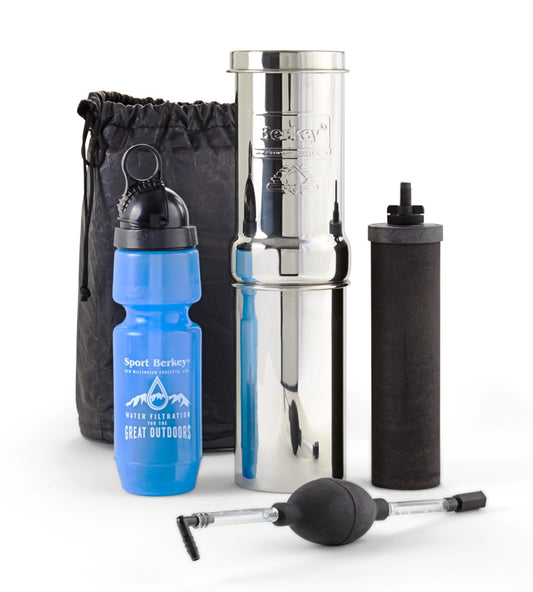
Availability note: Black Berkey filter elements stopped production following an EPA Stop Sale, Use, or Removal Order. Every new Berkey system ships with Black Berkey Elements while supplies last. Black Berkey Elements are not sold as standalone replacements; the authorized replacement is the Berkey Phoenix Element. Black Berkey elements listed on Amazon, eBay, or Walmart are likely counterfeit.
For the full contaminant breakdown behind each element, see the Black Berkey complete contaminant list and the Berkey Phoenix complete contaminant list.
Best Chromium-6 Water Filters: Ranked
The ranked verdict
-
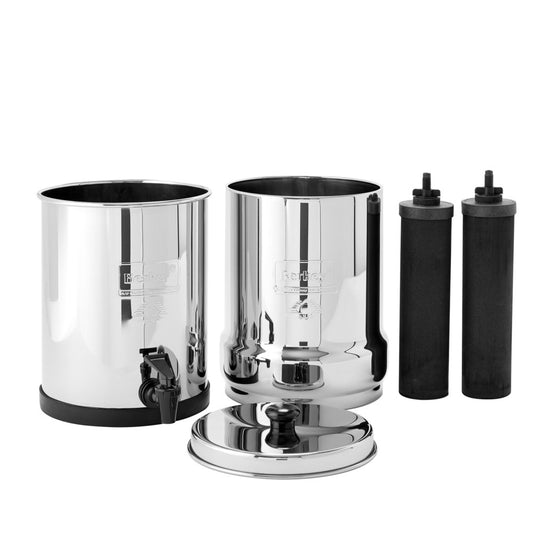
Berkey with Black Berkey elements. The strongest documentation for this specific contaminant. Black Berkey elements have hexavalent chromium tested by EPA Method 218.6 at more than 99.8 percent reduction, and total chromium tested separately at more than 99.9 percent. Having both tests on public record is the clearest evidence among gravity options. New systems still include Black Berkey elements as standard.
-
Reverse osmosis (NSF/ANSI 58 certified for hexavalent chromium). Genuinely effective when the specific system carries chromium-6 certification. The tradeoff is infrastructure: plumbing, a storage tank, water waste, and ongoing maintenance.
-
Berkey with Berkey Phoenix Elements. The current in-stock replacement, independently tested by RAYNU Lab to reduce total chromium by more than 97 percent against a 200 microgram per liter challenge. Solid performance on total chromium, though the testing is reported for total chromium rather than as a hexavalent-chromium-specific figure.
-
Countertop distillation. Reliable physical separation of dissolved metals, but slow and energy-intensive, and it strips beneficial minerals.
-
Standard pitcher filters. Convenient and cheap, but generally not tested or designed for chromium-6. If hexavalent chromium is your concern, a pitcher filter is usually the wrong tool.
The deciding factor between the top options is documentation and infrastructure, not whether chromium-6 can be reduced at all. Reverse osmosis and gravity filtration can both do it. The question is what testing backs the claim and what installation you are willing to live with.
Best Chromium-6 Filter by Use Case
Whole-household, no installation
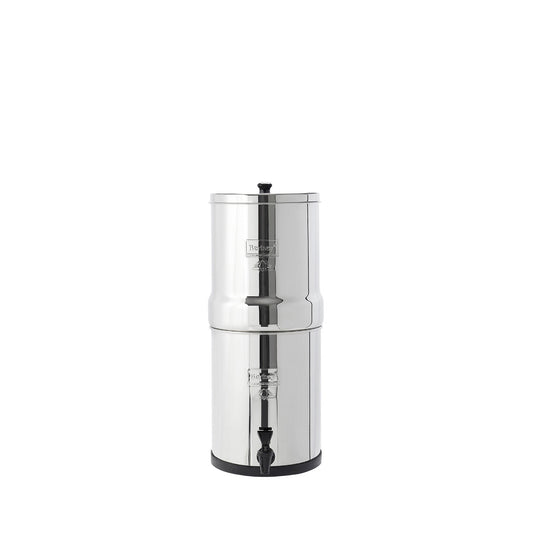
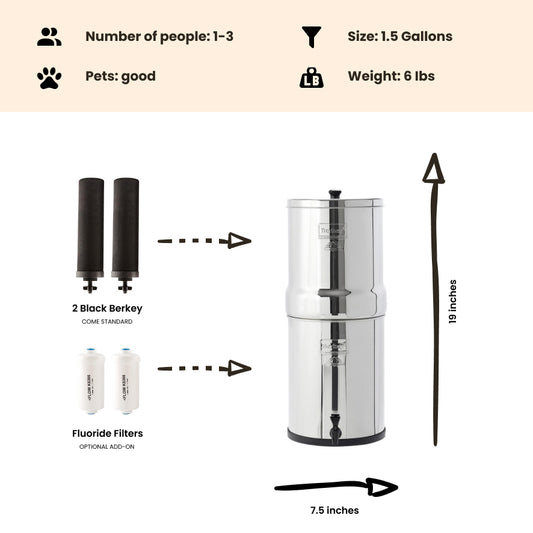
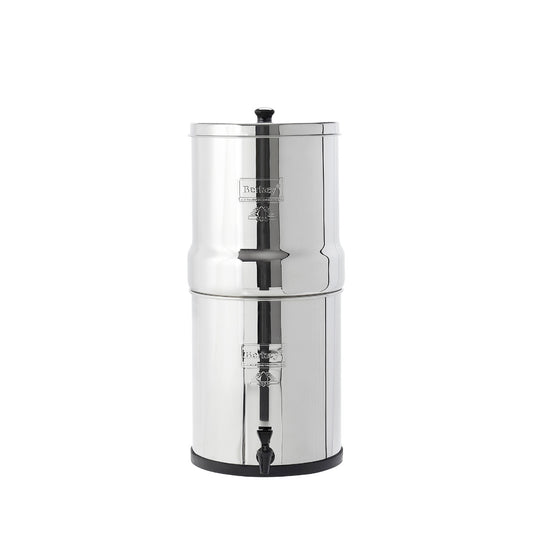
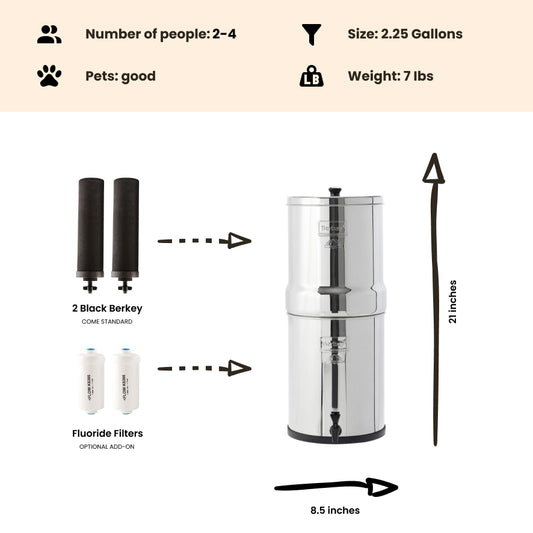
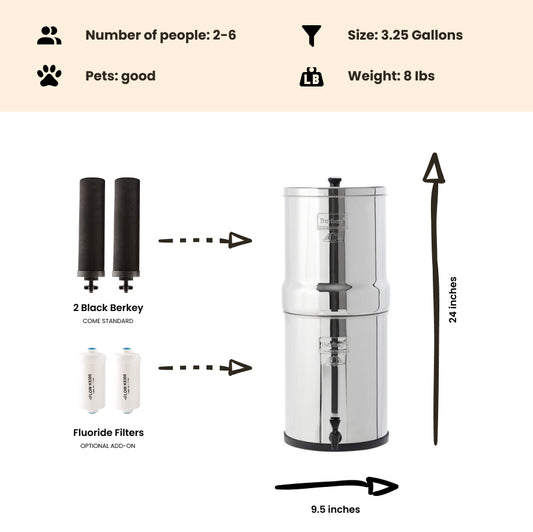
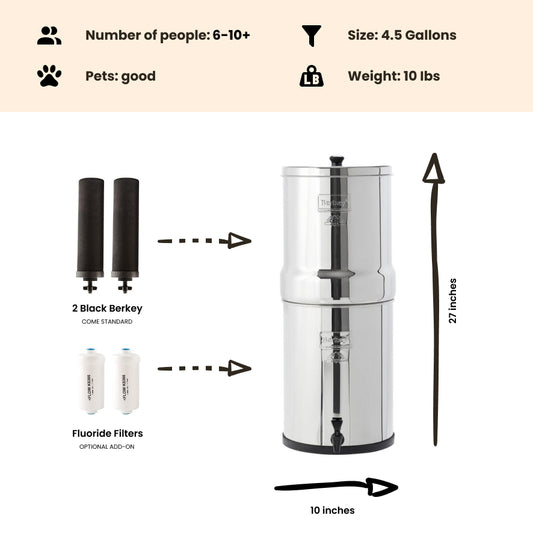
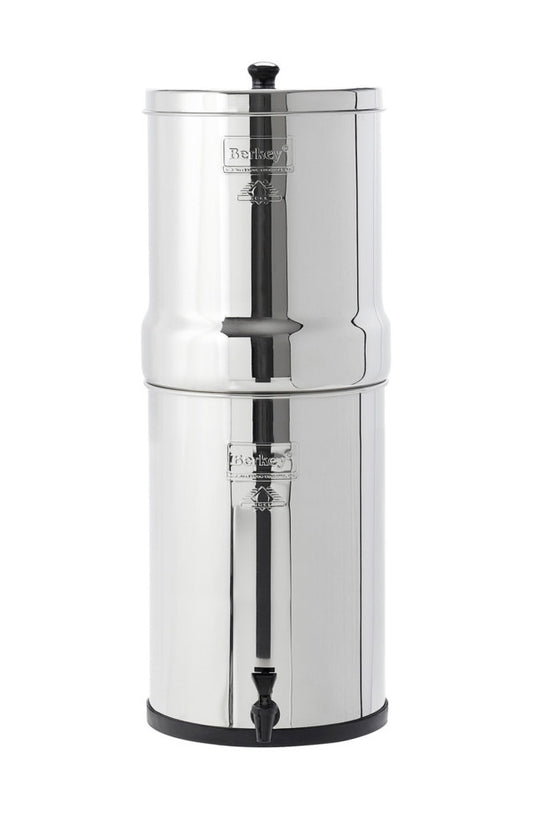
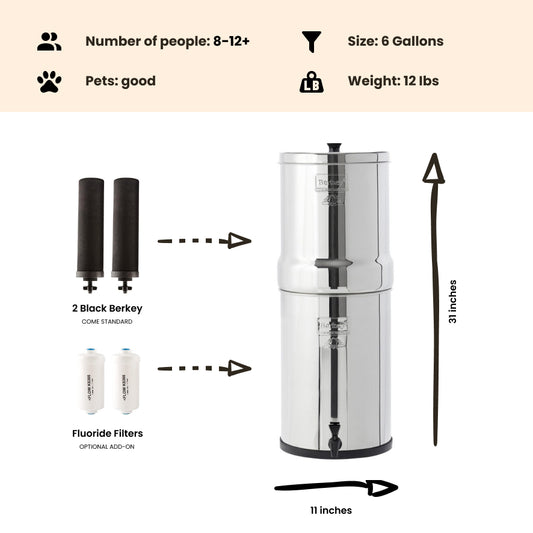
A Berkey gravity system on the countertop covers daily drinking and cooking water for a family without plumbing changes. Choose the chamber size to match household size; the Big Berkey suits most families of two to four.
Well water and everyday use
Chromium-6 occurs naturally in groundwater in parts of the Southwest, so private well users are a real at-risk group. A gravity-fed Berkey works without electricity or water pressure, which makes it practical for wells, rentals, and locations where reverse osmosis cannot run. If your well is near active oil and gas drilling, chromium is one of several contaminants worth testing for specifically, see our guide to testing well water near oil and gas activity.
Renters
Reverse osmosis usually requires drilling a faucet hole and connecting to the supply line, which many leases do not allow. A countertop gravity system needs no installation and moves with you.
Maximum dissolved-solids reduction
If your priority is near-zero dissolved solids across the board and you own your home, an NSF/ANSI 58 reverse osmosis system certified for hexavalent chromium is the most thorough option, provided you accept the water waste and the need to remineralize.
Adding fluoride and arsenic reduction
Chromium-6 often appears in the same groundwater that carries arsenic and fluoride. PF-2 fluoride and arsenic reduction filters attach to the base of Berkey filter elements in the lower chamber and are compatible with both Black Berkey and Berkey Phoenix Elements.
Cost Over Five Years
A rough five-year cost picture for daily household drinking water, covering the system plus replacement consumables. Berkey system pricing is set by the manufacturer; the figures below use current pricing for context.
Big Berkey system
Low ongoing cost
Gravity system with replacement filter elements over the period. No electricity, no water waste. Black Berkey elements run about 2 cents per gallon over their rated life.
Reverse osmosis system
Moderate to high
System cost plus pre-filters, post-filters, and membrane replacements on a schedule, plus the cost of the water sent to drain.
Countertop distiller
Moderate, plus power
Appliance cost plus ongoing electricity to boil every gallon, plus periodic descaling supplies and carbon pods.
Standard pitcher filter
Low, but limited
Low upfront cost and frequent cartridge replacements, but generally without chromium-6 testing, so the low cost may not buy protection against this contaminant.
Frequently Asked Questions
How do you remove chromium-6 from drinking water?
Chromium-6 is reduced from drinking water by reverse osmosis, distillation, or gravity-fed carbon filtration with ion exchange media. Standard pitcher filters generally do not address it. The most important step when choosing a filter is confirming it has been tested for hexavalent chromium specifically, not just total chromium.
Does a Berkey water filter remove chromium-6?
Yes. Black Berkey elements are independently tested to reduce hexavalent chromium by more than 99.8 percent using EPA Method 218.6, and reduce total chromium by more than 99.9 percent in separate testing by Envirotek Laboratories. New Berkey systems ship with Black Berkey elements included as standard.
What is the best filter for chromium-6 removal at home?
For a no-installation option, a Berkey gravity system with Black Berkey elements has the strongest chromium-6-specific test documentation among gravity filters. For maximum dissolved-solids reduction in a home you own, an NSF/ANSI 58 reverse osmosis system certified for hexavalent chromium is the most thorough choice, with the tradeoff of plumbing and water waste.
What water filters remove hexavalent chromium from tap water?
Reverse osmosis systems certified to NSF/ANSI 58 for hexavalent chromium, countertop distillers, and gravity-fed filters with ion exchange media such as Berkey systems are the filter types that address hexavalent chromium. Basic activated carbon pitcher filters typically are not tested or designed for it.
Do Brita filters remove chromium-6?
Brita pitcher filters are not certified to reduce hexavalent chromium, and chromium-6 does not appear among Brita's published certified contaminants. Brita filters are designed mainly to improve chlorine taste and odor and to reduce certain other contaminants, but a pitcher that has not been tested for chromium-6 should not be assumed to address it. For chromium-6 specifically, a reverse osmosis system or a gravity-fed filter tested for hexavalent chromium is the more reliable choice.
Is chromium-6 in my drinking water and how do I filter it out?
You can check your annual water quality report from your utility or have a private lab test your water, since many reports list only total chromium rather than the hexavalent form. If chromium-6 is present, a reverse osmosis system or a gravity-fed filter tested for hexavalent chromium will reduce it. Private well users in the Southwest should test, because chromium-6 occurs naturally in some groundwater.
Berkey vs reverse osmosis for chromium-6 removal: which is better?
Both reduce chromium-6 effectively. The difference is infrastructure. A Berkey gravity system needs no plumbing, no electricity, and wastes no water, and Black Berkey elements have hexavalent-chromium-specific test data on public record. Reverse osmosis can deliver broader dissolved-solids reduction but requires plumbing, a storage tank, and sends several gallons to drain for every gallon delivered.
What is the difference between chromium-3 and chromium-6?
Chromium-3 (trivalent chromium) is a naturally occurring form the body uses in trace amounts. Chromium-6 (hexavalent chromium) is a toxic, carcinogenic form that comes mainly from industrial pollution and pipe corrosion. They are the same element in different oxidation states, which is why filter testing should name hexavalent chromium specifically.
Why does the Erin Brockovich case matter for water filtration?
The Erin Brockovich case involved hexavalent chromium contaminating groundwater in Hinkley, California, and it brought national attention to chromium-6 in drinking water. It is relevant to filtration because it established public awareness that this contaminant is both serious and not always covered by standard water treatment, which is why testing a filter for chromium-6 specifically matters.
Do Black Berkey and Berkey Phoenix Elements both reduce chromium?
Yes, both reduce chromium. Black Berkey elements have hexavalent chromium tested specifically by EPA Method 218.6 at more than 99.8 percent, plus total chromium tested separately at more than 99.9 percent. Berkey Phoenix Elements, the current in-stock replacement option, are independently tested by RAYNU Lab to reduce total chromium by more than 97 percent. The difference is that Black Berkey additionally has hexavalent-chromium-specific testing on record.
What is the legal limit for chromium-6 in drinking water?
The federal EPA standard regulates total chromium at 100 parts per billion and does not set a separate limit for the hexavalent form. California finalized the first chromium-6-specific maximum contaminant level in the country at 10 parts per billion. California's public health goal, the level the state associates with negligible cancer risk, is 0.02 parts per billion, far below the enforceable limit.


 By
Dan DeBaun
By
Dan DeBaun






I live in Josephine Tx, and have just been told I have hexavalent chromium toxicity. My arms and hands are covered in an off and on again itchy red rash.
I live in Holly Springs. Our water report for this year shows Chromium at levels above epa standard for safety but within NC’s set. It doesn’t say what type of chromium?
Hi Beth -
You should be able to contact them so that they can provide you this information. It's more probable this is chromium 6.
Thanks
Dan
Will the black filters for the Chromium also filter out Arsenic? What size filters? Do you have refrigerator/ice maker filters too?
Thanks
Hi Diane -
Yes, the black berkeys will remove arsenic from the water. And, no we do not make refrigerator/ice filters.
Thanks
Dan