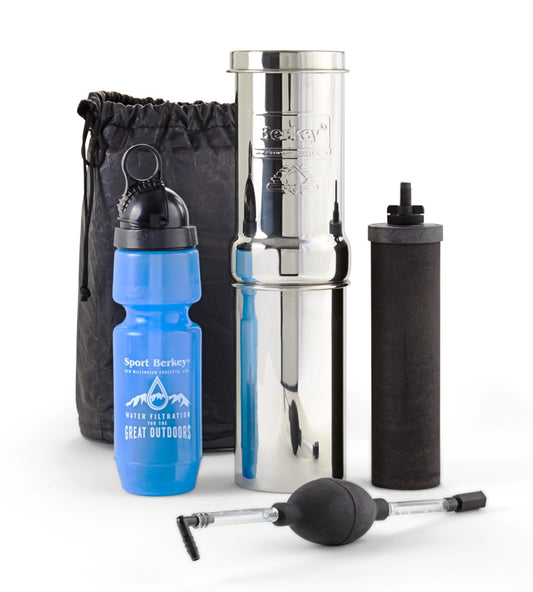
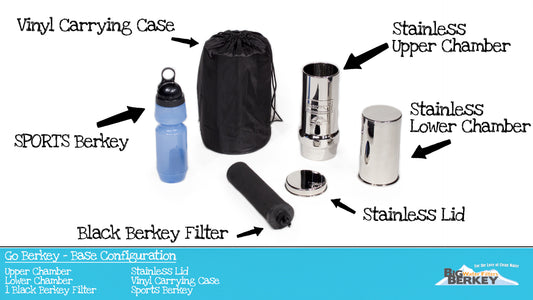
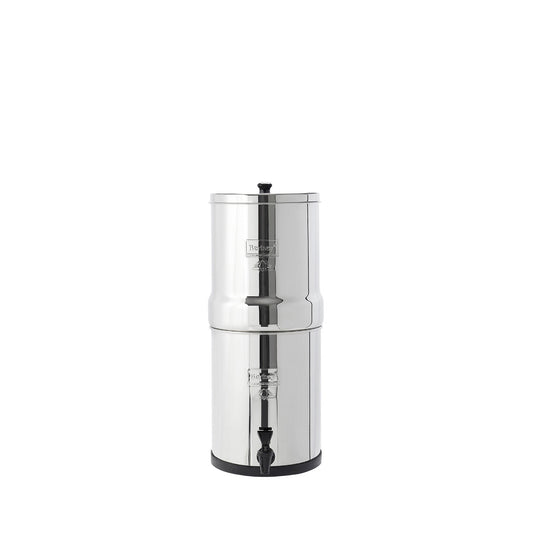
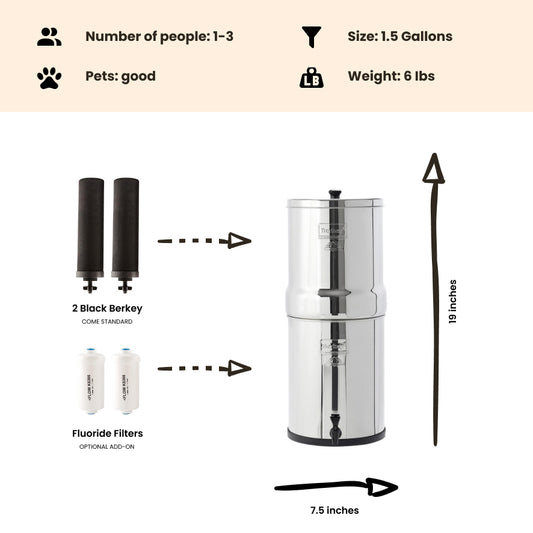
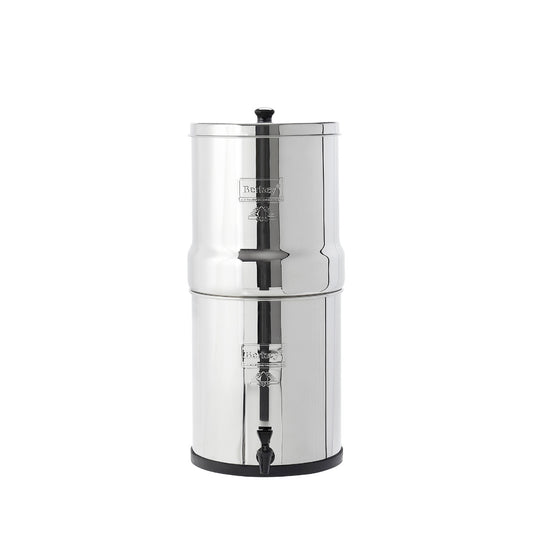
Short answer: the best countertop water filter for most homes is a gravity-fed system, because it needs no plumbing, no electricity, and no installation. You fill the top chamber, gravity pulls the water through the filter elements, and you draw filtered water from a spigot below. Among gravity systems, the Berkey line is the most widely tested against a broad contaminant list, with results from independent EPA-certified and ISO 17025-accredited laboratories.
If counter space is tight, a faucet-mounted or pitcher filter is smaller but reduces a much shorter list of contaminants. If you want the broadest reduction and do not mind a unit that sits on the counter, a gravity system is the stronger long-term value.
A countertop water filter is any system that treats your drinking water at a single point of use without being plumbed into your supply line. It is a practical alternative to bottled water and to under-sink systems that require installation. The category covers four main designs: gravity-fed chamber systems, faucet-mounted filters, countertop reverse osmosis units, and electric filtered-pitcher machines. They differ widely in what they reduce, how fast they work, and what they cost to run over several years.
This guide compares those options on the factors that actually decide the purchase, then looks closely at gravity systems, which is the category most countertop shoppers end up choosing. Every contaminant-reduction figure below is drawn from third-party laboratory testing and attributed to the lab that produced it.
Countertop water filter comparison at a glance
| Type |
Plumbing |
Electricity |
Typical contaminants reduced |
Filter life |
Independent lab data |
Typical price |
| Gravity chamber (Berkey) |
None |
None |
Broad: lead, PFAS, heavy metals, chlorine, chloramine, pesticides, VOCs |
About 6,000 gal per element pair |
Yes, published and attributed |
$327 to $478 |
| Countertop reverse osmosis |
Connects to faucet |
Some models |
Broad, but strips beneficial minerals and wastes water |
6 to 12 months per stage |
Varies by brand |
$150 to $400 |
| Electric pitcher machine |
None |
Required |
Moderate: chlorine, taste, some metals |
Roughly every 3 to 6 months |
Varies by brand |
$200 to $300 |
| Faucet-mounted |
Attaches to faucet |
None |
Limited: chlorine, taste, some lead |
Roughly every 100 gal |
Varies by brand |
$30 to $60 |
| Pitcher (Brita, PUR) |
None |
None |
Limited: chlorine, taste, some metals |
Roughly every 40 gal |
Varies by brand |
$25 to $50 |
Prices reflect current listed pricing for Berkey systems and general market ranges for other categories. Contaminant lists are summarized from manufacturer and third-party test data for each category.
What to look for in a countertop water filter
Three factors separate a filter that solves your water problem from one that mostly improves taste.
1. What it actually reduces, backed by independent testing. Before buying, find out what is in your water. If you are on a municipal supply, your utility publishes an annual water quality report. If you are on a private well, an EPA-certified lab can test a sample. Then match the filter to those contaminants. The important distinction is whether a manufacturer can show third-party lab results, not just a marketing list. Lab data tested to NSF/ANSI methods carries far more weight than an unverified claim.
2. No plumbing or electricity, if portability matters. Gravity systems and pitchers work anywhere, which makes them useful during outages, while traveling, or off-grid. Faucet-mounted and reverse osmosis units are tied to a tap. Electric machines need an outlet.
3. Long-term cost, not just the sticker price. A $30 pitcher with a filter that lasts 40 gallons can cost more per year than a system with a higher upfront price and a filter that lasts thousands of gallons. Always divide the replacement-filter cost by its rated gallons to get a true cost per gallon.
The main types of countertop water filter
Gravity-fed chamber systems
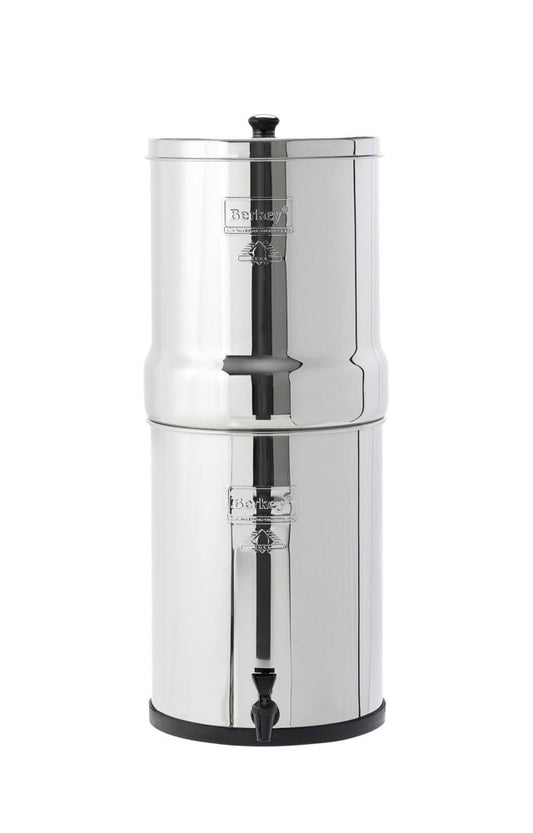
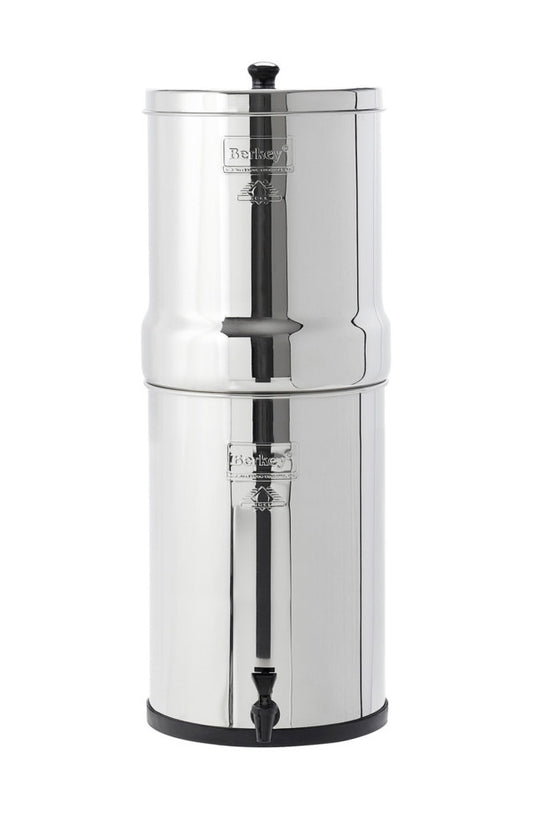
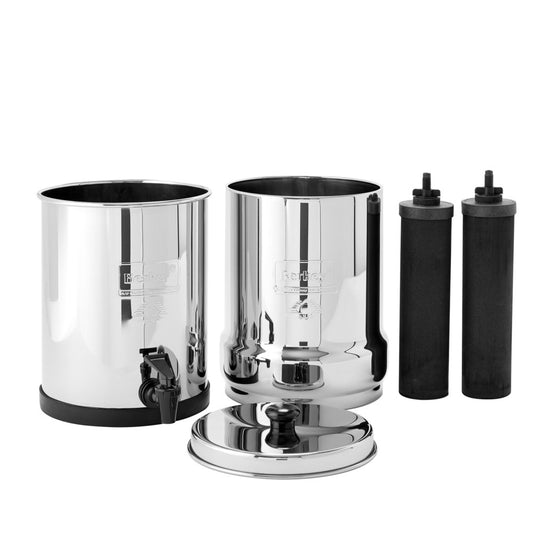
Two stacked chambers with filter elements between them. Water moves by gravity alone, so there is no plumbing, no power, and no water pressure required. These systems reduce the broadest range of contaminants in the countertop category and have the longest filter life, but they filter at a steady rather than instant rate and they take up vertical counter space.
Countertop reverse osmosis
Connects to a faucet and pushes water through a membrane. Reverse osmosis reduces a wide contaminant range, but it also strips beneficial minerals such as calcium and magnesium, and it sends several gallons to the drain for every gallon it produces. It cannot be moved freely and many units deliver slowly.
Faucet-mounted and pitcher filters
The smallest and cheapest options. They mainly improve taste and reduce chlorine, with limited reduction of metals depending on the model. Their filters are short-lived, so the running cost per gallon is high. They are a reasonable choice if taste is the only concern.
Electric pitcher machines
Plug-in units that filter into a removable pitcher. They reduce more than a basic pitcher but require an outlet and lose the portability advantage of a gravity system.
Best countertop gravity water filter
For shoppers who want the widest contaminant reduction with no plumbing or power, a gravity chamber system is the strongest fit, and Berkey is the most thoroughly tested line in that category. Berkey systems ship standard with a pair of Black Berkey Elements and are independently tested against more than 200 contaminants across major categories. The figures below come directly from the test reports.
Black Berkey Element lab results
The following reductions were measured by Envirotek Laboratories, an independent laboratory certified by the EPA and accredited by the New Jersey DEP and New York ELAP, testing to NSF/ANSI Standard 53 and Standard 42 methods.
| Contaminant |
Result |
Test detail |
| Lead |
99%+ reduction |
Reduced across 200 gallons from a 1,000 µg/L spike (Report 16-101) |
| PFOA and PFAS surrogates |
99%+, to below 2 ppt |
9 compounds reduced to below 0.002 µg/L (Report 16-296) |
| Arsenic |
99.9% |
Heavy metals panel (Report 14-260) |
| Chromium |
99.9% |
Heavy metals panel (Report 14-260) |
| Mercury |
99.9% |
Heavy metals panel (Report 14-260) |
| Copper, iron, manganese, zinc |
99.9% |
Heavy metals panel (Report 14-260) |
| Free chlorine and chloramine |
99.9% |
Inorganic non-metallic panel (Report 14-260) |
| Pesticides, PCBs, VOCs, PAHs |
99.9% |
Organic compounds panel (Report 14-260) |
| Pharmaceuticals |
99.5% |
Includes ibuprofen, caffeine, and others (Report 14-260) |
Source: Envirotek Laboratories, Inc. test reports for New Millennium Concepts, Ltd. Testing performed by an independent EPA-certified laboratory with no affiliation to the manufacturer.
For a full breakdown of every contaminant tested, see the complete Black Berkey contaminant list and the broader contaminant overview. Chromium-6 specifically is covered in how to reduce chromium-6 in water.
Which Berkey size fits your counter
All Berkey systems use the same Black Berkey Elements and reduce the same contaminants. The only differences are capacity, height, and how many people they comfortably serve. Height matters most, since the unit needs clearance under your upper cabinets when sitting on the counter.
| Model |
Capacity |
Height x Diameter |
Best for |
Price |
| Travel Berkey |
1.5 gal |
18 in x 7.5 in |
1 to 2 people, small counters |
$327 |
| Big Berkey |
2.25 gal |
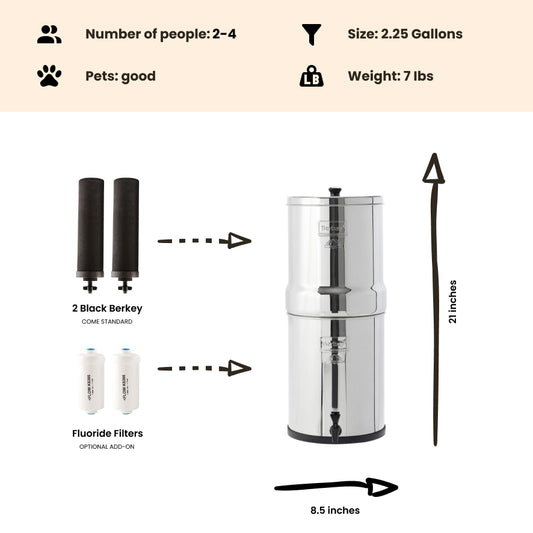
19 in x 8.5 in |
1 to 4 people |
$367 |
| Royal Berkey |
3.25 gal |
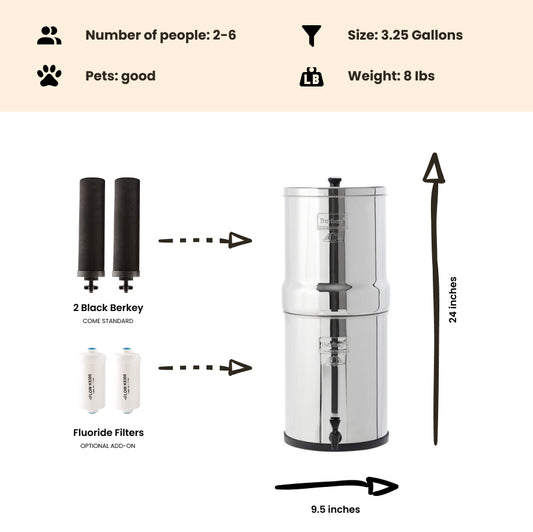
23 in x 9.5 in |
2 to 6 people |
$408 |
| Imperial Berkey |
4.5 gal |
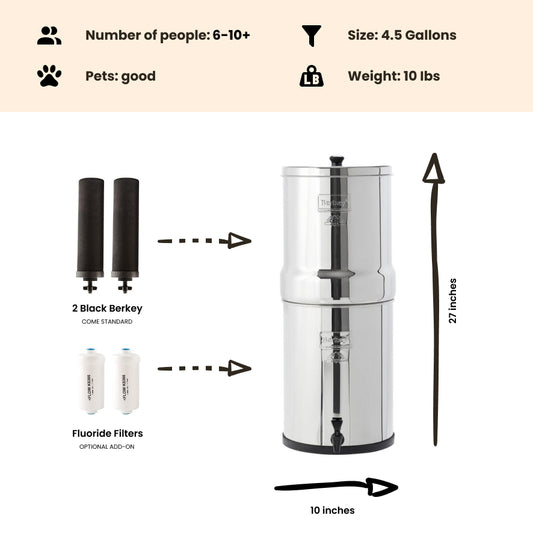
25.75 in x 10 in |
4 to 8 people |
$451 |
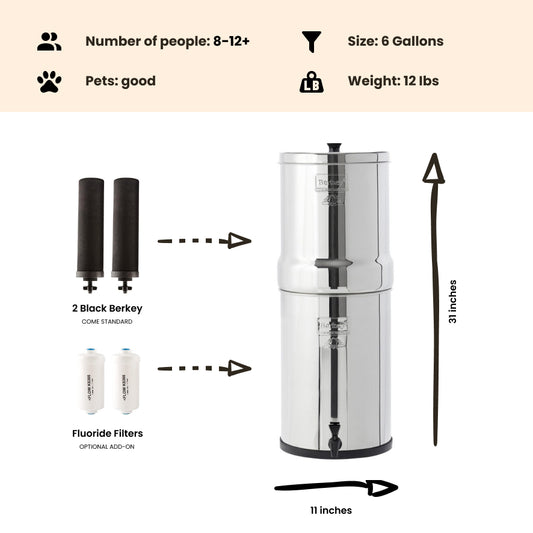
| Crown Berkey |
6 gal |
30 in x 11 in |
6 to 12 people |
$478 |
Flow rate note: a Big Berkey with two Black Berkey Elements produces up to 3.5 gallons per hour. Adding two more elements raises that to about 7 gallons per hour. Most households fill the system once or twice a day rather than waiting on demand.
Best for / Not for
Best for: households that want the broadest contaminant reduction with no plumbing or electricity, anyone who values a portable backup for outages or travel, and buyers focused on long-term cost per gallon.
Not the best fit for: homes with very limited cabinet clearance, anyone who needs instant filtered water on demand, or those wanting whole-house treatment at every tap.
Compare every Berkey size side by side and find the right fit for your household.
Shop Berkey Systems
Replacement elements: Black Berkey and Berkey Phoenix
New systems ship with Black Berkey Elements. When it is time to replace, the current replacement option is the Berkey Phoenix Elements. Phoenix Elements are certified to NSF/ANSI 42 and NSF/ANSI/CAN 372, and their PFAS performance was tested by RAYNU Analytical, a laboratory accredited to ISO/IEC 17025:2017 (NABL). In that testing, PFOA and PFOS were reduced to below 0.005 µg/L through 1,500 liters of throughput. A Phoenix pair is rated for about 5,500 gallons.
How gravity filters compare to other countertop options
Versus pitcher filters. A gravity system reduces a much broader contaminant range and its elements last thousands of gallons, while a pitcher filter mainly addresses taste and chlorine and needs replacing roughly every 40 gallons. The pitcher wins on price and counter space only.
Versus faucet-mounted filters. Faucet filters are compact and deliver instantly, but they attach to a single tap, cannot move with you, and reduce a shorter contaminant list. A gravity system works anywhere and covers more.
Versus countertop reverse osmosis. Reverse osmosis reduces a comparably broad range, but it strips beneficial minerals, sends several gallons to the drain per gallon produced, and stays tied to a faucet. A gravity system retains minerals, wastes nothing, and stays portable. Reverse osmosis can be the better tool where you specifically need mineral-level reduction such as high nitrates.
What a countertop gravity filter costs over time
The number that matters is cost per gallon, not the price on the box. A Berkey system ships with a pair of Black Berkey Elements rated for about 6,000 gallons. At the current replacement price of $166 per pair, that works out to roughly 2 to 3 cents per gallon of filtered water.
By contrast, a pitcher filter rated for 40 gallons at a typical replacement cost lands closer to 20 to 25 cents per gallon. Over several years of daily use, the gravity system's higher upfront price is offset many times over by its lower running cost. Bottled water, for comparison, runs well over $1 per gallon.
Cost summary: upfront cost is higher for a gravity system, but the long filter life makes the multi-year total lower than pitchers, faucet filters, or bottled water for most households.
Reducing fluoride and arsenic
Black Berkey Elements are not relied on for sustained, long-term fluoride reduction. For that, Berkey systems accept the PF-2 Elements, which reduce up to 99.75% of fluoride and also address arsenic. PF-2 Elements screw onto the bottom of the gravity elements and hang into the lower chamber, so they take no extra space. They are rated for 1,000 gallons or one year, whichever comes first.
Frequently asked questions
Does a Berkey fit on a standard kitchen counter?
Most kitchens have 18 to 20 inches of clearance between the counter and the upper cabinets. The Travel Berkey at 18 inches and the Big Berkey at 19 inches fit under typical cabinets. Taller systems like the Royal, Imperial, and Crown usually need to sit on a counter without cabinets above, or be filled away from the wall. Measure your clearance before choosing a size.
Do countertop gravity filters need plumbing or electricity?
No. Gravity systems work with no plumbing, no electricity, and no water pressure. You pour water into the top chamber and gravity does the rest. That is what makes them usable during power outages, while camping, or off-grid.
How long do the filter elements last?
A pair of Black Berkey Elements is rated for about 6,000 gallons. At typical household use that is several years of service. Berkey Phoenix replacement Elements are rated for about 5,500 gallons per pair.
What does a Berkey reduce?
Independent testing by Envirotek Laboratories shows reductions of lead, PFAS, arsenic, chromium, mercury and other heavy metals, chlorine and chloramine, pesticides, VOCs, and pharmaceuticals, with most results at 99% or higher. See the lab table above for specifics and the linked contaminant list for the full panel.
Does a Berkey reduce fluoride?
For sustained fluoride reduction, add the PF-2 Elements, which reduce up to 99.75% of fluoride and also address arsenic. They install in the lower chamber and are rated for 1,000 gallons or one year.
What is the smallest Berkey for a small kitchen?
The Travel Berkey, at 1.5 gallons and 18 inches tall, has the smallest footprint and fits under most upper cabinets. It serves 1 to 2 people comfortably.
Is a countertop gravity filter worth it compared to a pitcher?
If your only goal is better taste, a pitcher is cheaper. If you want a broad contaminant reduction backed by independent lab data and a much lower cost per gallon over time, a gravity system is the stronger value despite the higher upfront price.
How fast does a gravity system filter water?
A Big Berkey with two elements produces up to 3.5 gallons per hour, and up to about 7 gallons per hour with four elements. Most households simply refill once or twice a day rather than filtering on demand.


 By
Dan DeBaun
By
Dan DeBaun