Arsenic in private well water is one of the most under-recognized public health risks in the United States. A peer-reviewed journal series in Science of the Total Environment found that approximately 3 million Americans drink well water containing arsenic at levels of public health concern, with hot-spot regions including New England, parts of the Great Lakes, the Pacific Northwest, the Southwest, and stretches of the West. Geochemist Yan Zheng of Columbia University's Lamont-Doherty Earth Observatory, who coedited the journal series, called arsenic "the biggest public-health problem for water in the United States." Private wells are not federally regulated, which means well owners are responsible for their own testing and treatment.
Quick Answer
Private well water poses a serious arsenic risk in many US regions. An estimated 3 million Americans are affected, with 6.8% of tested private wells failing the EPA's 10 ppb arsenic standard. In Maine, contamination runs as high as 45% of wells. Arsenic is tasteless, colorless, and odorless, so testing is the only way to know it is present. For background on arsenic generally, see our arsenic in drinking water guide. For filter comparisons, see the arsenic water filter buying guide.
The Scale of the Problem
A special section of Science of the Total Environment titled "Arsenic in private well waters of the northeastern United States and Atlantic Canada" (volume 505, 2015; the editors' overview runs pages 1237 to 1247) presented a coordinated body of research on well-water arsenic contamination. The journal section was coedited by Yan Zheng (Columbia University's Lamont-Doherty Earth Observatory) and Joseph Ayotte (US Geological Survey hydrologist). The series confirmed that arsenic from naturally occurring geological sources is leaching into private well water at levels of concern across wide stretches of the US and Atlantic Canada.
43M
Americans on private well water
6.8%
Of US wells fail the 10 ppb arsenic standard (USGS)
~3M
Americans estimated exposed at concerning levels
45%
Of Maine wells in some counties exceed EPA limit
The EPA tightened the arsenic standard for public drinking water from 50 parts per billion to 10 ppb in 2001, as scientific evidence accumulated on the long-term health risks of chronic arsenic exposure. The 10 ppb standard applies only to public water systems. Private wells are not federally regulated and are not routinely tested, which is the central reason millions of Americans are exposed to arsenic without knowing it.
"Arsenic is the biggest public-health problem for water in the United States. It is the most toxic thing we drink. For some reason, we pay far less attention to it than we do to lesser problems."
Yan Zheng, geochemist and adjunct research scientist at Columbia University's Lamont-Doherty Earth Observatory, coeditor of the Science of the Total Environment special section
Where Arsenic Hotspots Are Concentrated
The geology that produces arsenic-contaminated groundwater is not uniform across the country. The US Geological Survey has mapped arsenic distribution in groundwater, and the journal series confirmed several high-risk regions:
-
New England. Approximately 20% of private wells are contaminated above the EPA limit. Maine is the most heavily affected, with up to 45% of wells exceeding 10 ppb in some counties, affecting around 80,000 residents.
-
The Great Lakes region. Patches of elevated well-water arsenic across Michigan, Minnesota, and Wisconsin.
-
The Pacific Northwest. Elevated concentrations in parts of Washington and Oregon.
-
The Southwest and West. Arizona, New Mexico, Nevada, parts of California, and stretches of the western states down to Texas.
-
Atlantic Canada. The journal series identified comparable contamination patterns extending into eastern Canadian provinces.
Joseph Ayotte, the USGS hydrologist who coedited the journal series, noted that distribution of high arsenic concentrations is geographically spotty. Even within identified hotspot states, local geology varies enough that wells can be safe or contaminated within a few miles of each other. This is why blanket assumptions based on state-level data are unreliable, and why testing individual wells is the responsible step regardless of regional risk profile.
The Geology Behind Arsenic-Contaminated Groundwater
Soils and rocks across many regions contain traces of arsenic that are bound up in minerals and harmless. The contamination problem occurs when certain geological sediments become enriched in arsenic and then chemically react with groundwater under specific conditions, releasing the arsenic into aquifers that supply private wells. Geologists studying these processes have identified the mechanism in roughly 70 countries worldwide, with parts of Asia (particularly Bangladesh and West Bengal in India) being the most severely affected.
In the US, the problem extends well beyond what is currently regulated. While most public water utilities that serve more than 25 people meet the 10 ppb safety standard (often through additional treatment when source water exceeds it), a 2014 study by the Columbia Water Center identified approximately 500 small public water utilities (primarily in rural areas) that still fail the safety standard, largely due to the additional cost of treatment.
Lower-Level Arsenic Exposure: Still Dangerous
The current 10 ppb EPA limit was set as a practical compromise between health protection and treatment cost, not as a level scientifically determined to be safe. The EPA's stated long-term goal for arsenic in drinking water is zero. Research conducted alongside the journal series provided strong evidence that arsenic exposure well below the current limit still produces measurable harm.
A 2014 study conducted by Columbia-affiliated researchers in Maine school districts found that arsenic levels as low as 5 ppb (half the current EPA limit) reduced children's IQ by 5 to 6 points. New Jersey, one of the few states to take a more protective stance, has reduced its state limit for arsenic to 5 ppb. Maine state officials estimate that even at the tighter 5 ppb threshold, roughly 20% of Maine's wells would still violate the standard.
"The risk for pregnant women and children is much higher. We're hoping that recognition may be a turning point in getting more action."
Joseph Graziano, pharmacologist and Earth Institute professor at Columbia's Mailman School of Public Health
The full health picture associated with chronic low-level arsenic exposure includes increased risk of bladder, lung, skin, and kidney cancer; cardiovascular disease; diabetes; and reduced cognitive development in children. For a deeper review of the health effects, see our arsenic in drinking water guide.
Why Most Affected Households Take No Action
One of the most striking findings in the journal series came from a behavioral study by Sara Flanagan, a researcher at Lamont-Doherty. Her team surveyed homeowners who had been formally notified, 3 to 7 years prior to the study, that their well water was contaminated with arsenic. The results:
43%
Installed water filtration
30%
Switched to bottled water
More than a quarter of households who knew their water was contaminated took no action at all to reduce their exposure. Some researchers attribute this to a combination of optimism bias, perceived cost barriers, and uncertainty about which treatment options actually work.
"People say, I'm not going to worry about it, maybe I'll get cancer, maybe I won't. For local and state government, it's a hardy perennial, once in a while it gets some press, there's a little shuffle of activity, then it dies again until the next study comes out."
Joseph Graziano, Columbia's Earth Institute, on public and policy response to well-water arsenic
Filtration Alone Is Not Always Enough
The journal series surfaced an uncomfortable finding for households that had already taken action. Among Maine study households where homeowners had installed water filtration to address known arsenic contamination, 15% of homes still produced water that failed to meet the 10 ppb EPA standard.
The implication is critical: not all filters labeled for arsenic actually reduce arsenic to safe levels in real-world household conditions. The factors that separate effective filtration from ineffective filtration include:
-
Independent lab testing. The filter should have a traceable third-party lab report showing arsenic reduction against a specific challenge concentration, not just a marketing claim.
-
NSF/ANSI 53 certification for arsenic, where applicable, on the specific model (not the brand line).
-
Matching the filter to the form of arsenic present. Arsenic V (more common in chlorinated municipal water) is easier to address by adsorption; arsenic III (more common in anaerobic well water) is harder to reduce unless first oxidized. Many off-the-shelf filters are not effective against raw arsenic III.
-
Replacement on schedule. All adsorption media has finite capacity. A filter past its rated life can produce post-filter water above the EPA limit even if it was effective when installed.
-
Testing post-filter water. The only reliable confirmation that any filter is working at any given moment is to test the water it produces.
For households on well water with confirmed arsenic, the responsible approach combines an independently lab-tested gravity element with a targeted activated alumina post-filter, plus periodic retesting. For lab data on gravity-filter arsenic reduction, see our does Berkey reduce arsenic page (Black Berkey elements were tested by Envirotek Laboratories at a 312 microgram per liter arsenic challenge and Phoenix elements by Atom Testing Laboratory at 200 micrograms per liter, with both reduced to below the lab detection limit).
What Well Owners Should Do
-
Test your well now. Send a sample to a certified laboratory for arsenic analysis. Test costs are typically $20 to $80 per sample, far less than the long-term cost of undiagnosed exposure.
-
Retest periodically. Arsenic concentrations can change as groundwater chemistry shifts. Maine CDC guidance is to retest for arsenic every 3 to 5 years even if initial results are favorable.
-
If your water tests positive, do not assume bottled water is the answer. The FDA holds bottled water to the same 10 ppb arsenic standard the EPA applies to tap water (21 CFR 165.110), results are not disclosed at point of sale, and quality varies by brand. An independently tested filter is more reliable, can be verified by testing, and is far less expensive over time.
-
Match your filter to your water. See our arsenic water filter buying guide for a side-by-side comparison of gravity filters, reverse osmosis, and whole-house point-of-entry systems with 5-year cost analysis.
-
Test your filtered water to confirm the filter is performing as expected. Retest annually.
Reduce Arsenic in Your Well Water
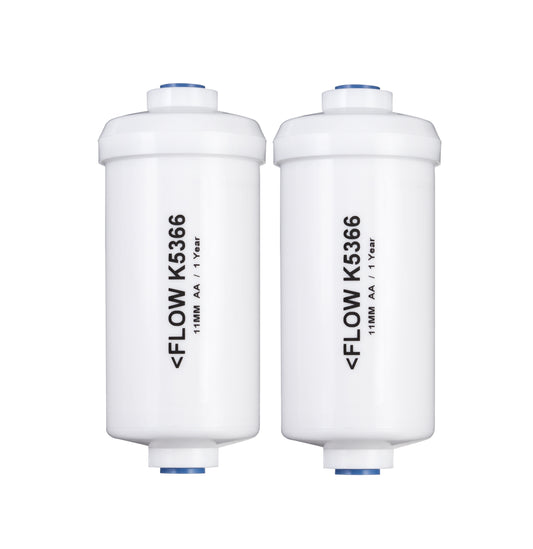
Independent lab data on gravity-filter arsenic reduction is available for both Black Berkey and Berkey Phoenix elements. For well water, the PF-2 activated alumina post-filter is recommended for added targeted protection.
Frequently Asked Questions
How widespread is arsenic in US well water?
Approximately 43 million Americans rely on private wells for drinking water, and around 6.8% of tested wells fail the EPA's 10 ppb arsenic standard. This translates to an estimated 3 million Americans exposed at levels of public health concern. Contamination is geographically spotty, with the heaviest concentrations in New England (particularly Maine, where up to 45% of wells in some counties exceed the limit), parts of the Great Lakes region, the Southwest, the Pacific Northwest, and Atlantic Canada.
Why isn't private well water regulated for arsenic?
EPA drinking water standards apply to public water systems serving more than 25 people. Private wells fall outside that regulatory framework. There is no federal requirement to test a private well, no testing schedule, and no enforcement mechanism if a well exceeds safety standards. Some states (Maine, New Jersey, and others) have begun considering or implementing state-level requirements, but most well owners are responsible for their own testing and treatment.
Is 10 ppb really a safe limit for arsenic?
The EPA's 10 ppb maximum contaminant level is a practical compromise between health protection and treatment cost, not a level scientifically determined to be safe. The EPA's stated long-term goal for arsenic is zero. Research published in the Science of the Total Environment journal series and elsewhere has found measurable harm at concentrations well below 10 ppb, including reduced child IQ at 5 ppb. New Jersey has reduced its state limit to 5 ppb in response.
Can a filter alone solve well-water arsenic?
Sometimes yes, sometimes no. The journal series found that 15% of Maine households who installed filtration to address known arsenic contamination still produced post-filter water exceeding the 10 ppb EPA standard. Effective arsenic filtration requires an independently lab-tested filter, NSF/ANSI 53 certification on the specific model where applicable, matching the filter to the form of arsenic present (As V vs As III), replacement on schedule, and periodic testing of the filtered water to confirm performance.
What did the Columbia and USGS researchers recommend for well owners?
The researchers behind the journal series recommended that well owners in identified hotspot regions test their wells now, retest periodically (Maine CDC guidance is every 3 to 5 years) even if initial results are favorable, and treat their water with an independently lab-tested filter if contamination is confirmed. They emphasized that arsenic-related cancers and other health effects can appear years after exposure, so delay carries real cost. The team also called for stronger state and federal action, including possible mandatory testing at point of home sale, which Maine has been actively considering.
What is the difference between bottled water and filtered water for arsenic?
The FDA holds bottled water to the same 10 ppb arsenic limit the EPA applies to tap water, results are not disclosed at point of sale, brand quality varies, and the long-term cost of relying on bottled water for a whole household is substantial. An independently lab-tested filter installed at point-of-use generally provides better arsenic reduction at far lower cost over a 5-year horizon, with the additional advantage that performance can be verified by testing the filtered water at any time.
Where can I learn more about the Science of the Total Environment journal series on well-water arsenic?
The special section "Arsenic in private well waters of the northeastern United States and Atlantic Canada" appears in Science of the Total Environment, volume 505 (2015). The editors' overview, "At the crossroads: Hazard assessment and reduction of health risks from arsenic in private well waters of the northeastern United States and Atlantic Canada," is on pages 1237 to 1247 (DOI 10.1016/j.scitotenv.2014.10.089). Coeditors were Yan Zheng (Columbia University Lamont-Doherty Earth Observatory) and Joseph Ayotte (US Geological Survey). The journal articles are available through academic databases and the publisher's website.

 By
Dan DeBaun
By
Dan DeBaun