The best water filter for arsenic in drinking water depends on the arsenic concentration, where the water enters your home, and your budget. For most households at point-of-use, an independently tested gravity filter (paired with a targeted arsenic post-filter when concentrations run high) provides strong reduction without plumbing changes. For whole-house arsenic at very high concentrations, a reverse osmosis or dedicated point-of-entry system is the more thorough option, at higher cost. This guide compares the realistic choices, with lab-traceable performance data for each.
Quick Answer
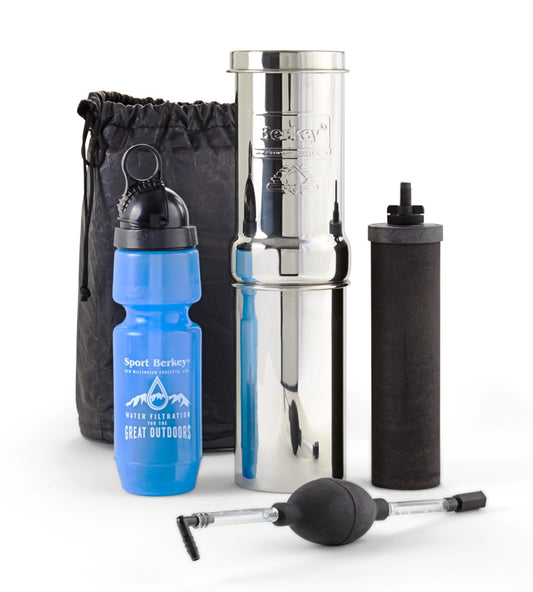
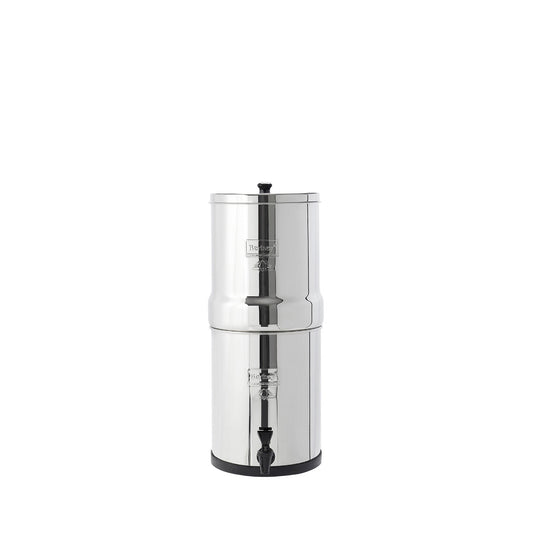
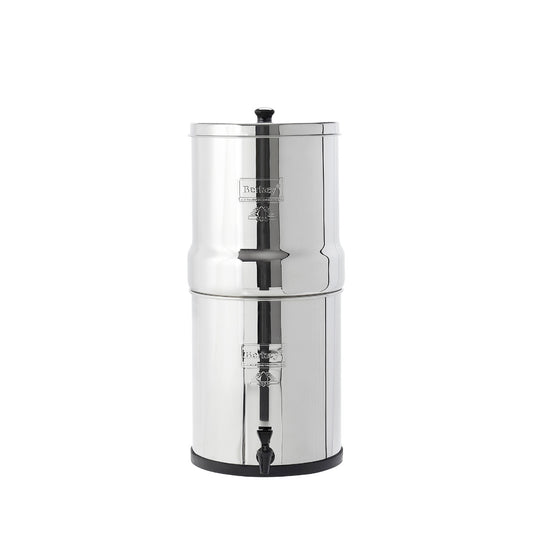
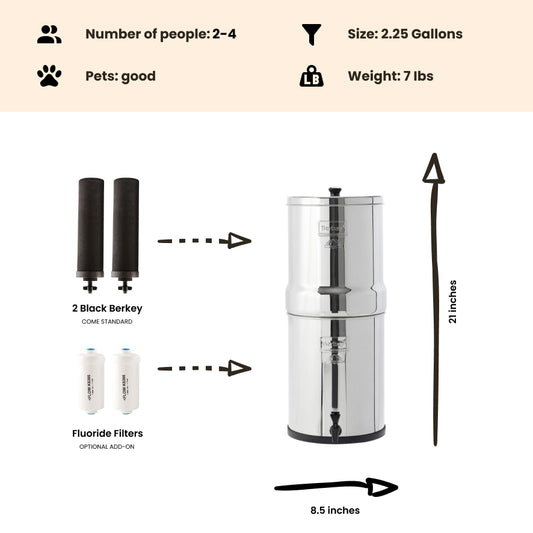
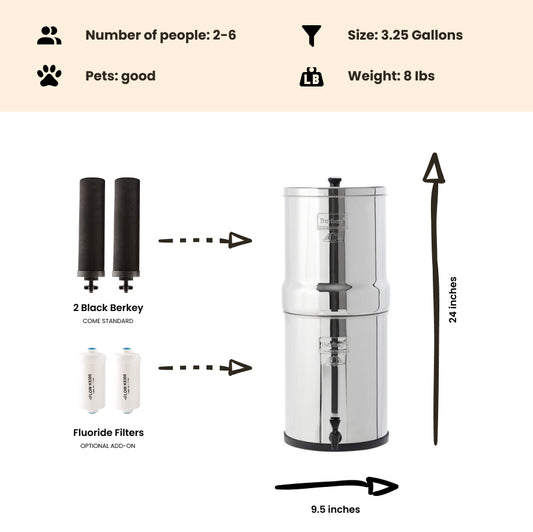
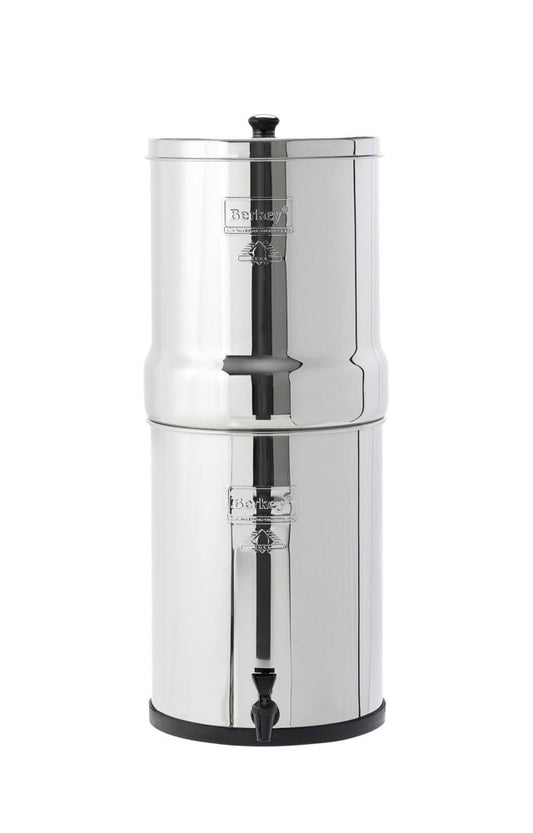
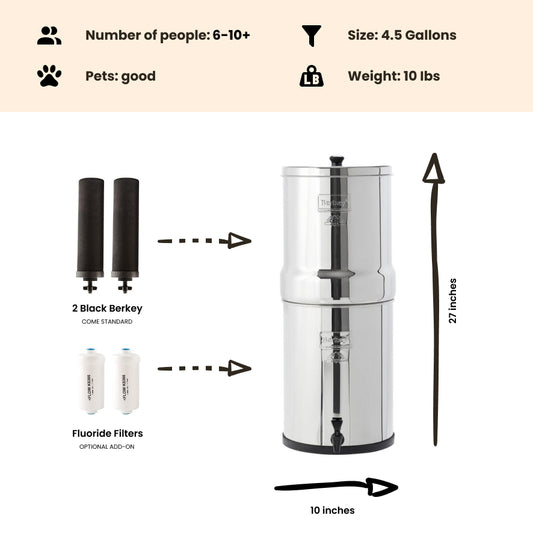
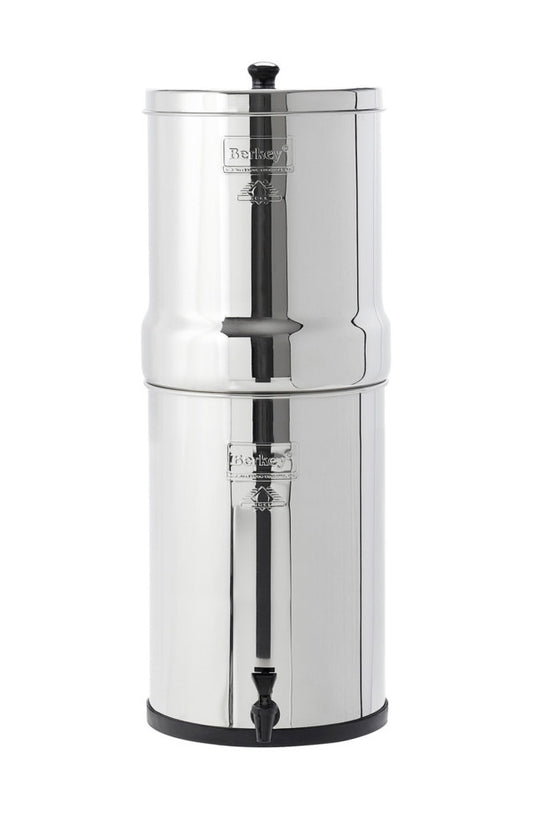
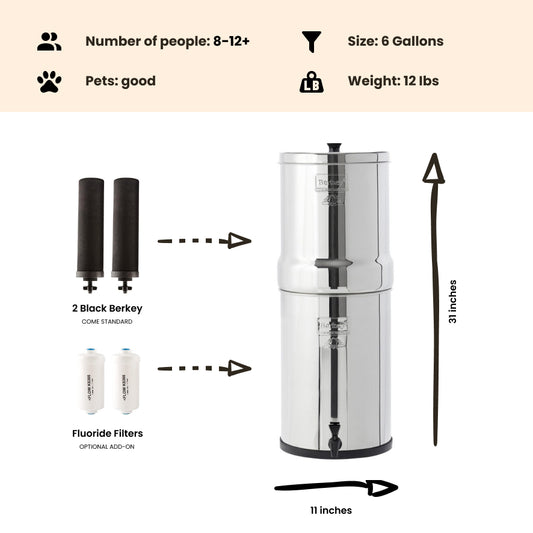
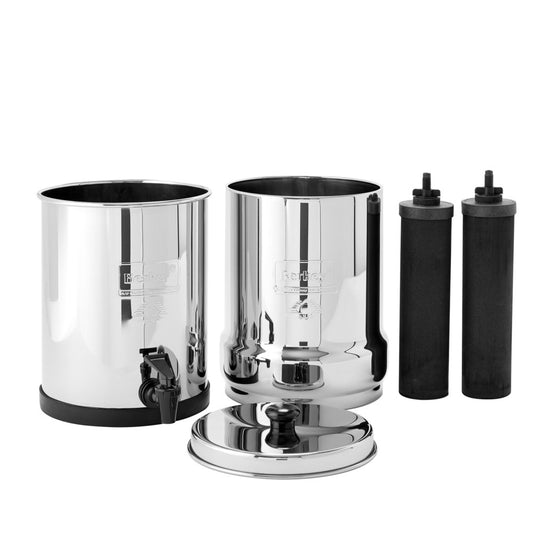
Best overall point-of-use water filter for arsenic: a gravity-fed system (Berkey or comparable) reduces arsenic by 99% or more in independent lab testing, with no plumbing or electricity required. Adding a PF-2 activated alumina post-filter provides additional targeted arsenic reduction in homes with high concentrations or well-water sources. For whole-house treatment at very elevated arsenic levels, reverse osmosis or a dedicated point-of-entry system is more thorough, with higher upfront cost and ongoing maintenance.
What Reduces Arsenic in Drinking Water
Arsenic is a naturally occurring toxic metalloid found in rocks and soils that can leach into groundwater and drinking water supplies. The EPA action level for arsenic in public drinking water is 10 micrograms per liter (parts per billion), and the EPA's stated long-term goal is zero. Several treatment methods can reduce arsenic, but they vary widely in performance, cost, and which form of arsenic they target. For broader context on heavy-metal reduction, see our guides on heavy metal water filtration and the full contaminant list a Berkey reduces.
Arsenic in water generally exists in two forms. Arsenic V (arsenate) is more common in oxygenated municipal water and is easier to reduce through adsorption media. Arsenic III (arsenite) is more common in anaerobic well water and is harder to reduce unless first oxidized to arsenic V. This distinction matters because some treatment options only address one form. Effective products either target both forms directly or include a pre-oxidation step.
How We Evaluated These Options
Five criteria applied across every option
-
Independent lab performance for arsenic. Does third-party testing confirm a specific reduction percentage against an arsenic challenge, with a traceable lab document?
-
Certification and accreditation. NSF/ANSI 53 for arsenic where applicable, plus the credentials of the testing lab.
-
Installation and ongoing requirements. Plumbing, electricity, drain connection, periodic cartridge or media changes.
-
Five-year total cost. Upfront price plus replacement filters and maintenance.
-
Practical fit. Household size, renter vs. owner, well vs. municipal, and whether arsenic levels are mildly elevated or sharply above the EPA limit.
Arsenic Water Filter Options Compared
Scroll to see the full table
| Option |
Arsenic Reduction |
Where It Sits |
Plumbing or Power |
5-Year Cost (Est.) |
Notable Limitation |
| Gravity filter (Berkey or comparable) |
Black Berkey: 99.0%+ at a 200 µg/L challenge (LA County ETL, EPA Method 200.8). Berkey Phoenix: 99.5%+ at 200 µg/L, below 1 µg/L detection limit (CVR Labs, NABL accredited). Full contaminant detail: Black Berkey list | Phoenix list. |
Countertop, point-of-use |
None |
$400 to $700 |
Tested at point-of-use; not a whole-house solution. Phoenix elements are newer than Black Berkey, so long-term independent performance data is still accumulating. |
| Gravity filter plus activated alumina post-filter (PF-2 add-on) |
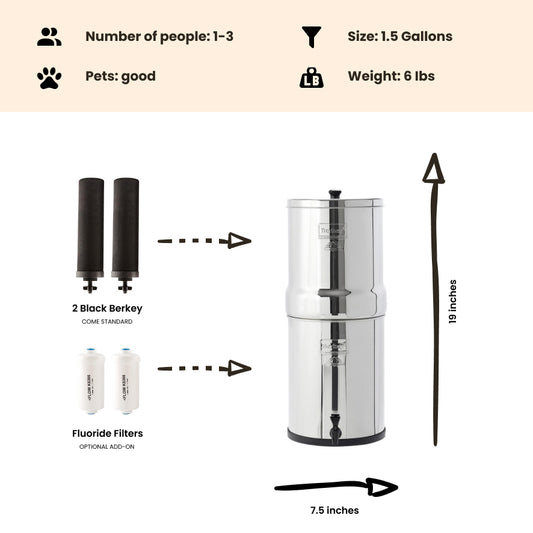
Adds targeted arsenic V and pre-oxidized arsenic III reduction beyond the primary element. See current spec on the PF-2 product page. |
Countertop, point-of-use (PF-2 attaches inside the lower chamber) |
None |
$500 to $850 |
Activated alumina does not effectively reduce raw arsenic III without pre-oxidation. Recommended where source water is municipal (chlorinated) or where elevated arsenic is confirmed by testing. |
| Reverse osmosis (under-sink) |
Typically 95% to 99%+, with NSF/ANSI 58 systems available certified for arsenic V. Performance against arsenic III is lower without pre-treatment. |
Under-sink, dedicated faucet |
Plumbing connection, drain line |
$600 to $1,400 |
Wastes 2 to 4 gallons per filtered gallon depending on system efficiency. Requires periodic membrane and pre-filter replacement. |
| Reverse osmosis (whole-house) |
Comparable to under-sink RO at higher flow rates with proper system design. |
Point-of-entry |
Significant plumbing, storage tank, often booster pump |
$4,000 to $10,000 plus annual service |
Highest upfront and lifetime cost. Requires professional installation and ongoing maintenance contract. Best reserved for very high arsenic well water where every tap matters. |
| Faucet-mounted filter (NSF 53 certified for arsenic) |
Varies by model. Only specific NSF/ANSI 53 arsenic-certified models reduce arsenic; many faucet filters do not. |
Attaches to single faucet |
None (threads onto faucet) |
$200 to $500 |
Slow flow when filtering, short cartridge life (2 to 4 months typical), most models on the market are not actually arsenic-certified. |
| Pour-through pitcher (standard) |
Most pitchers are NOT certified for arsenic. A small number of newer models claim arsenic reduction; verify the specific model's NSF/ANSI 53 listing before relying on it. |
Refrigerator or counter |
None |
$150 to $400 |
Small batch size, frequent cartridge changes, lead-time before water is filtered. Confirm arsenic certification per individual model. |
| Distillation |
Reduces arsenic effectively (typically 95%+) by boiling and condensing water vapor. |
Countertop |
Electricity (significant) |
$700 to $1,500 |
Slow throughput (about 1 gallon every 4 to 6 hours), high energy use, strips minerals along with contaminants which affects taste. |
| Boiling alone |
None. Boiling does NOT reduce arsenic and concentrates it as water evaporates. |
Stovetop |
Heat source |
Negligible |
Not a treatment option for arsenic under any circumstances. |
Pricing estimates include initial purchase and replacement consumables over five years at typical household use. Independent certification varies by individual model. Always confirm a product's NSF/ANSI 53 arsenic listing before purchase.
Verdict: Ranked by Real-World Practicality
-
Gravity filter (most households, point-of-use). Best value-to-performance ratio for typical residential arsenic at or near the EPA action level. No plumbing, no electricity, lab-traceable performance at extreme stress challenges.
-
Gravity filter plus PF-2 (well water or high-arsenic homes). Adds a targeted activated alumina stage for arsenic V and pre-oxidized arsenic III. Same point-of-use convenience.
-
Under-sink reverse osmosis (single dedicated tap). Strong performance, certified options available, but higher installation friction and ongoing maintenance.
-
Whole-house RO or POE arsenic system (very high arsenic on well water). Most thorough at the highest cost. Reserve for confirmed elevated arsenic where every tap matters.
-
NSF 53 arsenic-certified faucet filter. Workable for renters or apartments. Verify certification model-by-model.
Best Water Filter for Arsenic by Use Case
Private Well, Known Elevated Arsenic
Test your well annually. For arsenic confirmed above the EPA action level, a gravity filter plus PF-2 covers point-of-use. For arsenic confirmed well above 50 µg/L across the supply, consider professional consultation on a point-of-entry system.
Recommended: Berkey system + PF-2 (or whole-house RO if very high)
Municipal Supply, Low or Unknown Risk
Most US municipal water sits below 10 µg/L arsenic. A gravity filter provides protection against arsenic plus a wider contaminant range without certifying for arsenic alone.
Recommended: Berkey gravity system
Renter or Apartment (No Plumbing Changes)
RO and POE systems are off the table without landlord approval. A countertop gravity filter or a verified NSF/ANSI 53 arsenic-certified faucet filter are the practical options.
Recommended: Berkey gravity system (no install required)
Small Household or Limited Counter Space
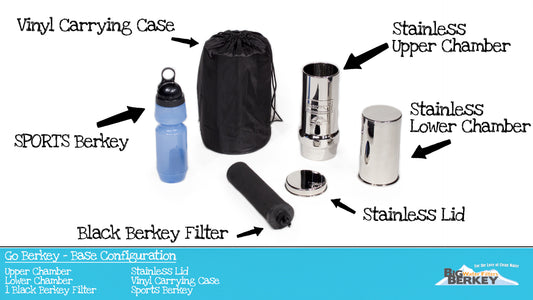
The smaller Berkey models (Go Berkey, Travel Berkey) fit smaller kitchens. Faucet-mount filters take no counter space at all but require NSF/ANSI 53 certification for arsenic.
Recommended: Travel Berkey or NSF 53 arsenic-certified faucet filter
Budget-Conscious, Arsenic Confirmed
A gravity filter delivers the most arsenic reduction per dollar over five years. Faucet filters cost less upfront but cartridges run higher per gallon. Pitchers are cheapest but most are not certified for arsenic.
Recommended: Berkey gravity system for best 5-year cost per gallon
Five-Year Cost Comparison
Approximate total cost including filter system purchase and replacement consumables, based on a typical four-person household.
Gravity Filter
$400 to $700
2 to 3 cents per gallon
Gravity + PF-2
$500 to $850
Targeted arsenic stage included
Under-Sink RO
$600 to $1,400
Plus install + membrane changes
Whole-House RO/POE
$4,000 to $10,000+
Plus annual service contract
Whole-House Arsenic Filtration: When It Makes Sense
Most arsenic exposure happens through ingestion of drinking water rather than skin contact during showering or bathing. For that reason, point-of-use filtration at the kitchen tap addresses the dominant exposure route for most households at a fraction of whole-house cost. A whole-house point-of-entry system becomes the more defensible choice when:
- Arsenic concentrations are confirmed sharply above 10 µg/L across the supply
- Multiple household members consume water at multiple taps regularly
- The household includes pregnant women, infants, or young children for whom even low-level cumulative exposure is a concern
- Well water is the source and a single point-of-use filter cannot cover all the relevant draw points
For these households, whole-house RO or a dedicated POE arsenic adsorption system (typically using iron-based or activated alumina media) is the appropriate investment, with professional installation and a service plan. For everyone else, point-of-use gravity filtration captures the dominant exposure route at a sustainable cost.
How to Verify Any Arsenic Filter Claim
Manufacturer claims for arsenic reduction should be backed by independent third-party laboratory testing with a traceable report. Before choosing any filter:
-
Look for NSF/ANSI 53 arsenic certification on the specific model (not the brand, since brands often have certified and uncertified models in the same product line).
-
Ask for the lab report. A real lab report includes the testing facility's name and accreditation, the challenge concentration, the post-filter result, and the EPA or ANSI test method used.
-
Check whether the test covers arsenic V, arsenic III, or both. Some products only address one form.
-
Test your own water first. Send a sample to a certified lab to confirm your actual arsenic level, then match the filter to the result. Buying a whole-house arsenic system without knowing your water's arsenic concentration is expensive guesswork.
For full lab documentation on the gravity-filter options compared above, see the Black Berkey inorganic test results (LA County ETL, EPA Method 200.8) and the Berkey Phoenix VOC, pesticide, and heavy metals test results (CVR Labs, NABL accredited).
For background on arsenic itself (sources, health effects, EPA limits, testing), see our arsenic in drinking water guide. For the brand-specific answer to whether Berkey systems reduce arsenic, see do Berkey water filters reduce arsenic. For comparable reduction of other heavy metals, see our guides on lead in drinking water and chromium-6 reduction.
Frequently Asked Questions
What is the best water filter for reducing arsenic in drinking water?
For most households at point-of-use, a gravity-fed filter delivers the best balance of performance, cost, and convenience. Independent lab testing recorded Black Berkey elements reducing arsenic by 99.0% or more at a 200 microgram per liter challenge (LA County Environmental Toxicology Laboratory), and Berkey Phoenix elements reducing arsenic by 99.5% or more at the same challenge level (CVR Labs, NABL accredited). For high-arsenic well water, adding a PF-2 activated alumina post-filter provides additional targeted reduction. For very elevated whole-house arsenic, reverse osmosis or a dedicated point-of-entry system is more thorough at higher cost.
What is the best whole-house water filter for arsenic?
For confirmed elevated arsenic across an entire household supply, whole-house reverse osmosis or a dedicated point-of-entry arsenic adsorption system (typically iron-based or activated alumina media) are the appropriate choices. Both require professional installation, a service plan, and a five-year total cost typically between $4,000 and $10,000 or more. For most households where arsenic exposure is dominated by ingestion at the kitchen tap, point-of-use gravity filtration covers the primary exposure route at a fraction of the cost.
Do pitcher filters reduce arsenic?
Most pour-through pitchers are not certified for arsenic reduction. A small number of newer pitcher models claim arsenic reduction, but certification is model-specific, not brand-wide. Before relying on a pitcher for arsenic, verify the exact model's NSF/ANSI 53 arsenic listing on the certifier's website.
What is the difference between arsenic V and arsenic III?
Arsenic V (arsenate) is the more oxidized form and is more common in chlorinated municipal water. Arsenic III (arsenite) is the more reduced form and is more common in anaerobic well water. Arsenic V is easier to reduce by adsorption media; arsenic III is harder to reduce unless first oxidized to arsenic V. When choosing a filter, confirm whether it has been tested against the form of arsenic likely present in your water.
Does boiling water reduce arsenic?
No. Boiling does not reduce arsenic. Because arsenic is a metalloid, not a volatile compound, boiling actually concentrates arsenic as water evaporates as steam, raising the per-liter concentration in what remains. Effective arsenic reduction requires filtration, adsorption, or reverse osmosis.
What is the EPA limit for arsenic in drinking water?
The EPA maximum contaminant level for arsenic in public drinking water is 10 micrograms per liter (parts per billion). The EPA's stated long-term goal is zero, as no safe level of arsenic exposure has been established. Private well water is not regulated under this standard and is not routinely tested by federal or state agencies, so well owners are responsible for their own testing.
How do I know if my water has arsenic?
Arsenic is tasteless, colorless, and odorless in water, so it cannot be detected without testing. For municipal water, request your utility's annual Consumer Confidence Report. For well water, send a sample to a certified laboratory for analysis. Some at-home test kits indicate presence or absence but do not quantify exact levels; if a home test is positive, follow up with a lab analysis to confirm the concentration.


 By
Dan DeBaun
By
Dan DeBaun