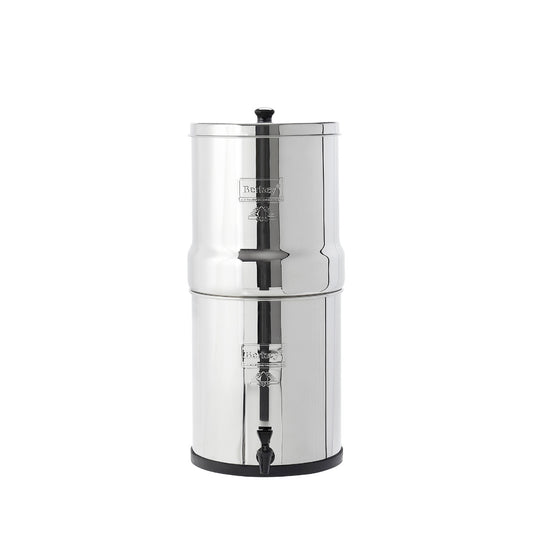
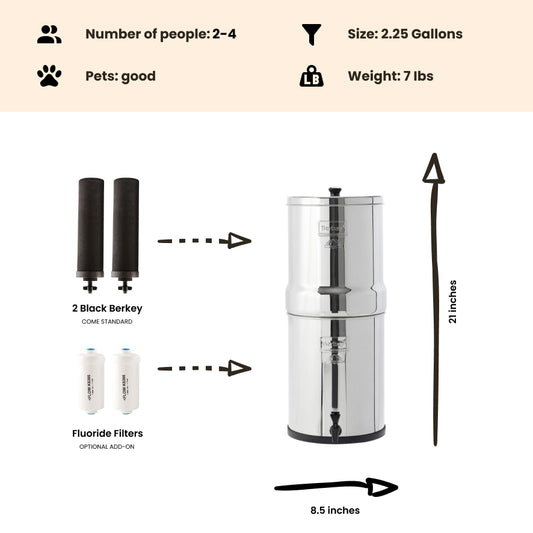
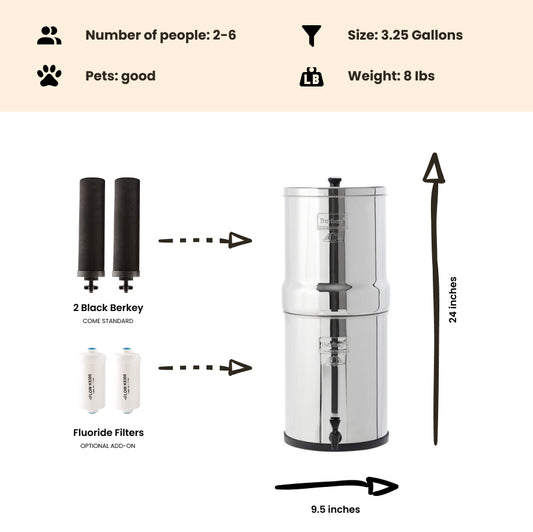
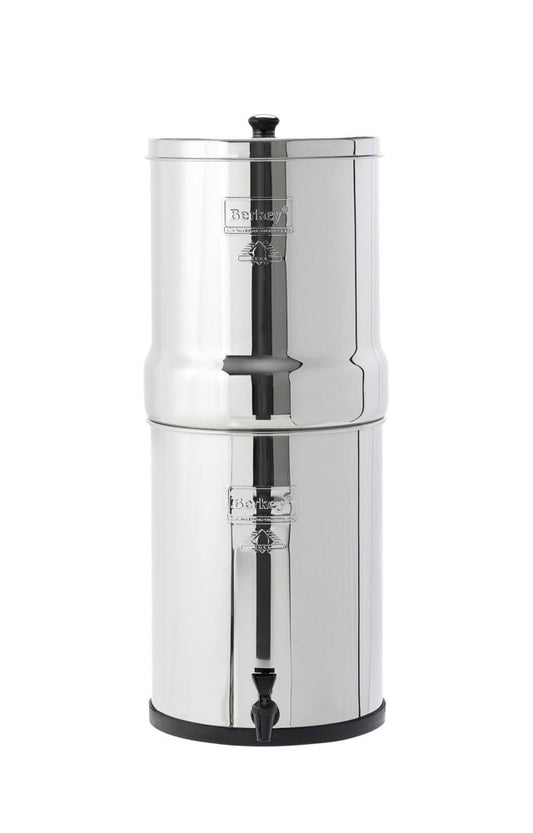
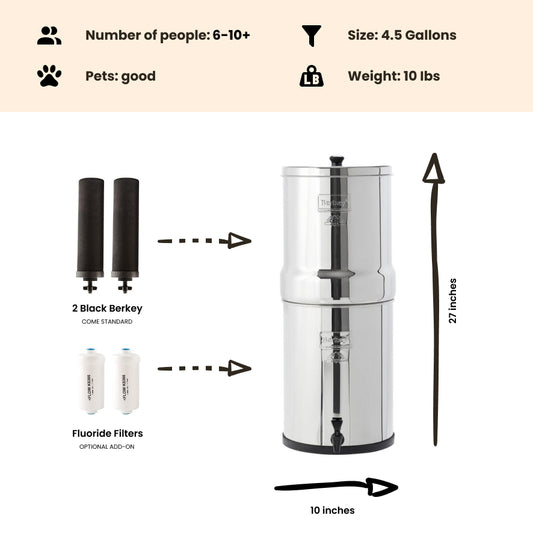
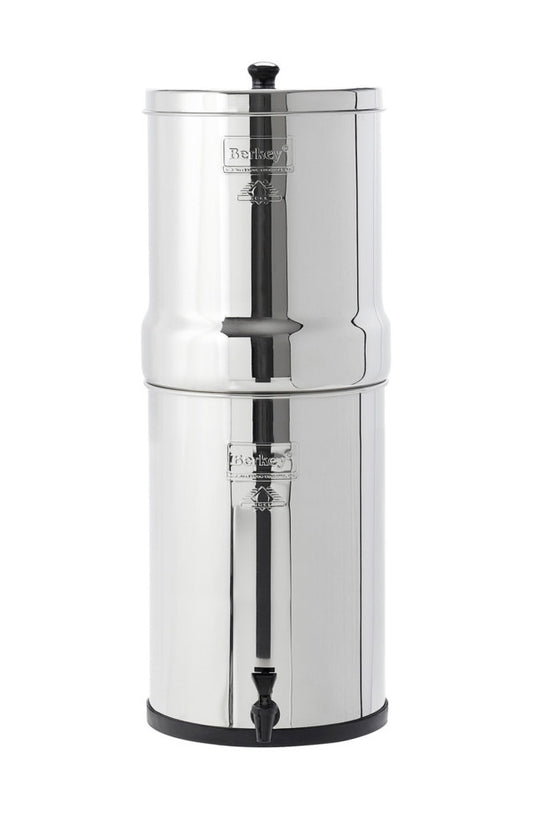
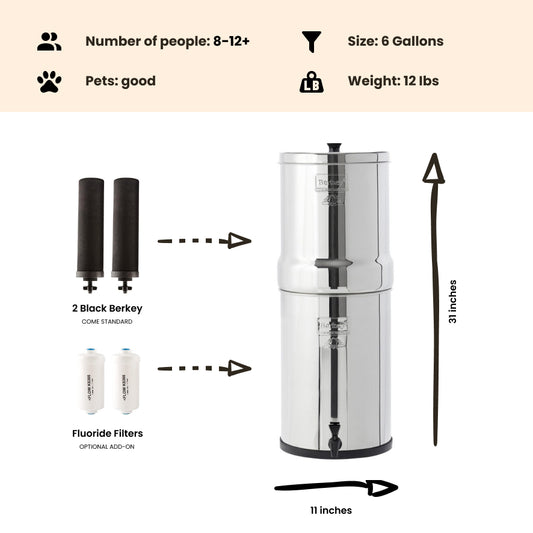
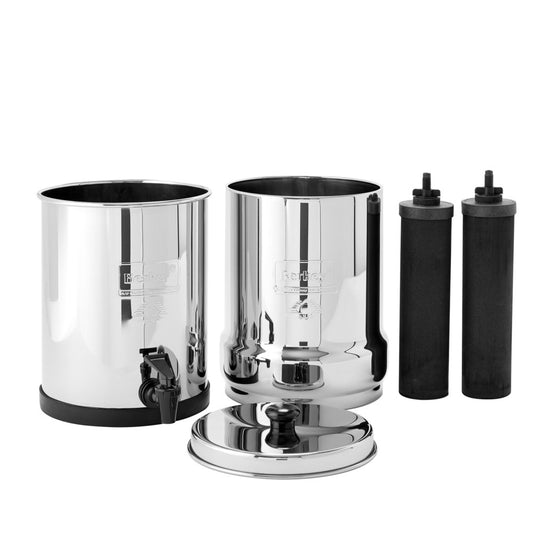
Berkey and Culligan are two of the most searched water filter brands in the U.S., but in 2026 Culligan is not a single product. They now sell two distinct pitcher lines: a legacy basic pitcher filtered only for chlorine taste and odor, and a ZeroWater Technology line with 5-stage filtration certified to reduce PFAS, lead, and 25+ contaminants. Berkey gravity filtration systems are tested against 200+ contaminants by independent EPA-accredited third-party laboratories, come standard with Black Berkey filter elements, and produce filtered water at roughly $0.02 per gallon over the life of the elements. The ZeroWater line is more capable than the old Culligan pitcher, but its filter lifespan and long-term cost tell a very different story than the upfront price suggests.
Quick answer: The legacy Culligan pitcher addresses chlorine taste only. Culligan ZeroWater offers broader certified filtration but carries one of the highest per-gallon filter costs in its category, as much as $0.90 per gallon in high-TDS water. Berkey wins on documented filtration depth, filter lifespan, and cost per gallon at virtually every usage level.
About the Brands
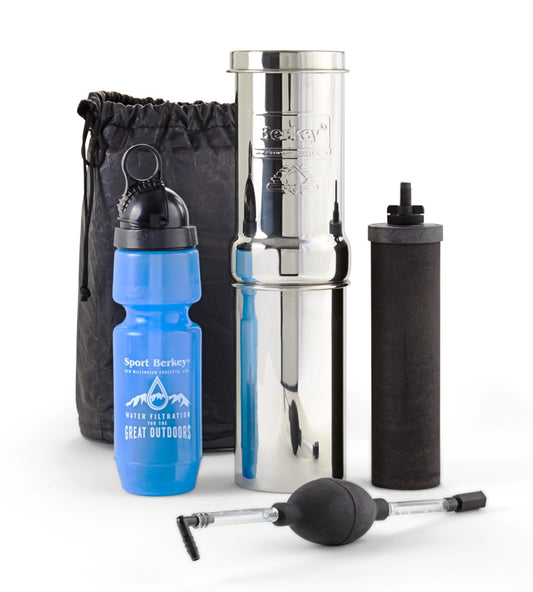
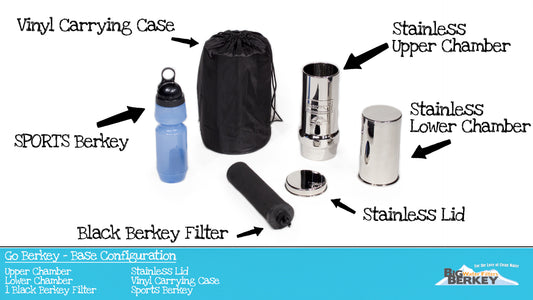
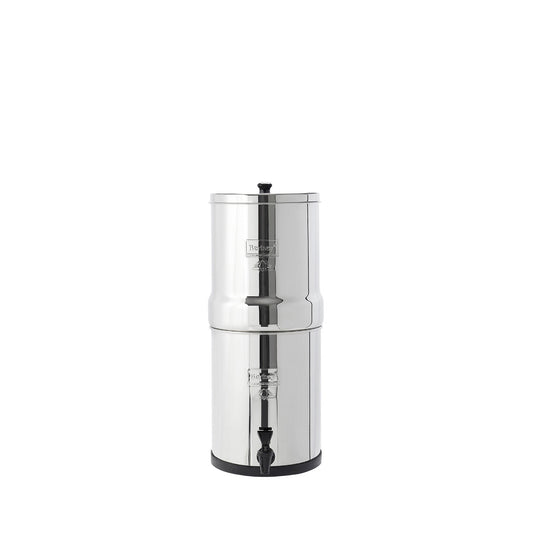
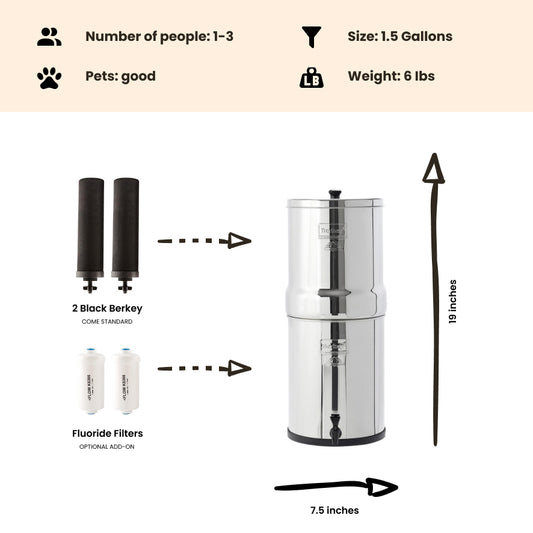
Berkey has been producing gravity-fed filtration systems for over 25 years, manufactured by New Millennium Concepts, Ltd. (NMCL) and sold exclusively through an authorized dealer network. BigBerkeyWaterFilters.com is the largest authorized Berkey dealer in the U.S., offering the full product line alongside publicly downloadable lab test results from independent EPA-accredited third-party laboratories. Berkey does not sell through mass retail; purchases go through authorized dealers only.
Culligan was founded in 1936 and is one of the oldest water treatment companies in the U.S., historically known for whole-home water softeners and dealer-installed systems. Their consumer pitcher line evolved significantly in recent years following the acquisition of ZeroWater, a separate brand built around 5-stage ion exchange deionization technology. The two Culligan pitcher products in this article represent very different technologies. The legacy Culligan pitcher is a basic activated carbon filter. The Culligan ZeroWater Technology pitcher is a more advanced deionization system with a broader certified contaminant profile and a meaningfully different cost structure. Culligan also sells a stainless steel countertop gravity system called MaxClear, which is a direct competitor to Berkey in the countertop gravity category. We compare that system separately in our Berkey vs. Culligan MaxClear gravity filter comparison.
Quick Comparison: Berkey vs. Culligan Pitchers
Scroll right to see all columns
| Feature |
Berkey |
Culligan ZeroWater |
Culligan Legacy |
| Starting Price |
~$367 (Big Berkey, Black Berkey elements included) |
~$35 to $50 (10 to 22-cup) |
~$20 to $25 |
| Included Filter |
Black Berkey elements (standard), 6,000 gal/pair |
1 ZeroWater 5-stage filter |
1 activated carbon filter |
| Filter Lifespan |
6,000 gal/pair (Black Berkey) |
TDS-dependent, as low as 20 gal in high-TDS water |
40 to 50 gallons |
| Est. Cost Per Gallon |
~$0.02 |
~$0.36 to $0.90+ |
~$0.20 to $0.30 |
| Certification Body |
Tested to NSF/EPA standards; Phoenix Elements NSF/ANSI 42 and 372 certified |
IAPMO (NSF/ANSI 42 and 53) |
NSF/ANSI 42 |
| Contaminants Tested |
200+ including PFAS, heavy metals, pharmaceuticals, VOCs, radiologicals |
25+ including total PFAS, lead, pharmaceuticals, pesticides |
Chlorine taste/odor, sediment, mercury, copper, zinc |
| PFAS Reduction |
Yes, PFOA directly tested at 99.9%+ reduction; 8 additional PFAS compounds via surrogate methodology, all at 99.9%+ |
Yes, PFOA/PFOS certified; total PFAS on newer line |
No |
| Lead Reduction |
Yes, documented in lab reports |
Yes, IAPMO certified |
No |
| Removes Beneficial Minerals |
No, minerals retained |
Yes, deionization removes calcium and magnesium |
No |
| Lab Reports Public |
Yes, downloadable PDFs |
Certification report listed; no full PDF lab library |
No |
| System Warranty |
Berkey system warranty |
90 days |
Limited |
| Electricity Required |
No |
No |
No |
| EWG Recognition |
Yes, Travel Berkey "Best Overall" |
Not recognized |
Not recognized |
The Culligan Legacy Pitcher: Narrow Scope, Low Cost
The legacy Culligan pitcher (PIT-1 and OP-1) is an activated carbon filter certified to NSF/ANSI 42. It covers chlorine taste and odor, sediment, mercury, copper, and zinc, and does that job reliably at a low price. The filter lasts 40 to 50 gallons and the pitcher holds roughly 2 quarts. For someone whose only concern is improving city tap water taste, it works for that specific problem.
The scope is also narrow by design. NSF/ANSI 42 is one of the more limited water filter certifications available. It does not cover PFAS, lead, pharmaceuticals, pesticides, or VOCs. There are no publicly downloadable lab reports. If your concern goes beyond taste and odor, this product was not engineered to address it.
It is also increasingly a legacy option in Culligan's own lineup. Their retail and marketing push has shifted almost entirely to the ZeroWater line, which represents a different technology at a different price point. Most buyers searching for a Culligan pitcher today will encounter ZeroWater at the point of sale.
Culligan ZeroWater: More Capable, But Read the Fine Print on Cost
The Culligan ZeroWater pitcher is IAPMO certified to NSF/ANSI 42 and 53, covering chlorine taste and odor, lead, chromium, PFOA/PFOS, and mercury. The newer Culligan ZeroWater Technology line extends that to total PFAS, pharmaceuticals, and pesticides, covering more than 25 contaminants. It includes a TDS meter so you can verify filtration performance directly. For a pitcher-format filter, that is a genuine step up from the basic carbon filters that dominate the market.
The filtration technology is not the problem. The cost structure is.
The Filter Lifespan Problem
ZeroWater uses ion exchange deionization, a process that strips virtually all dissolved solids from water, including both contaminants and beneficial minerals like calcium and magnesium. That thoroughness is also why the filters exhaust quickly. Filter lifespan is entirely TDS-dependent, meaning it varies based on the mineral content of your local tap water. In low-TDS areas, a filter may last several months. In average to high-TDS water, which covers a large portion of U.S. cities, particularly in the Southwest, Midwest, and Florida, filters can reach end-of-life in a matter of weeks.
Culligan does not publish a fixed gallon capacity for the ZeroWater filter. They direct buyers to a TDS chart to estimate lifespan. Independent testing has documented certified capacity as low as 20 gallons per filter, with a calculated maintenance cost approaching $0.90 per gallon. Replacement filters run approximately $18 per filter when purchased in a 2-pack. At 20 gallons per filter and 1 to 2 gallons of use per day, that means replacing a filter every 10 to 20 days.
Culligan does not list a fixed gallon capacity for ZeroWater filters. Lifespan depends entirely on the TDS of your local tap water. In cities with high mineral content, you may replace filters multiple times per month. Look up your city's average TDS before factoring ZeroWater into a long-term cost comparison.
The Mineral Removal Trade-Off
ZeroWater's deionization removes 99.9% of total dissolved solids, including naturally occurring calcium and magnesium. Culligan acknowledges this openly and notes that dietary minerals come primarily from food. For buyers who prefer water that retains naturally occurring minerals, deionization is worth factoring into the decision. Berkey's gravity filtration reduces targeted contaminants while leaving naturally occurring minerals intact.
5-Year Cost Comparison
At 1 to 2 gallons of filtered water per day, the cost difference between these three products becomes significant over time. The ZeroWater estimates below use a conservative 40-gallon per filter lifespan. In high-TDS water the actual cost will be higher.
Culligan Legacy
Estimated 5-year total
~$370 to $625
Pitcher~$20 to $25
Filter lifespan40 to 50 gal each
Replacement cost~$10 to $12 each
Est. filters per year~7 to 10
5-year total~$370 to $625
Cost per gallon~$0.20 to $0.30
Culligan ZeroWater
Estimated 5-year total
~$850 to $1,660+
Pitcher (10-cup)~$35 to $50
Filter lifespan20 to 40 gal (TDS-dependent)
Replacement cost~$18 each
Est. filters per year~9 to 18+
5-year total~$850 to $1,660+
Cost per gallon~$0.36 to $0.90+
Big Berkey
Estimated 5-year total
~$367 to $487
System + Black Berkey elements$367
Black Berkey lifespan6,000 gal/pair
Phoenix replacement (if needed)$120/pair
Est. replacements over 5 years0 to 1
5-year total~$367 to $487
Cost per gallon~$0.02
The ZeroWater pitcher's $40 upfront cost looks reasonable until the filter replacement math catches up. In average-TDS water, five-year ZeroWater filter costs alone can exceed $1,000, two to three times the total cost of Berkey ownership over the same period. The legacy Culligan pitcher is actually cheaper to run annually than the ZeroWater line, despite offering a fraction of the filtration capability.
The math: ZeroWater's $40 pitcher can become a $1,600+ commitment over five years in high-TDS water. Berkey's cost per gallon of ~$0.02 holds constant regardless of your local water TDS, because the Black Berkey element's lifespan is not TDS-dependent.
Filtration Depth and Lab Documentation
Berkey's test library covers 200+ contaminants with results from independent EPA-accredited third-party laboratories, available as downloadable PDFs on the BBWF test results page. Current Phoenix Elements are tested by NABL-accredited ISO/IEC 17025:2017 certified laboratories, carry NSF/ANSI 42 and NSF/ANSI 372 certifications, and their results are available on the Phoenix lab results page.
The documented contaminant list includes PFAS (PFOA directly tested at 99.9%+ reduction, with 8 additional PFAS compounds including PFOS, PFNA, PFBS, and PFHxS evaluated via surrogate methodology, all at 99.9%+), heavy metals, pharmaceuticals, pesticides, VOCs, and radiologicals.
Culligan ZeroWater's IAPMO certification to NSF/ANSI 42 and 53 is a legitimate third-party credential. NSF/ANSI 53 covers health-effects contaminants including lead and PFOA/PFOS, and that is meaningful independent validation. The newer Culligan ZeroWater Technology line extends certified coverage to total PFAS, pharmaceuticals, and pesticides. Where ZeroWater differs from Berkey is in public documentation depth. Culligan lists a certifications report but does not publish a downloadable lab PDF library comparable to Berkey's publicly available test documentation, making independent verification of specific reduction percentages across the full contaminant list more difficult.
Two additional areas where the filtration profiles diverge:
-
Radiologicals. Berkey's test library documents radiological contaminant reduction. ZeroWater publishes no equivalent data.
-
Contaminant breadth. Berkey documents specific reduction percentages across 200+ contaminants. ZeroWater's certified list covers 25+ contaminants. Both outperform the legacy Culligan pitcher, but the documentation depth is substantially different.
Media Recognition: Berkey's Verified Coverage
Berkey's media coverage is independently documented with links to original published articles. Every source below is verified and listed on the BBWF media coverage page.
-
EWG (Environmental Working Group) - Rated the Travel Berkey "Best Overall" in their independent PFAS water filter guide.
-
Food Network - Called Berkey the "holy grail of filtration" in a standalone product review.
-
CBS News - Covered EWG's PFAS filter testing with Berkey cited as a top performer.
-
LA Times - Referenced Berkey as the "Rolls-Royce of water filters."
-
The Prepared - Named Berkey a top gravity filter pick in their homestead water filtration guide.
-
Quality Edit - Reviewed Berkey and called it "worth the hype."
Neither the Culligan legacy pitcher nor the ZeroWater line appears in comparable independent performance evaluations focused on documented contaminant reduction depth.
Renters: Which Filter Actually Makes More Sense
Culligan pitchers are frequently recommended for renters on the basis of low upfront cost and zero installation. Both points are accurate. What the recommendation typically misses: Berkey also requires zero installation. It sits on a countertop, runs on gravity, and requires no plumbing, drilling, or landlord permission. The practical setup difference between a Berkey and a ZeroWater pitcher is filling one reservoir vs. filling another.
For renters in cities with average to high TDS water, the ZeroWater recurring filter cost can become a significant ongoing expense. A renter in Phoenix or Tampa replacing ZeroWater filters every two to three weeks is effectively on a subscription model. A renter who buys a Berkey takes it to the next apartment with years of filter life remaining on the same Black Berkey elements.
The one situation where a pitcher genuinely fits renters better: a stay of three months or less where the only goal is improved tap water taste. At that duration and that specific goal, the upfront cost difference is difficult to justify.
When Culligan Is the Right Choice
A Culligan pitcher is the right choice in four specific situations, and being clear about them matters for buyers trying to make the right call.
-
You live in a verifiably low-TDS city. In areas with naturally soft water, ZeroWater filter lifespan improves substantially and the cost-per-gallon math improves with it. If your local TDS is consistently low, the ZeroWater pitcher delivers certified PFAS and lead reduction at a more defensible ongoing cost.
-
Your only concern is chlorine taste from treated city water. The legacy Culligan pitcher handles this with an NSF/ANSI 42 certification at the lowest possible entry cost.
-
You have zero upfront budget right now. A $22 legacy pitcher is better than no filtration while you save toward a Berkey. It is a starting point, not a long-term solution.
-
You are in temporary housing of three months or less. Short-term stays where portability matters and taste improvement is the only goal, a pitcher makes practical sense.
Verdict
The legacy Culligan pitcher is an NSF/ANSI 42 taste-and-odor filter with a 40 to 50 gallon lifespan. It works for that narrow use case. It is not a meaningful competitor to Berkey on filtration scope or long-term cost.
The Culligan ZeroWater pitcher is a more capable product with certified PFAS and lead reduction, and one of the highest per-gallon filter costs in its category. Independent testing has documented certified capacity as low as 20 gallons per filter and maintenance costs approaching $0.90 per gallon. In high-TDS water, five-year ownership costs can exceed $1,600, well above total Berkey cost over the same period, at a fraction of the filtration breadth.
Berkey comes standard with Black Berkey elements tested against 200+ contaminants by independent EPA-accredited third-party laboratories, and produces filtered water at ~$0.02 per gallon across a 6,000 gallon per pair lifespan that does not depend on your local TDS. For any buyer planning to use a filter beyond a single season, that combination is difficult to match at any price point.
Frequently Asked Questions
Is Berkey better than the Culligan ZeroWater pitcher?
For most households, yes, on filtration depth, filter lifespan, and long-term cost. Berkey documents 200+ contaminants with downloadable lab reports from independent EPA-accredited third-party laboratories and produces water at ~$0.02 per gallon. Black Berkey elements are rated at 6,000 gallons per pair. The ZeroWater pitcher is IAPMO certified for 25+ contaminants including PFAS and lead, but filter lifespan is TDS-dependent and can be as low as 20 gallons per filter, driving per-gallon costs to $0.36 to $0.90 or higher.
How long does a Culligan ZeroWater filter last?
Culligan does not publish a fixed gallon capacity for ZeroWater filters. Lifespan depends entirely on the TDS of your local tap water. In low-TDS water a filter may last two to four months. In high-TDS water, common across large parts of the U.S., filters can reach end-of-life in weeks. Independent testing has documented certified capacity as low as 20 gallons per filter. By comparison, Berkey's Black Berkey elements are rated at 6,000 gallons per pair.
Does Culligan ZeroWater remove PFAS?
Yes. The newer Culligan ZeroWater Technology line is IAPMO certified to reduce total PFAS. The legacy ZeroWater line is certified for PFOA and PFOS specifically. Berkey's Black Berkey elements were independently tested with PFOA directly at 99.9%+ reduction and 8 additional PFAS compounds via surrogate methodology, all at 99.9%+, with results available as downloadable PDFs on the BBWF test results page.
What is the difference between the Culligan legacy pitcher and ZeroWater?
The Culligan legacy pitcher uses activated carbon filtration certified to NSF/ANSI 42, covering chlorine taste and odor, sediment, mercury, copper, and zinc, with a 40 to 50 gallon filter lifespan. The ZeroWater pitcher uses 5-stage ion exchange deionization certified to reduce 25+ contaminants including PFAS and lead. ZeroWater is more capable but carries a TDS-dependent lifespan that can be significantly shorter and more expensive to maintain long term.
How long do Berkey filter elements last compared to Culligan?
Big Berkey systems come standard with Black Berkey elements rated at 6,000 gallons per pair, typically four to seven years at average household use. When replacement is needed, Phoenix Elements are the current option at 5,500 gallons per pair for $120. Culligan legacy filters last 40 to 50 gallons each. ZeroWater filters can be as low as 20 gallons each in high-TDS water. The lifespan gap between Berkey and either Culligan product is among the largest in the category.
Is Berkey cheaper than Culligan ZeroWater long term?
Yes, significantly so in most markets. Berkey filter media costs roughly $0.02 per gallon and the Black Berkey element lifespan does not depend on local water TDS. ZeroWater filter media costs $0.36 to $0.90+ per gallon depending on TDS. Over five years, ZeroWater filter replacement costs alone can exceed $1,000 in average-TDS water, compared to $0 to $120 in element replacement costs for Berkey.
Does ZeroWater remove beneficial minerals?
Yes. ZeroWater's ion exchange deionization removes 99.9% of total dissolved solids, including naturally occurring minerals like calcium and magnesium alongside contaminants. Culligan acknowledges this and notes that dietary minerals come primarily from food. Berkey's gravity filtration reduces targeted contaminants while leaving naturally occurring minerals intact.
What certifications does Berkey have compared to Culligan?
Berkey's Phoenix replacement elements carry NSF/ANSI 42 and 372 certifications, with all testing conducted by NABL-accredited ISO/IEC 17025:2017 certified independent laboratories and results published as downloadable PDFs covering 200+ contaminants. Culligan ZeroWater is certified by IAPMO to NSF/ANSI 42 and 53. The Culligan legacy pitcher holds NSF/ANSI 42 only. The primary distinction is publicly available documentation depth. Berkey's lab library allows independent verification of specific reduction percentages across the full contaminant list.
See the Full Berkey Lineup and Lab Documentation
Explore gravity filter systems backed by independent, downloadable lab results and see what 200+ contaminants tested actually looks like.
For additional comparisons see Berkey vs. Brita and the full BBWF media coverage page for verified third-party recognition from EWG, Food Network, CBS News, LA Times, and The Prepared.


 By
Dan DeBaun
By
Dan DeBaun