
British Berkefeld vs. Berkey Water Filters – Complete Guide and Filters Comparison 2026
Last updated: April 14, 2026 By
Dan DeBaun
By
Dan DeBaun
Table of Contents
- How Does British Berkefeld and Berkey Water Filters' Contaminant Reduction Performance Compare?
- How Do the Filter Materials and Technology Differ?
- How Do Their Optional Fluoride Filters Compare?
- Which System Has a Faster Filtration Rate?
- How Do the System Models and Build Quality Compare?
- What Is the Total Cost of Ownership for Each System?
- How Do Setup and Maintenance Requirements Differ?
- What Warranty and Return Policies Does Each Brand Offer?
- Frequently Asked Questions: Berkey vs. British Berkefeld
How Does British Berkefeld and Berkey Water Filters' Contaminant Reduction Performance Compare?
Berkey outperforms British Berkefeld in heavy metal and chemical contaminant reduction, while British Berkefeld focuses on particulate and bacterial removal through its ceramic structure. Both are gravity-fed systems, but their filtration technologies and long-term cost profiles are meaningfully different.
It's also worth noting that fluoride-reduction media has its limitations in some setups. Contact time matters: the longer water stays in the filter, the more effectively heavy metals can be removed. Higher flow rates are convenient, but they can reduce how thoroughly certain contaminants, such as pesticides, are filtered out.
Comparison Table of Berkey and British Berkefeld Systems
|
Feature |
Berkey Systems |
British Berkefeld Systems |
|
Filter Technology |
Carbon composite formulation with ion exchange resin. |
Ceramic structure (diatomaceous earth) with granular activated carbon. |
|
NSF Certifications |
Tested by State & EPA-accredited laboratories to exceed EPA & ANSI/NSF Standard 42, 53, 372 and 401 protocols |
Holds multiple official certifications: NSF 42, 53, 372, and 401. |
|
Contaminant Reduction |
Removes >99% heavy metals, chlorine & disinfection byproducts, VOCs, pesticides, pharmaceuticals, and PFAS. |
Reduces bacteria, parasites, sediment, chlorine, and taste & odor contaminants. |
|
Fluoride Filtration |
Uses PF-2 add-on filters; 99.75% effective at optimal PF of 6. |
Often integrated into specialized ceramic candles (e.g., Ultra Fluoride). |
|
Filtration Flow Rate |
Faster: Approximately 0.75 gallons per hour (GPH). |
Slower: Often 50% slower than the Berkey benchmark. |
|
Housing Material |
Durable 304 stainless steel with a standard plastic spigot. Stainless steel spigot available as optional upgrade. |
Durable 304 stainless steel; often includes a stainless steel spigot. |
|
Filter Lifespan |
6,000 gallons per pair of Black Berkey elements. |
800 gallons or six months for Ultra Sterasyl filters. |
|
Upfront Cost |
Higher initial price (approx. $367 for a Big Berkey). |
Lower purchase price, making it more accessible for budget buyers. |
|
Long-term Cost |
Lower cost per gallon (approx. two cents) due to long filter life. |
Higher long-term cost due to the need for frequent filter replacements every 6 months. |
|
Setup & Maintenance |
Requires manual priming of elements; surface scrubbing for maintenance. |
Ready-to-use or simple soak; cleaning with a soft brush or pad. |
|
Warranty |
Lifetime (housing) when purchased from bigberkeywaterfilters.com; 2-year pro-rated (filtration elements). |
Lifetime (housing); 6-month (filter candles). |
How Do the Filter Materials and Technology Differ?
The biggest difference is how the filters are built. Black Berkey elements use a carbon composite formulation to capture a wide range of dissolved and chemical contaminants through adsorption and ion exchange. British Berkefeld uses Ultra Sterasyl filters, which feature a ceramic structure that acts as a physical barrier against bacteria, parasites, and sediment.

What Is the Difference Between Black Berkey Elements and Ceramic Filters?
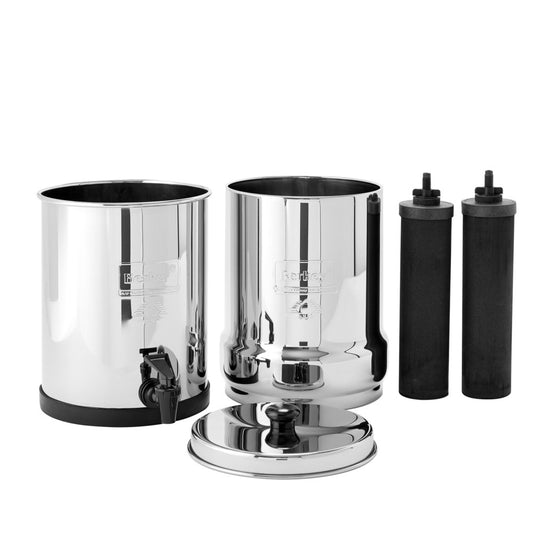
Black Berkey elements are composed of a formulation of more than a half dozen different media types constructed into a very fine matrix creating millions of micro-fine pores. The media formulation both absorbs some contaminants and adsorbs others. This porous carbon block core also speeds up water flow compared to ceramic alternatives.
British Berkefeld filters use a microporous ceramic element for particulate and sediment reduction, combined with integrated carbon media in certain models to reduce chlorine and improve taste and odor. Flow rate is governed by ceramic pore structure and surface loading over time.
How Do Their Optional Fluoride Filters Compare?
Berkey and British Berkefeld take different approaches to fluoride reduction: Berkey uses external add-on PF-2 elements, while British Berkefeld integrates fluoride media directly into specialized ceramic candles. Both approaches rely on similar adsorption principles and are subject to the same gravity-filtration constraints that affect fluoride reduction performance.
Berkey offers optional PF-2 fluoride elements that attach to the stems of Black Berkey filter elements. These use activated alumina media, a widely used and food-grade fluoride-reduction material in gravity and point-of-use systems. As with all gravity-based fluoride filtration, performance depends on contact time, flow rate, and source-water chemistry, and reduction efficiency can vary under real-world conditions.
British Berkefeld offers specialized ceramic candles with integrated fluoride-reduction media, such as its Ultra Fluoride configurations. While this design consolidates filtration into a single element, it relies on similar adsorption media and is subject to the same gravity-filtration constraints affecting fluoride reduction performance.
Which System Has a Faster Filtration Rate?
Berkey filters water faster than British Berkefeld. A standard gravity-fed system with two Black Berkey elements achieves a flow rate of approximately 0.75 gallons per hour (GPH). British Berkefeld models typically run 50% slower due to their denser ceramic outer shell.
The proprietary porous carbon block core in Berkey elements lets water pass through quickly without sacrificing contaminant reduction. British Berkefeld's tight physical barrier ensures thorough particulate and bacterial removal, but restricts water passage, making Berkey the better choice for users with high daily water needs.
How Do the System Models and Build Quality Compare?
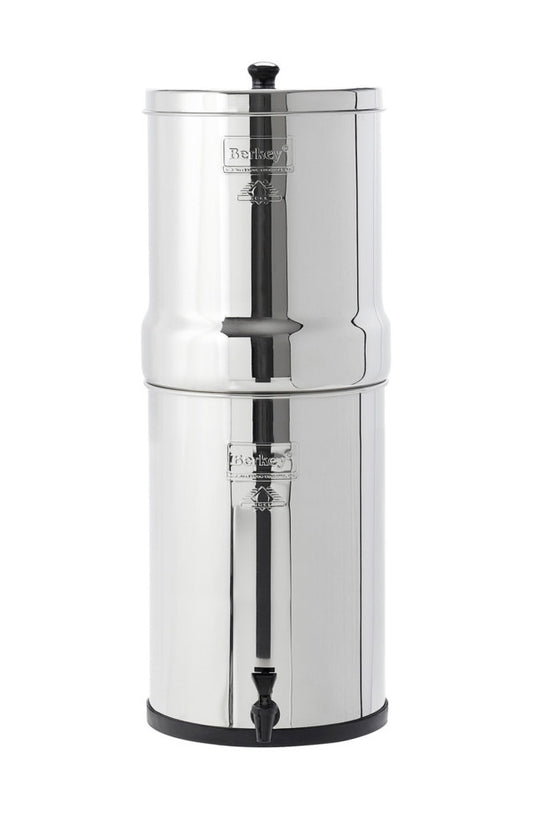
Both Berkey and British Berkefeld build their primary gravity-fed chambers from durable, polished 304 stainless steel, making them equivalent in housing quality and material safety. The key differences come down to spigot options and available model sizes.
Both brands offer systems across a range of sizes, including travel-sized and larger household configurations. Berkey systems typically ship with a standard BPA-free plastic spigot, with stainless steel and sight glass spigots available as upgrades to monitor water levels. British Berkefeld frequently includes a stainless steel spigot with newer units.
What Is the Total Cost of Ownership for Each System?
Berkey has a higher upfront price but delivers a lower cost per gallon over time. British Berkefeld has a lower entry price but requires filter replacements every 800 gallons or six months, which increases cumulative spend significantly for active households.
Calculating total ownership cost requires balancing upfront prices against long-term maintenance. Berkey systems cost more initially but offset this through extended service intervals. British Berkefeld units have a lower purchase price to get started, but require more frequent filter changes.
How Do the Upfront Purchase Prices Compare?
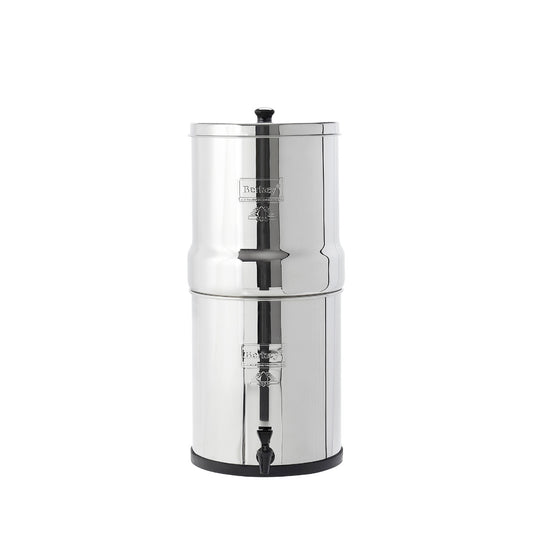
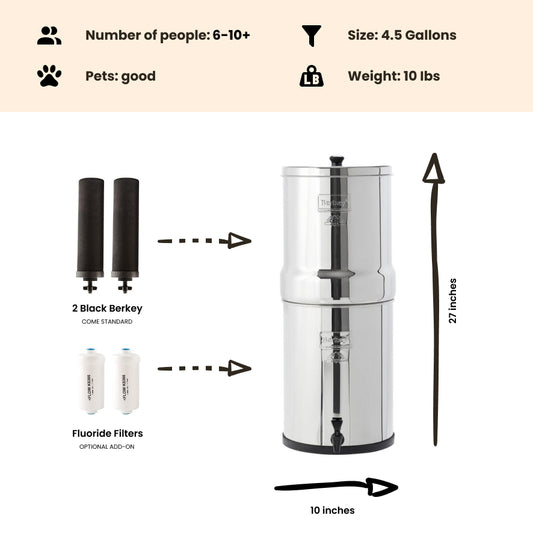
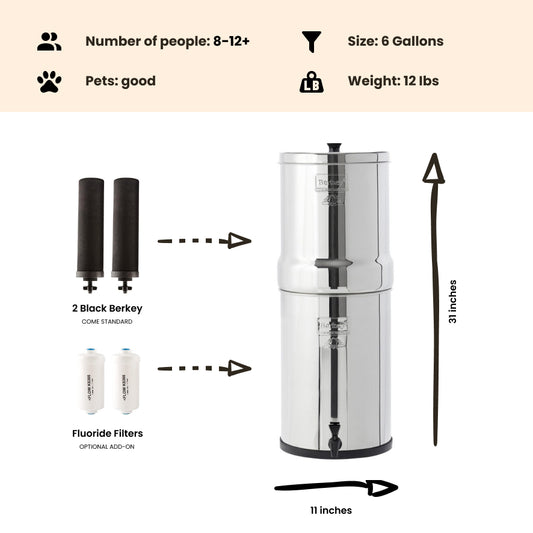
Berkey systems generally cost more than British Berkefeld units, a price difference that applies across models like the Travel Berkey, Royal Berkey, Imperial Berkey, and Crown Berkey. A standard Big Berkey with two Black Berkey elements costs approximately $367. Configurations that include two PF-2 fluoride filters increase the total upfront cost to $467.
British Berkefeld offers a lower entry price for their gravity-fed systems, making them the more accessible option for budget-conscious buyers. However, Berkey's premium price reflects its position as an established industry benchmark.
What Is the Long-Term Cost per Gallon Based on Filter Lifespan?
Black Berkey elements provide a significantly lower cost per gallon because they last for 6,000 gallons per pair, reducing ongoing costs to approximately two cents per gallon. British Berkefeld Ultra Sterasyl filters require replacement every 800 gallons or six months, which increases cumulative filter costs considerably over the life of the system.
Buyers must weigh Berkey's long-term savings against the more frequent replacement schedule that British Berkefeld's certified performance standard requires.

How Do Setup and Maintenance Requirements Differ?
Berkey requires manual priming before first use; British Berkefeld filters are typically ready to use or require only a brief soak. Both systems use similar stainless steel housing assembly, but filter preparation and ongoing maintenance differ between the two brands.
Which Filters Require Priming Before Use?
Black Berkey elements must be manually primed before first use to remove air and ensure proper water flow. This involves forcing water through the elements using a priming button or faucet adapter. British Berkefeld Ultra Sterasyl filters typically come pre-primed or require only a simple soak, eliminating the manual priming step.
What Is the Cleaning Process and Replacement Frequency?
Both systems require periodic chamber cleaning with mild soapy water to prevent buildup. To maintain Black Berkey elements, scrub the surface with a Scotch Brite pad to remove sediment accumulation. British Berkefeld recommends cleaning Ultra Sterasyl filters with a soft brush or pad under running water.
Replacement frequency varies significantly. A pair of Black Berkey elements lasts for 6,000 gallons, offering a potential filter lifespan of over 10 years. Add-on PF-2 fluoride filters require replacement every six months. British Berkefeld requires replacement filters every six months or 800 gallons to maintain certified performance levels.

What Warranty and Return Policies Does Each Brand Offer?
Berkey offers a lifetime warranty on stainless steel housing when purchased through bigberkeywaterfilters.com, plus a 2-year pro-rated warranty on filter elements. British Berkefeld offers a lifetime warranty on their stainless steel housing with a 6-month warranty on ceramic filter candles. Both brands typically offer a 30-day return policy.
Warranty terms for the filtration media differ meaningfully. Berkey's elements carry a 2-year pro-rated warranty calculated in six-month intervals. British Berkefeld's 6-month filter candle warranty aligns with their recommended replacement schedule. Both brands typically extend a standard 30-day return policy, giving buyers time to evaluate whether the system meets their needs.
Sources:
Frequently Asked Questions: Berkey vs. British Berkefeld
Is Berkey better than British Berkefeld?
Berkey is the stronger system for buyers who prioritize chemical contaminant removal, long filter life, and lower long-term cost. Berkey removes 200+ contaminants including heavy metals, pharmaceuticals, PFAS, and VOCs, with filter elements lasting 6,000 gallons per set. British Berkefeld excels at bacterial and particulate removal through its ceramic filtration structure and holds official NSF 42, 53, 372, and 401 certifications. The better choice depends on your water source and primary filtration goals.
What is the difference between Berkey and British Berkefeld filtration technology?
Berkey uses a carbon composite formulation with ion exchange resin that removes contaminants through both mechanical blockage and adsorption, an ionic process that bonds dissolved chemicals and heavy metals to the filter media. British Berkefeld uses a microporous ceramic outer shell (diatomaceous earth) as a physical barrier against bacteria, parasites, and sediment, with integrated carbon media in some models for chlorine and taste reduction. Berkey is better suited for chemical and dissolved contaminant removal; British Berkefeld is better suited for biological and particulate reduction.
How long do British Berkefeld filters last compared to Berkey?
British Berkefeld Ultra Sterasyl filters require replacement every 800 gallons or six months, whichever comes first. Berkey Black Elements last approximately 6,000 gallons per set, the equivalent of several years of use for most households. On a per-gallon basis, Berkey filters last roughly 7 to 8 times longer than British Berkefeld ceramic candles, making Berkey significantly more cost-efficient over the life of the system.
Does British Berkefeld have NSF certification?
Yes. British Berkefeld holds official NSF certifications under Standards 42, 53, 372, and 401. These cover aesthetic effects (chlorine, taste, and odor), health effects (lead and other contaminants), lead-free materials, and emerging contaminants respectively. Berkey Black Elements are tested by State and EPA-accredited laboratories to exceed the same NSF/ANSI standard protocols, though the Black Elements themselves do not carry official NSF product certifications. Berkey Phoenix Elements hold official NSF/ANSI 42 and NSF/ANSI/CAN 372 certifications.
Which system has a faster flow rate: Berkey or British Berkefeld?
Berkey is faster. A standard Berkey system with two Black Berkey elements achieves approximately 0.75 gallons per hour. British Berkefeld models typically flow at rates up to 50% slower due to the density of their ceramic outer shell. For households with higher daily water needs, Berkey's faster throughput is a meaningful practical advantage.
Which is cheaper long-term: Berkey or British Berkefeld?
Berkey is cheaper per gallon over time. Black Berkey elements cost approximately two cents per gallon over their 6,000-gallon lifespan, with most households replacing filters every several years. British Berkefeld's Ultra Sterasyl filters require replacement every 800 gallons or six months, resulting in significantly higher cumulative filter costs. While British Berkefeld has a lower upfront system price, Berkey delivers better long-term value for households that plan to use their system consistently.
Can Berkey filter well water? Can British Berkefeld?
Yes. Berkey is well-suited for well water because its carbon composite formulation with ion exchange resin targets the heavy metals, VOCs, and chemical contaminants commonly found in private well water beyond what municipal treatment addresses. British Berkefeld performs well for bacterial and particulate removal, which can also be relevant for well water, but its contaminant removal breadth for dissolved chemicals is more limited. For comprehensive well water treatment, Berkey offers broader coverage.
Does bigberkeywaterfilters.com offer a warranty on Berkey systems?
Yes. In addition to the manufacturer's 2-year pro-rated warranty on filter elements, bigberkeywaterfilters.com provides a lifetime warranty on all Berkey stainless steel housing and parts purchased through our store. This dealer-backed lifetime warranty exceeds what most competing systems offer and ensures your Berkey housing is protected for as long as you own it.
What is the difference between Berkey and British Berkefeld fluoride filtration?
Berkey uses optional external PF-2 fluoride filter elements that attach to the stems of Black Berkey filter elements. These use activated alumina media and achieve up to 99.75% fluoride reduction at optimal conditions. British Berkefeld integrates fluoride-reduction media directly into specialized ceramic candles such as the Ultra Fluoride configuration. Both approaches use similar adsorption-based media and are subject to the same gravity-filtration variables that affect real-world fluoride reduction, including contact time, flow rate, and source-water chemistry.

Dan DeBaun
-
Regular price $234.00 USDRegular priceUnit price per
-
Regular price $327.00 USDRegular priceUnit price per
-
Regular price From $367.00 USDRegular priceUnit price per
-
Regular price From $408.00 USDRegular priceUnit price per
-
Regular price From $451.00 USDRegular priceUnit price per
-
Regular price From $478.00 USDRegular priceUnit price per
-
Regular price $332.50 USDRegular priceUnit price per
$350.00 USDSale price $332.50 USDSale