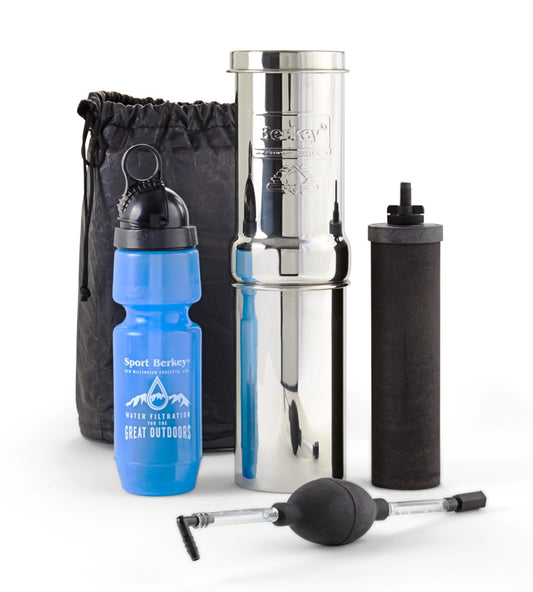
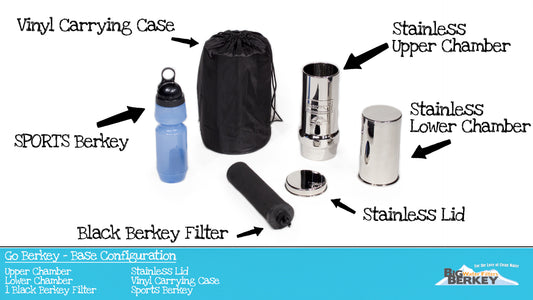
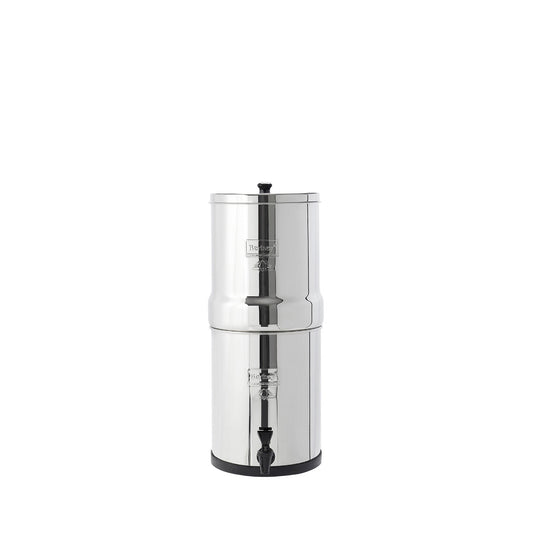
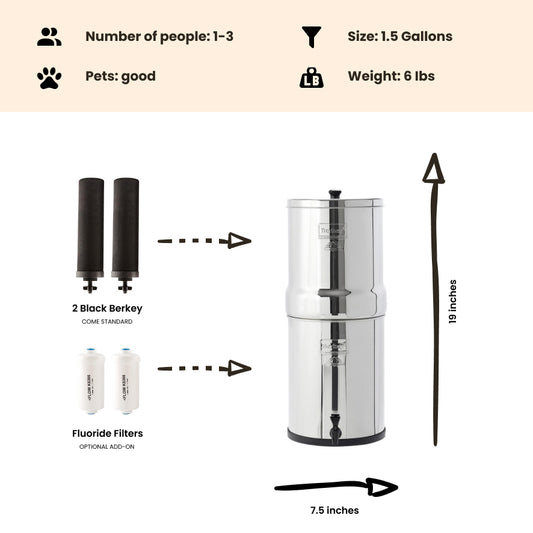
Black Berkey filter elements reduced the vast majority of the 54 organic contaminants tested by 99% or more in independent testing by the County of Los Angeles Environmental Toxicology Laboratory. The full test covers VOCs, chlorinated pesticides, herbicides, carbamates, glyphosate, MTBE, and haloacetic acids. All reported reduction percentages are minimums bounded by laboratory instrument sensitivity, so actual reduction may be higher. The full lab report is available as a downloadable PDF below.
Laboratory: County of Los Angeles, Department of Agricultural Commissioner, Environmental Toxicology Laboratory
Certification: California State DHS Certificate #1430
Report Date: August 22, 2012
Sample: Black Berkey Filter Element (Lab ID: E1201232001)
Commissioned by: New Millennium Concepts, Ltd.
Organic Contaminant Reduction Results
Results are grouped by contaminant category. All post-filtration results fell at or below the laboratory reporting limit, meaning actual reduction may be higher than the percentages shown.
Scroll to see full table
| Contaminant |
Pre-Filter |
Post-Filter |
% Reduction |
| Volatile Organic Compounds (VOCs): Method 524.2 |
| Dibromochloropropane (DBCP) |
100 µg/L |
<0.01 µg/L |
>99.99% |
| Ethylene Dibromide (EDB) |
100 µg/L |
<0.02 µg/L |
>99.98% |
| Bromodichloromethane |
250 µg/L |
<0.5 µg/L |
>99.80% |
| Bromoform |
250 µg/L |
<0.5 µg/L |
>99.80% |
| Chloroform |
250 µg/L |
<0.5 µg/L |
>99.80% |
| Dibromochloromethane |
250 µg/L |
<0.5 µg/L |
>99.80% |
| Benzene |
250 µg/L |
<0.5 µg/L |
>99.80% |
| Carbon Tetrachloride |
250 µg/L |
<0.5 µg/L |
>99.80% |
| 1,2-Dichlorobenzene |
250 µg/L |
<0.5 µg/L |
>99.80% |
| 1,4-Dichlorobenzene |
250 µg/L |
<0.5 µg/L |
>99.80% |
| 1,1-Dichloroethane |
250 µg/L |
<0.5 µg/L |
>99.80% |
| 1,2-Dichloroethane |
250 µg/L |
<0.5 µg/L |
>99.80% |
| 1,1-Dichloroethylene |
250 µg/L |
<0.5 µg/L |
>99.80% |
| cis-1,2-Dichloroethylene |
250 µg/L |
<0.5 µg/L |
>99.80% |
| trans-1,2-Dichloroethylene |
250 µg/L |
<0.5 µg/L |
>99.80% |
| Dichloromethane (Methylene Chloride) |
250 µg/L |
<0.5 µg/L |
>99.80% |
| 1,2-Dichloropropane |
250 µg/L |
<0.5 µg/L |
>99.80% |
| Ethylbenzene |
250 µg/L |
<0.5 µg/L |
>99.80% |
| 1,3-Dichloropropene |
250 µg/L |
<0.5 µg/L |
>99.80% |
| Monochlorobenzene |
250 µg/L |
<0.5 µg/L |
>99.80% |
| Styrene |
250 µg/L |
<0.5 µg/L |
>99.80% |
| 1,1,2,2-Tetrachloroethane |
250 µg/L |
<0.5 µg/L |
>99.80% |
| Tetrachloroethylene |
250 µg/L |
<0.5 µg/L |
>99.80% |
| Toluene |
250 µg/L |
<0.5 µg/L |
>99.80% |
| 1,2,4-Trichlorobenzene |
250 µg/L |
<0.5 µg/L |
>99.80% |
| 1,1,1-Trichloroethane |
250 µg/L |
<0.5 µg/L |
>99.80% |
| 1,1,2-Trichloroethane |
250 µg/L |
<0.5 µg/L |
>99.80% |
| Trichloroethylene (TCE) |
250 µg/L |
<0.5 µg/L |
>99.80% |
| Trichlorotrifluoroethane (Freon 113) |
250 µg/L |
<10 µg/L |
>96.00% |
| Total Xylenes |
750 µg/L |
<1.5 µg/L |
>99.80% |
| MTBE |
250 µg/L |
<1 µg/L |
>99.60% |
| Chlorinated Pesticides: Method 505 |
| Heptachlor |
10 µg/L |
<0.01 µg/L |
>99.90% |
| Heptachlor Epoxide |
10 µg/L |
<0.01 µg/L |
>99.90% |
| Endrin |
10 µg/L |
<0.1 µg/L |
>99.00% |
| Lindane |
10 µg/L |
<0.2 µg/L |
>98.00% |
| Hexachlorocyclopentadiene |
10 µg/L |
<1 µg/L |
>90.00% |
| Methoxychlor |
100 µg/L |
<10 µg/L |
>90.00% |
| Nitrogen and Phosphorus Pesticides: Method 507 |
| Atrazine |
50 µg/L |
<0.5 µg/L |
>99.00% |
| Simazine |
50 µg/L |
<1 µg/L |
>98.00% |
| Thiobencarb |
50 µg/L |
<1 µg/L |
>98.00% |
| Molinate |
50 µg/L |
<2 µg/L |
>96.00% |
| Chlorinated Acids and Herbicides: Method 515.3 |
| Pentachlorophenol |
6.65 µg/L |
<0.2 µg/L |
>96.99% |
| Silvex |
10.2 µg/L |
<1 µg/L |
>90.20% |
| 2,4-D |
10.1 µg/L |
<1 µg/L |
>90.10% |
| Dinoseb |
14.3 µg/L |
<2 µg/L |
>86.01% |
| Carbamates: Method 531.1 |
| Oxamyl |
100 µg/L |
<5 µg/L |
>95.00% |
| Carbofuran |
100 µg/L |
<5 µg/L |
>95.00% |
| Glyphosate: Method 547 |
| Glyphosate |
100 µg/L |
<25 µg/L |
>75.00% |
| Haloacetic Acids (Disinfection Byproducts): Method 552.2 |
| Bromoacetic Acid |
50 µg/L |
<1 µg/L |
>98.00% |
| Dibromoacetic Acid |
50 µg/L |
<1 µg/L |
>98.00% |
| Dichloroacetic Acid |
50 µg/L |
<1 µg/L |
>98.00% |
| Total Haloacetic Acids (HAA5) |
50 µg/L |
<1 µg/L |
>98.00% |
| Chloroacetic Acid |
50 µg/L |
<2 µg/L |
>96.00% |
Important note on reported percentages: Every post-filtration result in this report fell at or below the laboratory's reporting limit, the lowest concentration the equipment is capable of measuring. This means the percentages shown are floors, not ceilings. The filter may have reduced these contaminants to near zero, but the lab instruments could not confirm any value below their detection threshold. A result of ">75% reduction" for glyphosate, for example, does not mean 25% remained in the water. It means the post-filtration concentration was below 25 µg/L, the lowest level that instrument could measure, and actual reduction may be significantly higher.
Frequently Asked Questions
Does Black Berkey reduce VOCs?
Yes. Independent testing by the County of Los Angeles Environmental Toxicology Laboratory confirmed Black Berkey elements reduce 31 volatile organic compounds (VOCs) by 99.60% or more, including benzene, chloroform, toluene, TCE, and MTBE.
Does Black Berkey reduce glyphosate?
Yes. Black Berkey elements reduced glyphosate to below the laboratory's 25 µg/L reporting limit, recorded as greater than 75% reduction. That percentage reflects the sensitivity of the test equipment, not the filter's maximum performance. The post-filtration concentration fell below the lowest level the instrument could measure, meaning actual reduction may be considerably higher than 75%.
Does Black Berkey reduce atrazine and other pesticides?
Yes. Black Berkey elements reduced atrazine by over 99%, simazine and thiobencarb by over 98%, and heptachlor by over 99.9% in independent testing. A total of 16 pesticides and herbicides were tested, all with reductions of 86% or higher.
Does Black Berkey reduce haloacetic acids (HAAs)?
Yes. All five haloacetic acids tested, including total HAA5, were reduced by 96% or more. Disinfection byproducts like HAAs form when chlorine reacts with organic matter in water and are regulated by the EPA.
Are Black Berkey filters still available?
Every new Berkey system ships with Black Berkey Elements while supplies last. Black Berkey Elements are not sold as standalone replacements; the authorized replacement is the Berkey Phoenix Element. The current in-stock replacement is the Berkey Phoenix New Millennium Edition, made by the same manufacturer, NMCL, and a direct drop-in for any existing Berkey system.
Where can I see all Berkey filter test results?
All independent laboratory reports for Black Berkey and Phoenix filter elements are available on the Berkey Test Results page, covering inorganic contaminants, PFAS, radiological contaminants, lead, and more.

 By
Dan DeBaun
By
Dan DeBaun