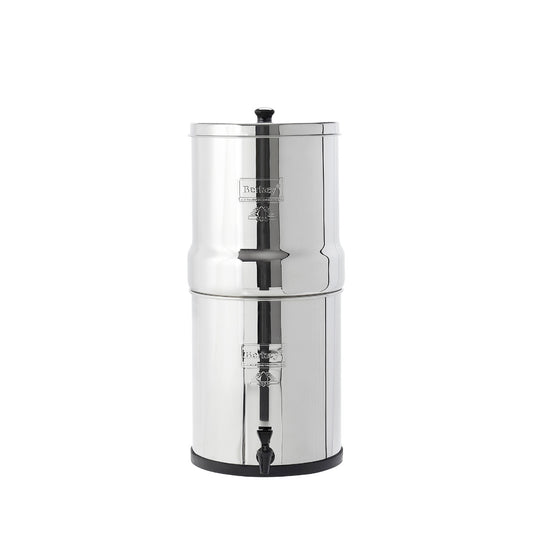
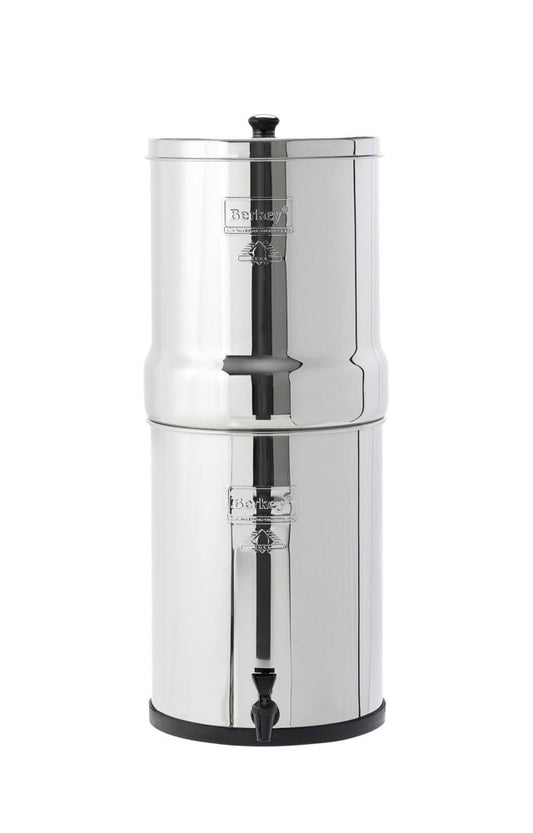
A heavy metal water filter is any drinking water system designed to reduce dissolved metals such as lead, arsenic, mercury, chromium, and cadmium from tap or well water. The most effective options are reverse osmosis systems, gravity-fed filters with activated carbon and ion exchange media, and certified under-sink filters tested specifically for heavy metals reduction. Pitcher filters and basic faucet filters offer limited heavy metals coverage and are not a reliable choice when lead or arsenic is a known concern. This guide compares the major filter categories, names the contaminants each one addresses, and ranks the systems with the strongest publicly available lab data. For a complete view of what Berkey filter elements reduce beyond heavy metals, see the contaminants Berkey filters remove guide.
Quick answer: For broad heavy metals reduction without plumbing or electricity, gravity-fed filters with documented lab testing for lead, arsenic, mercury, chromium, and cadmium are the strongest category for most households. Reverse osmosis is the strongest alternative when you have an under-sink installation point and accept the water-use trade-off. Pitcher and faucet filters should only be relied on for chlorine and basic aesthetic improvement, not heavy metals protection.
Which Heavy Metals Show Up in Drinking Water
The six metals that drive most home water testing concerns are lead, arsenic, mercury, chromium (including chromium VI), cadmium, and copper. Each one enters drinking water through a different pathway, and each has a federal EPA limit, called a Maximum Contaminant Level or action level, that determines when a utility must act.
Scroll to view full table →
| Metal |
Primary Source |
EPA Limit (MCL or Action Level) |
Key Health Concern |
| Lead |
Lead service lines, brass fixtures, solder |
15 ppb action level |
Neurological damage in children, kidney effects in adults |
| Arsenic |
Geological in groundwater, mining runoff |
10 ppb MCL |
Bladder, lung, skin cancer with long-term exposure |
| Mercury (inorganic) |
Industrial discharge, erosion of natural deposits |
2 ppb MCL |
Kidney damage |
| Chromium (total) |
Steel and pulp mills, erosion of deposits |
100 ppb MCL |
Allergic dermatitis, broader concern with Chromium VI |
| Chromium VI (hexavalent) |
Industrial discharge, plating operations |
No federal MCL; CA MCL 10 ppb |
Probable human carcinogen by ingestion |
| Cadmium |
Corrosion of galvanized pipes, runoff from waste |
5 ppb MCL |
Kidney damage with long-term exposure |
| Copper |
Corrosion of household plumbing |
1.3 ppm action level |
Gastrointestinal distress, liver damage at high levels |
Three notes on this table. First, boiling water does not reduce any of these metals. Boiling concentrates them by removing water as vapor. Second, taste and smell are not reliable indicators. Lead in water has no taste. Arsenic in water has no taste. A laboratory test or a certified home test kit is the only way to know what your water actually contains. Third, the EPA action level for lead is not a safety threshold. The agency states the goal for lead in drinking water is zero, and the action level is a treatment trigger for water systems, not a guarantee of safety for individuals.
How Heavy Metal Water Filters Work
Heavy metals are dissolved ions in water, not solid particles, so a sediment filter alone will not reduce them. Effective filters use one or more of four mechanisms: ion exchange (the primary mechanism for lead, mercury, and dissolved metals in carbon-blend gravity filters), adsorption by activated carbon, reverse osmosis membranes that physically reject dissolved ions, and specialty media such as activated alumina for fluoride and arsenic V. The strongest systems combine multiple mechanisms in sequence. Filter type alone does not predict performance: what matters is what the specific filter has been tested against, at what influent concentration, and by which laboratory.
How We Evaluated Heavy Metal Water Filters
This ranking is built on five criteria, applied consistently to every system in the comparison table. The goal is to surface filters with verifiable third-party data, not marketing claims.
-
Independent laboratory testing. Does the manufacturer publish lab reports from accredited third-party laboratories naming the contaminants tested, the influent concentrations, and the post-filtration results? Internal testing alone does not qualify.
-
Breadth of metals tested. A filter tested only for lead has a narrower use case than one tested across lead, arsenic, mercury, chromium, cadmium, and additional metals.
-
Documented reduction percentages. Specific numbers per metal carry more weight than category-level claims like "reduces heavy metals."
-
Cost per gallon over five years. Pitcher filters with low upfront cost often have higher long-term cost once cartridge replacement is factored in. Gravity systems and RO have higher upfront cost and lower per-gallon cost over time.
-
Honest limitations disclosed. Every filter has trade-offs. Systems whose marketing acknowledges the limitations of their certifications and testing scope are more credible than those that do not.
Heavy Metal Water Filter Comparison
The table below compares the gravity, under-sink, pitcher, and RO systems most commonly cited in heavy metals discussions. The Notable Limitation column applies to every brand, including Berkey.
Scroll to view full table →
| System |
Heavy Metals Tested |
Lab Reports Public |
Certifications |
Lifespan |
Notable Limitation |
| Berkey Gravity Systems* |
Lead, arsenic, mercury, chromium, chromium VI, cadmium, copper, iron, zinc, nickel, manganese, antimony, beryllium, bismuth, aluminum, selenium, thallium, and more |
Yes, downloadable PDFs |
Phoenix: NSF/ANSI 42 and NSF/ANSI/CAN 372. Black Berkey: tested by EPA and NSF-accredited labs |
5,500 to 6,000 gallons per set of 2, depending on element |
Phoenix Elements are newer; long-term third-party testing still accumulating |
| APEC under-sink RO |
Documented rejection for lead, arsenic, chromium, cadmium per industry rejection data |
Limited published per-system testing |
Some models NSF/ANSI 58 certified |
Membrane 2 to 5 years |
Requires plumbing and drain line; 2 to 4 gallons used per gallon produced |
| Aquasana under-sink |
Lead and select metals per certification scope |
Certification listings available |
NSF/ANSI 42, 53, 58, 401 on select models |
Cartridge 600 gallons typical |
Cartridge replacement cost compounds over time; performance scoped to certified contaminants only |
| PUR Plus pitcher |
Lead reduction certified to NSF/ANSI 53 |
Certification listings available |
NSF/ANSI 42, 53, 401 |
40 gallons or 2 months |
Short cartridge life; arsenic, chromium VI, mercury not in certification scope |
| ZeroWater pitcher |
Lead, chromium reduction in NSF/ANSI 53 scope; TDS-focused |
Certification listings available |
NSF/ANSI 42, 53 |
15 to 40 gallons depending on TDS |
Very short cartridge life in moderate-TDS water dramatically raises cost per gallon |
| Alexapure Pro gravity |
Lead, mercury, chromium per manufacturer claims |
Manufacturer summary data; key performance claims verified to 200 gallons per published footnotes |
Not NSF certified |
5,000 gallons claimed |
Independent verification depth and scope is narrower than peer gravity systems |
| British Berkefeld / Doulton |
Lead, mercury per NSF/ANSI 53 scope |
Certification listings available |
NSF/ANSI 53 on select elements |
1,500 gallons per element typical |
Same brand sold under two names; element lifespan shorter than peer gravity systems |
* Every Berkey system ships with Black Berkey Elements (6,000 gallons per pair, tested across 20+ heavy metals at Envirotek Laboratories and LA County ETL). Berkey Phoenix Elements are the current replacement option (5,500 gallons per pair, NSF/ANSI 42 and NSF/ANSI/CAN 372 certified, tested by NABL-accredited CVR Labs for lead, arsenic, mercury, chromium, chromium VI, cadmium, and copper at spiked-influent concentrations of 0.2 mg/L). NSF/ANSI 42 covers aesthetic contaminants including chlorine taste and odor. NSF/ANSI 372 confirms lead-free materials throughout the filter components. NSF/ANSI 53 covers contaminant reduction claims and is a different certification scope.
Berkey Heavy Metals Lab Data
Black Berkey Elements (ships standard with every Berkey system). Tested by Envirotek Laboratories (Report #14-260, October 2014) and the County of Los Angeles Environmental Toxicology Laboratory (August 2012). Results consistent at both pH 6.5 and pH 8.5:
- Lead: greater than 99.9% reduction
- Arsenic: greater than 99.9% reduction
- Mercury: greater than 99.9% reduction
- Chromium: greater than 99.9% reduction
- Chromium VI (hexavalent): greater than 99.85% reduction
- Cadmium: greater than 99.7% reduction
- Copper, Iron, Zinc, Nickel, Manganese: greater than 99.9% each
- Antimony, Beryllium, Bismuth: greater than 99.9% each
- Aluminum: greater than 99% reduction
- Selenium, Thallium: greater than 99.5% each
- Additional metals tested: Cobalt, Vanadium, Molybdenum, Barium
Berkey Phoenix Elements (current replacement option, $120/pair). Tested by CVR Labs (Report #25030011.01, March 2025), NABL-accredited under certificate TC-7618, ISO 9001:2015 and ISO 45001:2018 certified. Test protocol used spiked-influent at 0.2 mg/L to simulate worst-case contamination:
- Lead: greater than 99.9% reduction
- Arsenic: 100% removal to below detection limit
- Mercury: complete removal to below detection limit
- Chromium: complete removal to below detection limit
- Chromium VI: complete removal to below detection limit
- Cadmium: 100% removal to below detection limit
- Copper: complete removal to below detection limit
- Heavy metals across all tested compounds: greater than 99.5% reduction
Reduction percentages reflect the floor of laboratory detection at post-filtration testing. Where the result is stated as 100% or "below detection limit," the lab instrument could not detect any remaining contaminant. Actual reduction may be higher than the figure shown. Full lab reports are downloadable from the test results page, the Black Berkey complete contaminant list, and the Phoenix complete contaminant list.
Best Heavy Metal Water Filters: Ranked
The ranking below applies the five evaluation criteria to the systems in the comparison table. The winner is the option with the broadest documented heavy metals data, the longest filter lifespan, and the lowest cost per gallon over five years.
-
Berkey gravity systems with Black Berkey Elements. The strongest publicly available heavy metals lab data across the gravity category. Documented reduction percentages for lead, arsenic, mercury, chromium, chromium VI, cadmium, and additional metals from two independent accredited laboratories. No plumbing or electricity required. Filter lifespan of 6,000 gallons per pair delivers a cost per gallon around two cents.
-
Under-sink reverse osmosis (APEC, similar NSF/ANSI 58 systems). The strongest non-gravity option when broad heavy metals reduction is the goal and plumbing access is available. Documented rejection rates for lead, arsenic, and chromium are high. Trade-off is the water-use ratio and the drain line requirement.
-
British Berkefeld / Doulton gravity systems. NSF/ANSI 53 certification gives this system a legitimate credential for lead and mercury. Shorter element lifespan and narrower heavy metals testing scope than the top option.
-
Aquasana under-sink systems (select models). NSF/ANSI 53 certification on certified models gives credible lead reduction. Cartridge replacement cost compounds the long-term price.
-
Alexapure Pro gravity system. Manufacturer claims broad metals coverage but published verification depth is narrower than peer gravity systems. A reasonable option if certification depth is not a priority.
-
ZeroWater pitcher. Effective for short-term lead reduction in NSF/ANSI 53 scope. Cartridge replacement cadence in moderate-TDS water makes the long-term cost high.
-
PUR Plus pitcher. NSF/ANSI 53 certification covers lead specifically. Useful as an entry-level option. Not a substitute for broader heavy metals coverage when arsenic, chromium VI, or mercury are part of the concern.
Best Heavy Metal Water Filter by Use Case
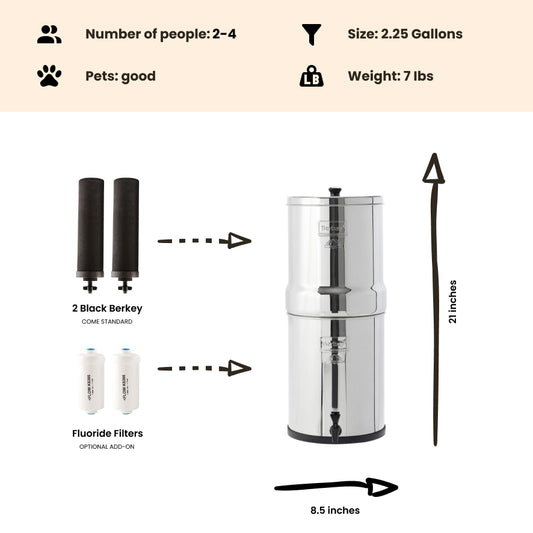
Best for a family of 2 to 4: Big Berkey
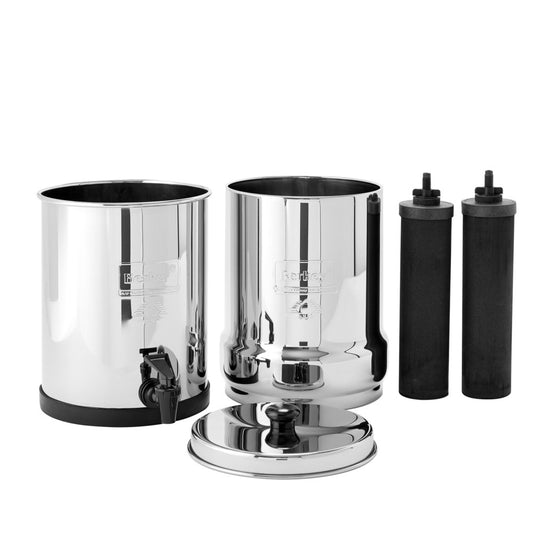
The Big Berkey holds 2.25 gallons and serves households of one to four people. It ships with two Black Berkey Elements, expandable to four for faster flow rates. Cost per gallon is approximately two cents over the lifespan of the filter elements.
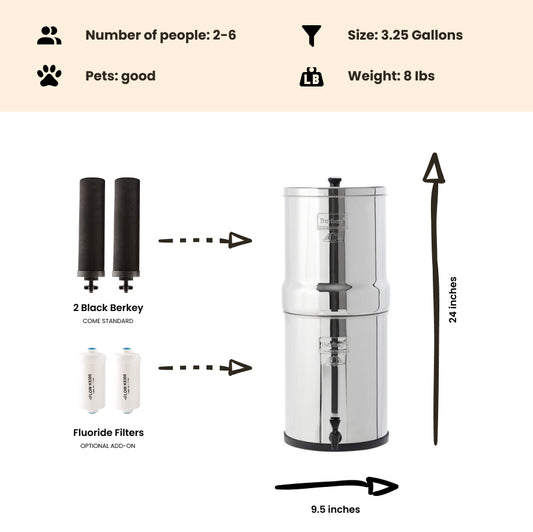
Best for a larger household: Royal or Imperial Berkey
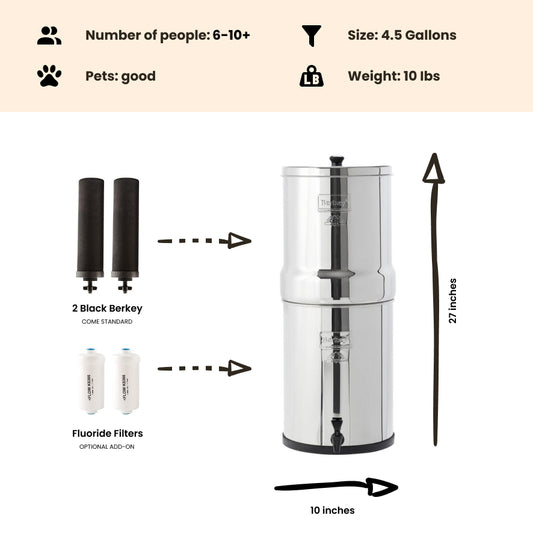
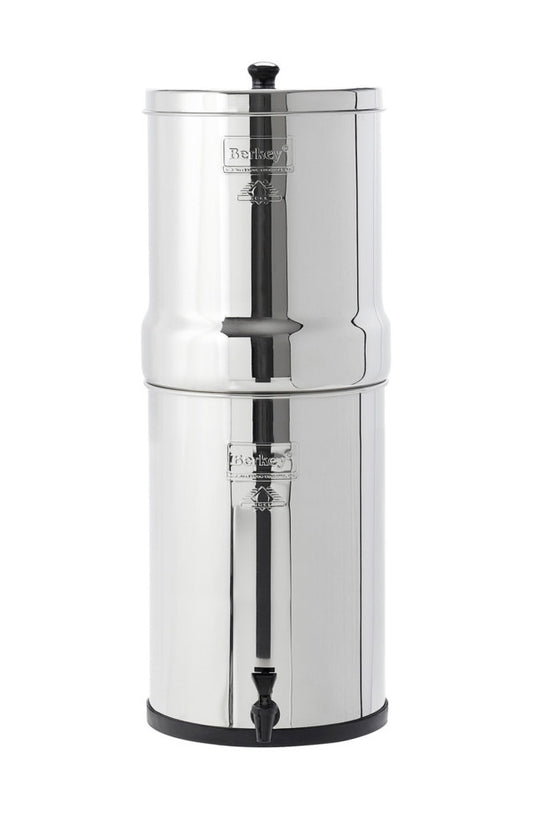
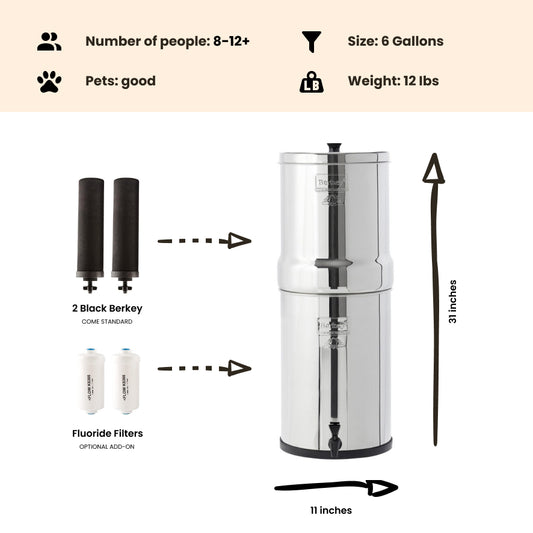
The Royal Berkey holds 3.25 gallons and serves two to six people. The Imperial Berkey holds 4.5 gallons and serves six to ten or more. Both systems use the same Black Berkey Elements and produce the same reduction percentages as the Big Berkey.
Best for travel, small households, and emergency preparedness: Travel Berkey
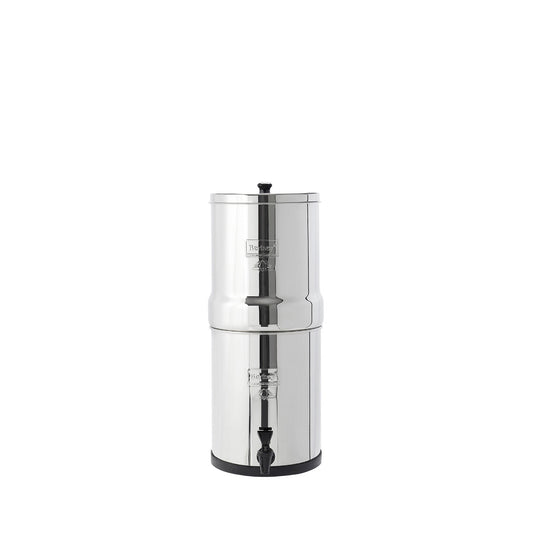
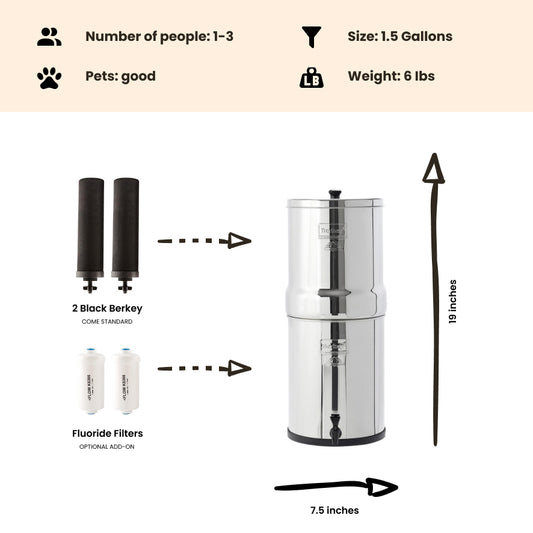
The Travel Berkey holds 1.5 gallons and serves one to three people. It uses the same Black Berkey or Phoenix Elements as the larger systems, so reduction percentages and contaminant coverage are identical. The compact stainless steel chambers nest for storage, making it the strongest fit for RV use, second homes, smaller households, and emergency preparedness kits. Accepts PF-2 Fluoride and Arsenic cartridges as an optional add-on for households with fluoride concerns.
Best ultra-portable option: Go Berkey Kit
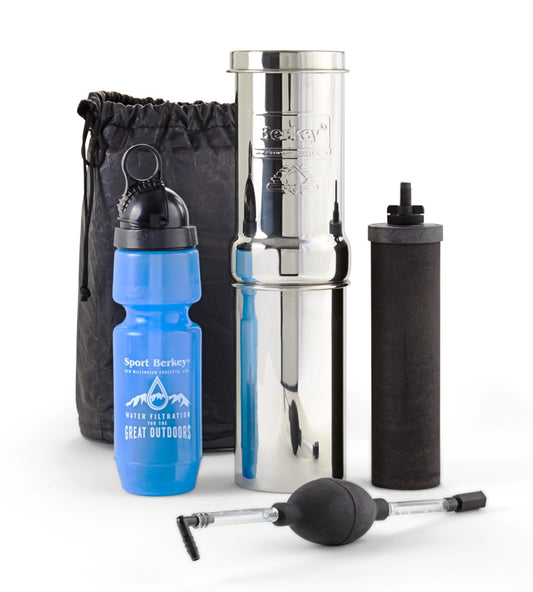
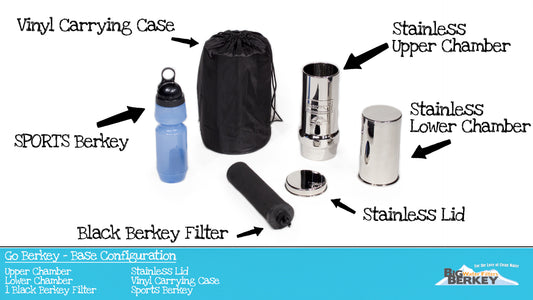
The Go Berkey Kit is a 1-quart stainless steel gravity filter paired with a Sport Berkey water bottle. The compact upper chamber nests inside the lower chamber for storage. The trade-off versus the Travel Berkey is smaller capacity and the Go Berkey Kit cannot accept a PF-2 cartridge. Best for single-person travel, camping, and packed luggage rather than household use.
Best for under-sink installation with broad metals coverage: certified RO
If counter space is a constraint and you accept the water-use trade-off, a quality NSF/ANSI 58 certified reverse osmosis system delivers broad heavy metals reduction. APEC ROES-50 and similar systems are commonly cited in this category.
If fluoride is a specific concern
Both Black Berkey and Phoenix filter elements already reduce arsenic at greater than 99 percent through ion exchange in the main filtration stage, so arsenic protection does not require any add-on. For households where fluoride is a documented concern, the optional PF-2 Fluoride and Arsenic Filters can be added to the lower chamber of any full-size Berkey system. PF-2 cartridges target both fluoride and arsenic using activated alumina, the documented industry standard for both contaminants. Because the main elements already address arsenic, PF-2 is functionally a fluoride add-on for most households. Cartridge life is 1,000 gallons per pair or one year, whichever comes first.
Cost Over Five Years
Big Berkey (2 to 4 people)
~$367
- System with 2 Black Berkey Elements: $367
- No element replacement within typical 5-year window at 3 gallons per day household use
- Approximate cost per gallon: $0.02
PUR Plus pitcher (replacement-heavy)
~$340
- Pitcher: $35
- ~30 cartridges over 5 years at $10 each: $300
- Excludes arsenic, mercury, chromium VI from certification scope
NSF/ANSI 58 under-sink RO (mid-range)
~$550 to $800
- System: $200 to $400
- Pre-filter and post-filter replacements: $200 to $300 over 5 years
- Membrane replacement (year 3 to 5): $50 to $100
- Installation if not DIY: add $150 to $300
ZeroWater pitcher (high-replacement cycle)
~$425 to $475
- Pitcher: $25 to $35
- ~22 cartridges over 5 years at $18 each: ~$400 (cartridges last 2 to 3 months in moderate-TDS water)
- NSF/ANSI 53 certified for lead and chromium; does not address arsenic
Five-year cost is one variable among several. The relevant question is whether the system's certification or testing scope covers the specific heavy metals in your water. A $35 pitcher that does not address arsenic is not a low-cost option in a household with arsenic-positive water. It is no option at all for that contaminant.
Frequently Asked Questions
Is a gravity water filter good enough to remove lead and microplastics?
A gravity water filter with documented lab testing for lead reduces lead in drinking water. Black Berkey Elements have been independently tested to reduce lead by greater than 99.9 percent. For microplastics, the filtration mechanism is mechanical: particles larger than the filter media's effective pore structure are physically blocked, while activated carbon and ion exchange media remove finer particulates. Microplastics testing protocols are still standardizing across the industry, so reduction claims should be supported by named laboratory data when possible.
Gravity water filter vs reverse osmosis for removing heavy metals and fluoride?
Both systems can reduce heavy metals effectively. Peer-reviewed rejection data for RO membranes documents arsenic, lead, chromium, and cadmium reduction in the high 90 percent range under controlled conditions. Quality gravity filters with independently tested elements deliver heavy metals reduction in the same range. For fluoride specifically, reverse osmosis membranes reduce fluoride as part of broad ion rejection, while gravity filters reduce fluoride through a dedicated activated alumina post-filter stage such as PF-2 cartridges. The choice depends on three trade-offs: plumbing access and drain line availability (RO requires both), water-use ratio (RO uses 2 to 4 gallons per gallon produced; gravity has no wastewater), and flow timing (RO produces water on demand; gravity fills over one to two hours). High-turbidity source water like some well water can compress maintenance intervals for both: gravity elements may need scrubbing if flow slows, and RO pre-filters clog faster.
Does a Berkey water filter remove fluoride, lead, and microplastics?
Berkey systems reduce lead at greater than 99.9 percent through the main Black Berkey or Phoenix filter elements. Arsenic is also addressed by the main elements at greater than 99 percent. For fluoride reduction, the optional PF-2 Fluoride and Arsenic cartridges add a dedicated activated alumina post-filter stage. For microplastics, the multi-media filtration in the main elements addresses particulates and bound contaminants. Full lab data covering each category is on the test results page.
What is the best water filter for lead removal?
The best water filters for lead are systems with documented NSF/ANSI 53 certification for lead reduction or systems with independent laboratory test results showing greater than 99 percent lead reduction. Quality gravity filters, under-sink reverse osmosis systems, and certified under-sink carbon block filters all qualify when independently tested. Pitcher and faucet filters that hold NSF/ANSI 53 lead certification work for lead specifically but typically do not cover the broader heavy metals spectrum.
Do water filters remove arsenic?
Reverse osmosis membranes reduce both arsenic V and arsenic III. Gravity-fed filters with activated carbon and ion exchange media reduce arsenic V effectively. For arsenic III, pre-oxidation to arsenic V improves reduction performance, which is why dedicated arsenic post-filter cartridges using activated alumina are commonly added to gravity systems when arsenic is a documented concern. Activated alumina is the documented industry standard for fluoride and arsenic V reduction.
Does boiling water remove heavy metals?
No. Boiling water concentrates heavy metals rather than reducing them. As water vaporizes, the dissolved metals remain in the pot or kettle. Heavy metals reduction requires filtration through activated carbon, ion exchange media, a reverse osmosis membrane, or specialty media such as activated alumina.
What heavy metals do Black Berkey Elements reduce?
Black Berkey Elements have been independently tested to reduce more than 20 heavy metals including lead, arsenic, mercury, chromium, chromium VI, cadmium, copper, iron, zinc, manganese, nickel, antimony, beryllium, bismuth, aluminum, selenium, thallium, and additional metals. Reduction percentages for lead, arsenic, mercury, and chromium exceed 99.9 percent. Chromium VI exceeds 99.85 percent. Cadmium exceeds 99.7 percent. The full lab reports from Envirotek Laboratories (Report #14-260) and the County of Los Angeles Environmental Toxicology Laboratory are downloadable from the Black Berkey complete contaminant list and the test results page.
What heavy metals do Berkey Phoenix Elements reduce?
Berkey Phoenix Elements have been independently tested by CVR Labs (NABL-accredited under certificate TC-7618, ISO 9001:2015 and ISO 45001:2018 certified) under Report #25030011.01, March 2025. The test protocol spiked influent water with heavy metals at 0.2 mg/L to simulate worst-case contamination. Results showed complete removal to below detection limit across all tested heavy metals including lead, arsenic, mercury, chromium, chromium VI, cadmium, and copper. Lead reduction is documented at greater than 99.9 percent. Overall heavy metals reduction across all compounds tested is greater than 99.5 percent. Full lab data is available on the Phoenix complete contaminant list and the Phoenix VOC, pesticide, and metals lab page.
How long do gravity filter elements last?
Black Berkey Elements last 6,000 gallons per pair. At typical household use of three gallons per day, that is approximately five to six years. Berkey Phoenix Elements last 5,500 gallons per pair. PF-2 fluoride and arsenic cartridges last 1,000 gallons per pair or one year, whichever comes first.
Can a pitcher filter remove arsenic and chromium VI?
Most pitcher filters do not carry certification or independent testing for arsenic or chromium VI. NSF/ANSI 53 certification on pitcher cartridges generally covers lead and select organics. When arsenic or chromium VI is a documented concern, a system with specific testing or certification for those contaminants is the safer choice.
Does a water filter need certification to be effective?
Certification is one form of credible verification. Independent third-party laboratory testing from accredited laboratories is another, particularly when the test reports name specific contaminants, influent concentrations, and post-filtration results. Marketing claims without either certification or named laboratory test data are not a reliable basis for selecting a filter.
What is the most affordable heavy metal water filter over five years?
Over a five-year window, gravity-fed systems with multi-year filter element lifespans typically have the lowest cost per gallon. A Big Berkey at approximately $367 with no element replacement needed within five years at typical household use works out to around two cents per gallon. Pitcher filters with two-month cartridge cycles can match or exceed the upfront cost of a gravity system once cartridge replacement is factored in, while covering a narrower contaminant scope.
Where can I see the lab reports for Berkey filter elements?
All lab reports for Black Berkey Elements, Berkey Phoenix Elements, and PF-2 cartridges are publicly available as downloadable PDFs on the test results page. For a category-by-category breakdown with detailed lab data, see the Black Berkey complete contaminant list and the Phoenix complete contaminant list. Independent media coverage and third-party reviews are linked on the media coverage page.


 By
Dan DeBaun
By
Dan DeBaun