Study Identifies First Human Population Adapted to Arsenic
Last updated: January 15, 2026 By
Dan DeBaun
By
Dan DeBaun

Table of Contents
** Argentina, scientists have identified the first known humans adapted to cope with high levels of arsenic ** Arsenic occurs naturally in rocks and soils and can leach into groundwater ** Scientists they did not know how populations could adapt to this toxin ** The adaptation is based on the rise in frequency of nucleotide variants helping metabolize arsenic faster ** Nucleotide variants observed in a sample of mummified women from approximately 7,000-10,000 years ago
High up in the Andes mountain range of Argentina, scientists have identified the first known human population that is uniquely adapted to cope with the high levels of the toxic arsenic chemical found in their drinking water. Inhabitants of some areas of the mountainous Andes have been exposed to high concentrations of the naturally occurring arsenic for centuries.
Arsenic occurs naturally in rocks and soils and can leach into groundwater that provides a source of drinking water to communities. Scientists know that arsenic occurs naturally, and that is poses a health risk to people exposed to it over long periods. However, until now, they did not know how populations such as this could adapt to this toxin to enable them to tolerate the potentially lethal killer chemical.

Arsenic Poisoning Shown On The Skin
In a study that was recently published online in Molecular Biology and Evolution, a team of Swedish researchers, led by Karin Broberg, a professor at the Karolinska Institutet, Uppsala University, conducted a genome wide survey of a sample group comprising 124 Andean women, looking at their ability to metabolize the chemical arsenic. After analyzing urine samples from the women, the researchers made a startling discovery.
According to the research report: 'The study pinpointed a key set of nucleotide variants in a gene, AS3MT, which were at much lower frequencies in control populations from Columbia and Peru.' However, a mummified hominid that was recently excavated from the region was found to have high levels of arsenic in hair samples tested. Based on age analysis on the mummy, the scientists estimate the rise in frequency of these nucleotide variants observed in the women sampled in the study occurred relatively recently -- approximately 7,000-10,000 years ago. The results show how human populations are able to adapt to their environment of time to ensure their survival. This particular Andean population adapted to the environmental effects of arsenic by developing an increase in the frequencies of nucleotide variants that offer protection against this toxin.
According to the researchers: "The set of AS3MT nucleotide variants, harbored on chromosome 10, were distributed worldwide, with the highest frequencies in Peruvians, Native Americans, Eastern Asia and Vietnam."
They suggest that this localized adaptation may have developed as an evolutionary response to the severe adverse health effects suffered by the population due to arsenic exposure in their drinking water, and the need for the body to metabolize arsenic faster if they were to survive. This population is not the only one in the world that is exposed to toxic arsenic in their drinking water. A study conducted in 2007 found that more than 137 million people from over 70 countries worldwide, including some areas of the US, are likely affected by arsenic poisoning as a result of their drinking water being contaminated.
The limit for arsenic in drinking water as recommended by the World Health Organization is 0.01 mg/L, or 10 parts per billion (ppb), however studies have shown that consuming drinking water with arsenic levels as low as 0.00017 mg/L (0.17 ppb) over a prolonged period can cause arsenicosis, or arsenic poisoning. Considering that this study suggests it takes thousands of years for local populations to adapt to arsenic by developing mechanisms to eliminate arsenic from the body, this is not going to help individuals cope in the short term. Thankfully we can take steps such as water filters to eliminate arsenic from our drinking water before it enters our bodies.
Journal Reference C. M. Schlebusch, L. M. Gattepaille, K. Engstrom, M. Vahter, M. Jakobsson, K. Broberg. Human Adaptation to Arsenic-Rich Environments. Molecular Biology and Evolution, 2015; DOI: 10.1093/molbev/msv046

Dan DeBaun
-
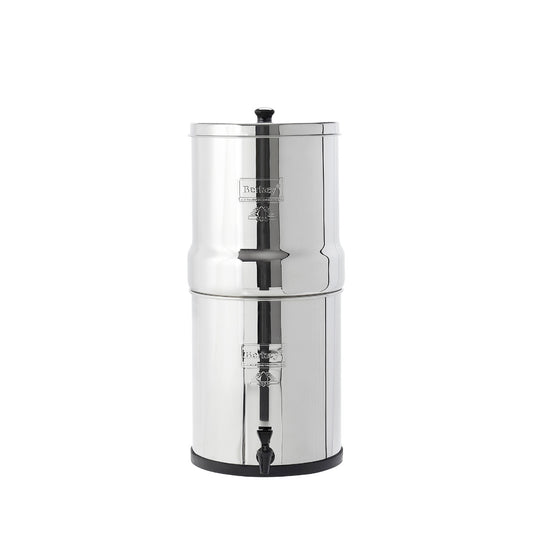
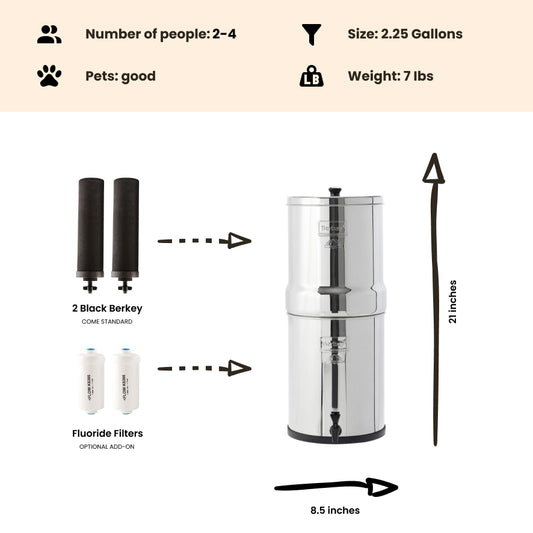
Our most popular system. Serves 1 to 4 people.
Regular price From $367.00Regular priceUnit price per -
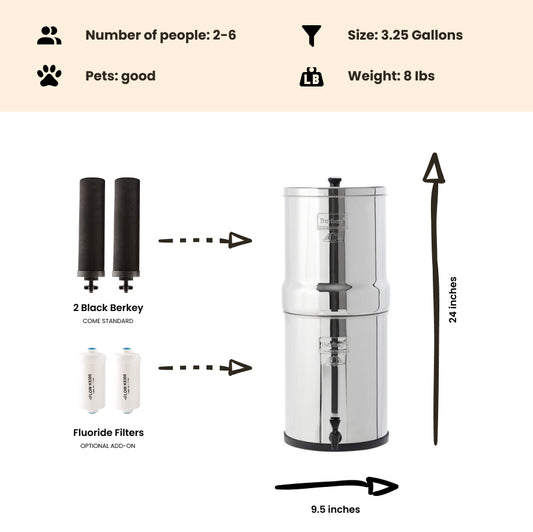
Regular price From $408.00Regular priceUnit price per
-
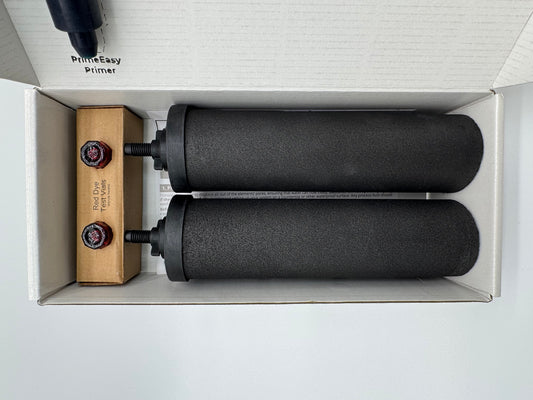
Fits every Berkey system. NSF/ANSI 42 and 372 certified.
Regular price $120.00Regular priceUnit price per -
Adds fluoride and arsenic reduction to your Berkey.
Regular price $103.00Regular priceUnit price per