Last updated: September 4, 2026 | By Dan DeBaun
Quick Answer
Most U.S. tap water is still fluoridated at a target of 0.7 milligrams per liter, the same limit the government set in 2015, and federal researchers have not linked that level to any proven health risk. The CDC's most recent data puts national fluoridation coverage at 72.3% of Americans on community water systems. A 2024 federal toxicology review did find lower IQ in children, but only at exposures above 1.5 mg/L, more than double the U.S. target. Infants face the highest risk from ordinary tap water levels: EWG's analysis found that in 25 of the 28 largest U.S. cities, fluoride from tap water alone puts 8 to 36% of babies under 6 months over the safe daily dose, which is why only filtered or otherwise non-fluoridated water should be used to mix infant formula. Two states banned fluoridation outright in 2025, and the science and legal fights behind that shift are still playing out. This article covers what fluoride actually does, where that debate stands today, and how to reduce your own exposure with a home filter if you decide that's right for your household.
For more than half a century, local governments in the United States have been adding fluoride to water supplies to prevent tooth decay. The U.S. Public Health Service reports: "over half of the U.S. population is served by drinking water that is fluoridated naturally or adjusted. Additionally, since the 1950's, fluorides have been incorporated into toothpaste, other dental products, and dietary supplements."
From day 1, there have been dissenters. In 2006, a National Academy of Sciences report on fluoridated tap water and health brought what are often dismissed as fringe concerns directly into the mainstream. An expert government advisory panel recommended reducing the level of tap-water fluoridation to protect Americans from the harmful effects of too much fluoride.
Fluoride in Tap Water and Dental Health
In the 1940's, exposure to fluoride through food and drink was fairly low and access to fluoride-containing dental products was not common. Scientists and public health officials concerned with dental health noticed that regions with naturally highly fluoridated water also had fewer cases of dental caries. Subsequent fluoridation of drinking water supplies is often credited with 30-50% reductions in dental cavities.
Over that period, there has also been a marked increase in dental fluorosis, discoloring and pitting of tooth enamel caused by excessive fluoride exposure while teeth are still developing. This has occurred both in areas of the country with fluoridated water and without, indicating that our overall fluoride exposure has gone up.
Critics of fluoridation argue that the chemical's benefit is overblown. A review out in April 2011 by the West Virginia University Rural Health Research Center found that:
Urban U.S. children, with more exposure to fluoridated water and dental care, have just as many cavities as less fluoridation-exposed rural children.
The researchers write: "For children's dental health measures, it was found that fluoridation rates were not significantly related to the measures of either caries or overall condition of the teeth for urban or rural areas."
Overall reductions in tooth decay have been most dramatic among wealthy Americans and least among poor Americans, the ones that fluoridation is supposed to benefit.
Too Much Fluoride and Health
Excessive exposure to fluoride has implications beyond cosmetic appearance of teeth. Skeletal fluorisis is a bone and joint condition that increases bone density and leads to joint pain and reduced mobility. Full skeletal fluorosis is extremely rare in the United States, but mild forms of fluorosis may be confused with arthritis. Chronic fluoride exposure has been studied for possible links to a range of other conditions. The federal government's own ATSDR toxicological profile on fluorides notes that some studies have examined a possible association with bone cancer, though the evidence remains mixed and the International Agency for Research on Cancer has not classified fluoride as carcinogenic to humans.
Fluoride Exposure Then & Now
Tap water, including foods and beverages made with it, is the top source of fluoride exposure for most Americans, accounting for roughly 60% of total intake, but all food and water has some fluoride. The geology of some part of the country results in more-than-average levels of fluoride. Fluoride is taken up in water-containing fruits and vegetables and accumulates in the bodies of animals and fish. Because of the sodium fluoride content of ocean water, seafood is a particularly good source of fluoride.
Since tap water is used to process food, processed food usually contains as much or more fluoride than the water used in processing. If evaporation was used in processing, the resulting food stuffs may contain a great deal of fluoride. Instant tea, for example, when reconstituted with fluoridated tap water, contain much more fluoride than non-instant tea prepared with the same water.
Fluoride-containing pesticides are another route of exposure and for years sufuryl fluoride was routinely applied to cocoa beans and dried fruit.
Finally, fluoride-containing toothpastes and mouthwashes are much more common and easily available than when tap-water fluoridation first began. Topical application is the most effective way to strengthen teeth with fluoride, but swallowing toothpaste exposes the brusher to much more fluoride than is healthy.
Do Infants and Children Get Too Much Fluoride?
In response to the National Academies' report, Environmental Working Group analyzed tap water fluoridation with respect to one particularly vulnerable group of Americans: babies whose diet was entirely comprised of infant formula prepared from powdered mix and tap water.
EWG's analysis shows that in 25 of the 28 largest cities in the U.S., fluoride levels in tap water alone will put 8 to 36 percent of all babies up to 6 months of age over the safe dose of fluoride on any given day. "These elevated early life exposures put children at risk for precisely the health problems that the NAS committee is concerned about," said Dr. Tim Kropp, toxicologist and senior scientist at EWG.
While exposures of infants are particularly dramatic, all children drinking overly-fluoridated water may be at risk of excessive exposure because of their small size.
U.S. Fluoridation Levels To Go Down?
In 2011, the U.S. Department of Health and Human Services proposed that the nation's water utilities sharply reduce the amount of fluoride in tap water, and the Environmental Protection Agency began a review of the maximum allowable amount of fluoride in drinking water. HHS finalized that recommendation in April 2015, setting a single target of 0.7 mg of fluoride per liter for community water systems, down from the earlier range of 0.7 to 1.2 mg/L. That 0.7 mg/L figure is still the standard most U.S. utilities aim for today.
Where the Fluoride Debate Stands in 2026
The debate this article opened with hasn't gone away. If anything, it has picked up new momentum since 2024, on three separate fronts.
First, the science. In August 2024, the National Toxicology Program, part of the National Institutes of Health, released a monograph reviewing 72 studies on fluoride and children's IQ. It found, with moderate confidence, that higher fluoride exposures, generally above the World Health Organization's guideline of 1.5 mg/L, are consistently associated with lower IQ in children. The report is explicit that it does not establish this effect at the roughly 0.7 mg/L levels used in typical U.S. water fluoridation, and it calls for more research at those lower exposure levels.
Second, the legal fight. In September 2024, a federal district court ruled in Food & Water Watch v. EPA that fluoridation at current U.S. levels poses an unreasonable risk and ordered the EPA to take regulatory action under the Toxic Substances Control Act. The EPA appealed, and in May 2026 the Ninth Circuit Court of Appeals vacated that order and sent the case back to the lower court for further proceedings. As of this writing, the EPA has no active legal obligation to regulate fluoride, and the case is still working its way through the courts.
Third, state and local policy. In March 2025, Utah became the first state to ban adding fluoride to public water supplies, and Florida followed in May 2025. Several other states debated similar bills in their 2025 sessions. Separately, the Fluoride Action Network, an advocacy group that opposes fluoridation, says it has tracked more than 60 individual communities, serving over 9 million people, that ended, suspended, or blocked water fluoridation between September 2024 and April 2025.
None of this settles the underlying scientific question of whether fluoridation at typical U.S. levels is harmful. It does mean more households than ever, whether by state law, local vote, or personal choice, are ending up with less fluoride in their tap water than they had a few years ago, and more households in still-fluoridated areas are choosing to filter it out themselves.
Big Berkey Water Filters and Fluoride
Your Berkey filters put you in charge of your household water quality, including your fluoride exposure, regardless of which way your local utility or state legislature comes down on the question above.
EWG recommends that all households with water supplies exceeding the new HHS recommendation of 0.7 mg of fluoride per liter filter their water. Only filtered, or otherwise non-fluoridated, water should be used to reconstitute infant formula.
To find out if your town complies with the new recommendations, start with our free zip code fluoridation lookup tool, which draws on the same CDC data. You can also consult the CDC fluoridation statistics or contact your water utility directly.
Optional Fluoride Water Filter for Your Big Berkey
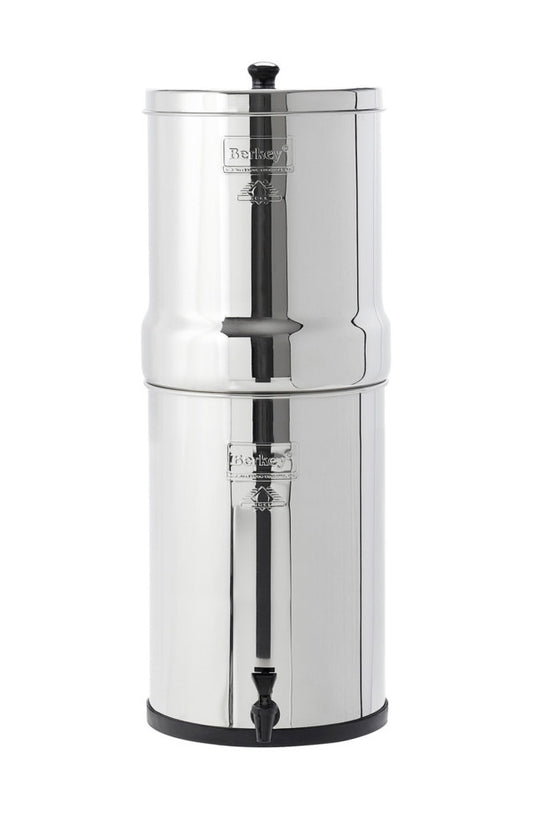
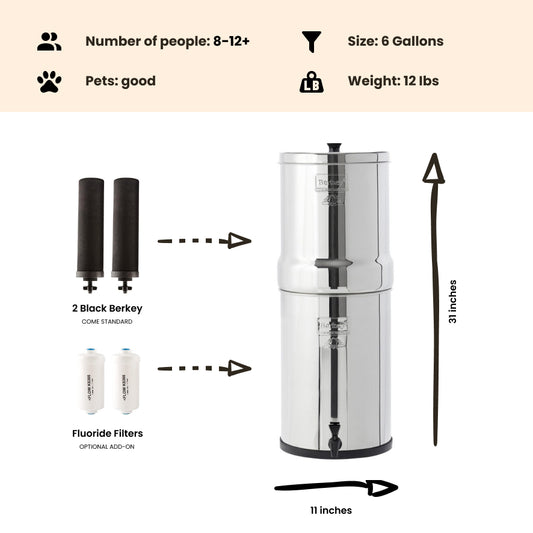
Whether your water supply contains more than the recommended levels of fluoride or you want to eliminate it for any reason, the Big Berkey filter can be a great water filter for you.
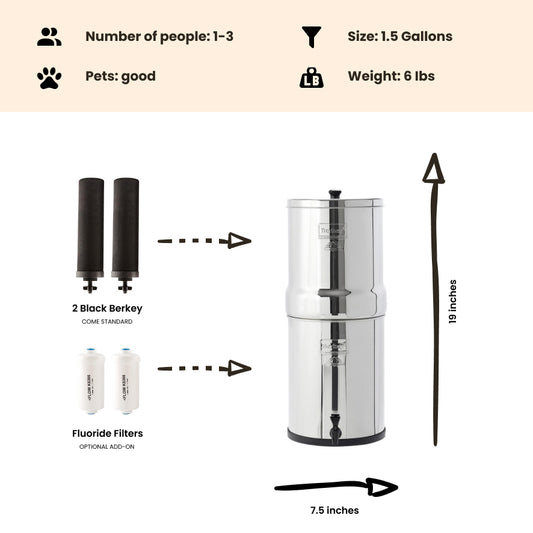
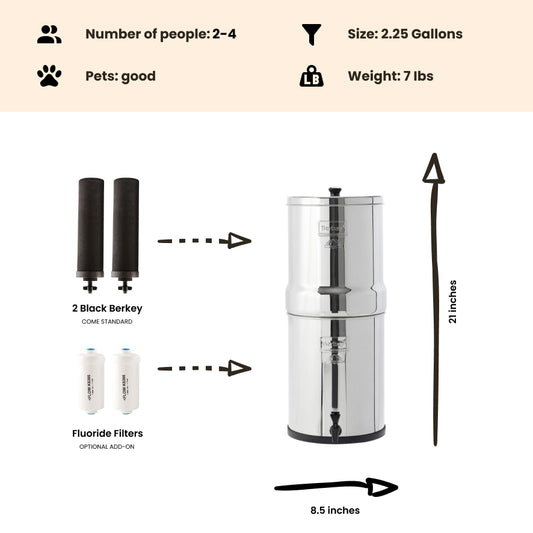
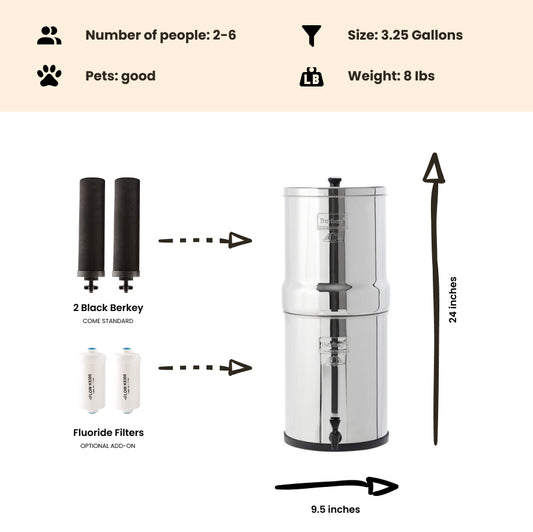
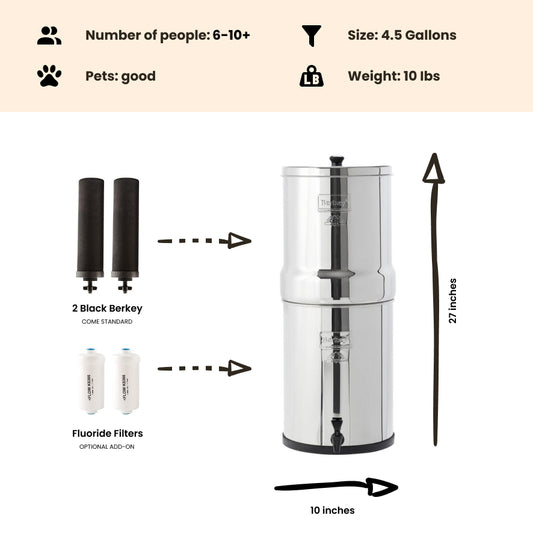
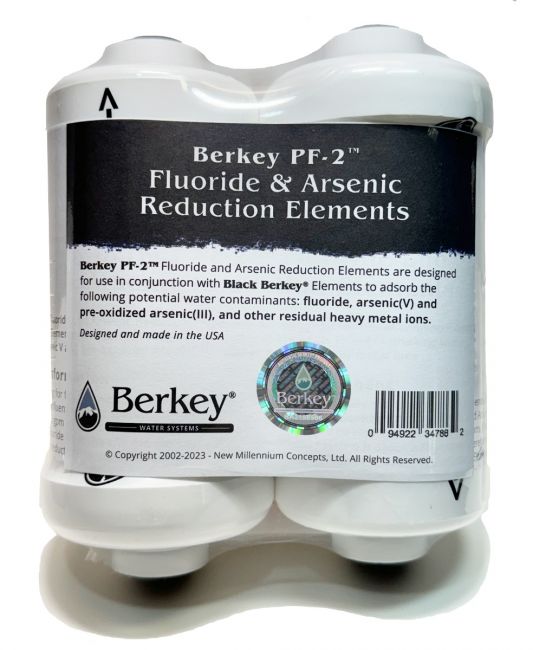
By adding a PF-2 fluoride water filter to any of the Berkey Water filtration systems, you can reduce up to 99.75% of the fluoride in your drinking water. The PF-2 filter is designed to work in conjunction with the Black Berkey or Phoenix filter elements for optimal water quality along with fluoride reduction. You can review the complete lab data behind these and 200+ other tested contaminants on our test results page.
Fluoride and Berkey: Frequently Asked Questions
Is fluoride still added to most U.S. tap water?
Yes, for most of the country. The CDC's most recent data shows 72.3% of Americans on community water systems receive fluoridated water. That share is starting to shift as states and individual communities opt out.
Is fluoridated tap water safe for mixing infant formula?
Not necessarily at ordinary tap water levels. EWG's analysis found that in 25 of the 28 largest U.S. cities, fluoride from tap water alone puts 8 to 36% of babies under 6 months over the safe daily dose. Because of this, only filtered or otherwise non-fluoridated water should be used to reconstitute powdered infant formula.
What is the current recommended fluoride level in drinking water?
The U.S. Public Health Service has recommended 0.7 mg of fluoride per liter since April 2015, when HHS finalized that figure and replaced the older range of 0.7 to 1.2 mg/L.
Does fluoride lower children's IQ?
A 2024 National Toxicology Program review found a consistent association between lower IQ and fluoride exposure above 1.5 mg/L, more than double the U.S. recommended level. The report does not establish that effect at the 0.7 mg/L level used in most U.S. water systems and calls for more research at that lower exposure range.
Is the EPA required to regulate fluoride in drinking water?
Not currently. A federal district court ordered the EPA to act in September 2024, but the Ninth Circuit vacated that order in May 2026 and sent the case back for further review. The litigation is ongoing.
Which states have banned water fluoridation?
Utah banned it statewide in March 2025, and Florida followed in May 2025. Other states have introduced similar bills, and advocacy groups report more than 60 individual communities have separately ended or paused fluoridation since late 2024.
How do I remove fluoride from water filtered by my Berkey?
Add the optional PF-2 fluoride filter to any Berkey system alongside the Black Berkey elements. Together they reduce up to 99.75% of the fluoride in your drinking water.
Berkey's water testing and track record have been covered by outlets including EWG, Food Network, CBS, and the LA Times. See our full media coverage for the details.
About the author: Dan DeBaun is the owner of Big Berkey Water Filters and has spent 18 years selling, supporting, and testing gravity water filtration systems. He holds an engineering degree and an MBA from Rutgers University, and personally reviews the lab data behind every product claim published on this site.


 By
Dan DeBaun
By
Dan DeBaun