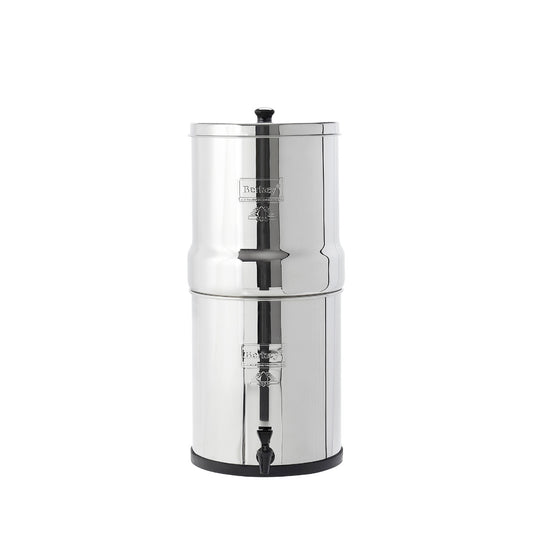
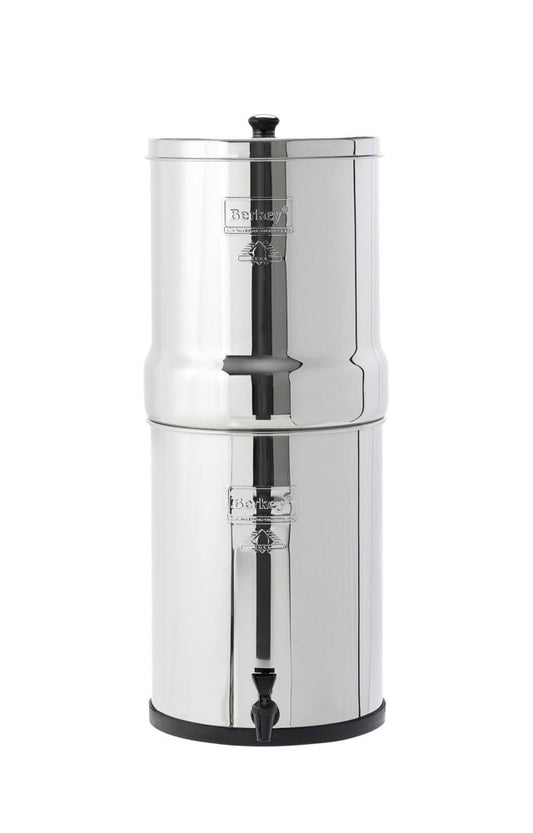
A gravity-fed water filter is a standalone system that uses the natural force of gravity to pull water through filter elements, removing contaminants without electricity, plumbing, or water pressure. They require no installation, work anywhere there is a countertop with no electricity required, and retain naturally occurring minerals that pressurized systems strip out. This guide covers how gravity filters work, the six main types, a side-by-side brand comparison of the four leading systems, and how to choose the right system for your home, family, second home, or travel.
How Gravity-Fed Water Filters Work
Gravity filters work by pouring water into an upper chamber, where it passes through filter elements by gravity alone and collects in a lower chamber ready to dispense from a spigot. No electricity, no water pressure, and no plumbing connection is required at any stage.
The key performance advantage of gravity filtration is contact time. Because water moves slowly through the filter media under low pressure, contaminants have more time to adsorb onto the filter surface rather than being forced through under high pressure as in reverse osmosis or faucet systems. This extended contact time is what allows quality gravity filters to reduce such a broad range of contaminants.
Step 1
Fill the Upper Chamber
Pour water from any potable freshwater source into the upper chamber. No setup, plumbing, or power needed.
Step 2
Gravity Pulls Water Through
Water moves slowly through the filter elements. Extended contact time allows the filter media to capture and adsorb a wide range of contaminants.
Step 3
Filtered Water Collects Below
Clean, filtered water accumulates in the lower chamber and is ready to dispense from the spigot at any time.
Step 4
Refill as Needed
Refill the upper chamber whenever it empties. Most households fill overnight so filtered water is ready by morning.
Gravity filters are completely self-contained. They require no installation, no dedicated faucet, and no power source, which makes them suitable for daily home use, renters and apartments, second homes, and travel between treated water sources.
Types of Gravity-Fed Water Filter Systems
Gravity-fed water filters come in several distinct configurations, each suited to different household sizes, lifestyles, and water sources. Understanding the differences helps you match the right system to your needs.
Countertop Gravity Filters
- Most common type for home use
- Two-chamber stainless steel design
- No plumbing or electricity needed
- Dispensed via spigot
- Best for: daily household drinking water
- For sizing, independent lab data, and pricing across every model, see our guide to the best countertop gravity water filter
Portable / Travel Gravity Filters
- Compact, lightweight systems
- Same filtration technology as full-size
- Designed for transport between locations
- Best for: travel, RVs on a hookup, vacation rentals, second homes
Ceramic Gravity Filters
- Use ceramic candle-style filter elements
- Long history of use worldwide (British Berkefeld / Doulton)
- Cleanable and reusable elements
- Best for: buyers prioritizing ceramic media
Large-Capacity Gravity Filters
- 4-6+ gallon capacity
- Higher daily output with multiple filter elements
- Best for: large families, offices, group settings
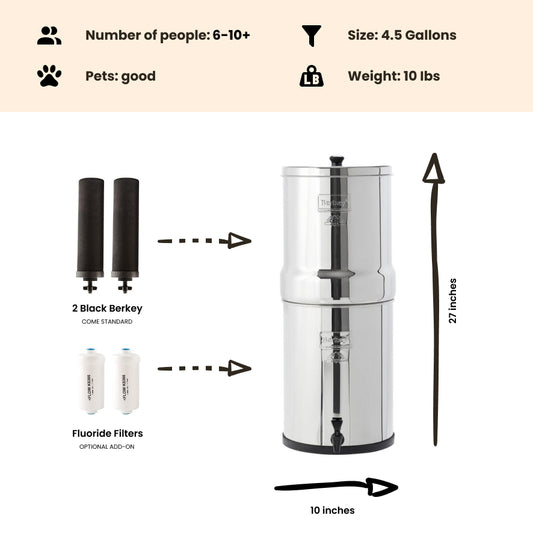
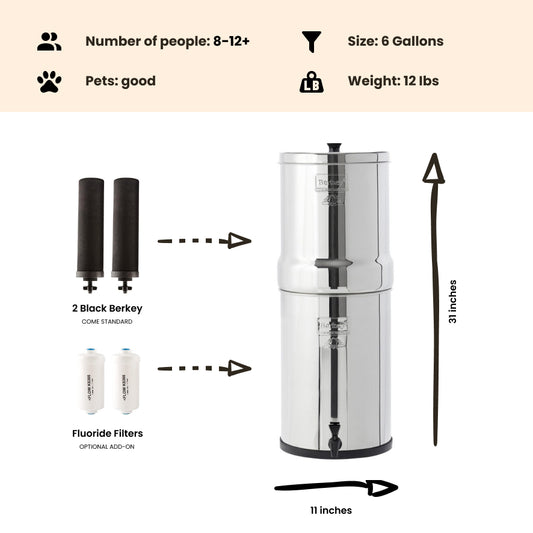
- Examples: Imperial Berkey (4.5 gal), Crown Berkey (6 gal)
Multi-Stage Gravity Filters
- Primary filter plus optional secondary stage
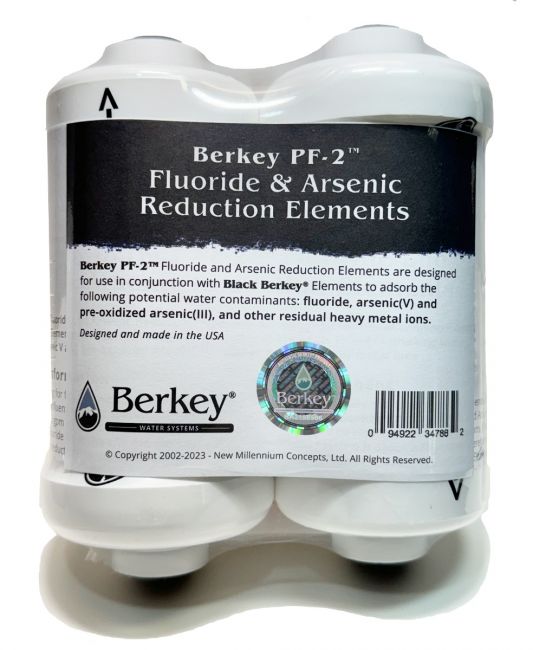
- Secondary stage targets specific contaminants (fluoride, arsenic)
- Modular - add only what your water source requires
- Best for: households with fluoride or arsenic concerns
Personal Gravity Filters
- Single-person, 1-quart scale
- Highly portable with carrying case
- Same filter element performance as larger systems
- Best for: solo travelers, gym, office, commuting
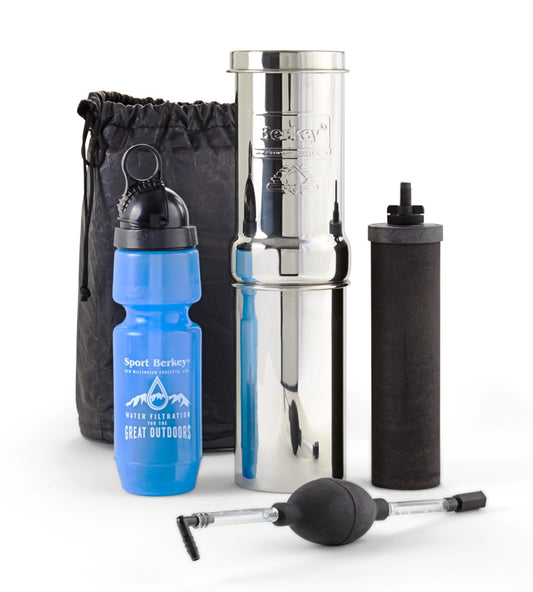
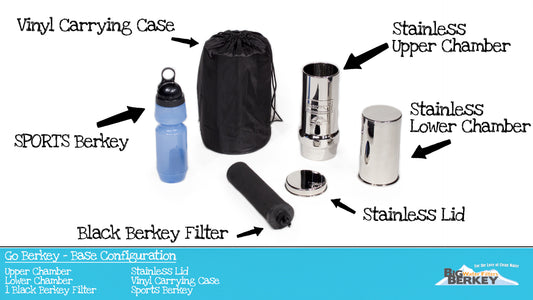
Berkey covers five of these six categories - countertop (Travel through Crown), portable (Travel Berkey), large-capacity (Imperial and Crown), multi-stage (with optional PF-2 fluoride filters), and personal (Go Berkey Kit) - using the same filter elements across all housing sizes. Every new Berkey system ships with Black Berkey elements while supplies last, and Berkey Phoenix elements are the authorized replacement when it is time to change them. Filtration performance is consistent regardless of which housing you choose.
Top Gravity Water Filters Compared: Berkey vs. ProOne vs. British Berkefeld vs. Alexapure
The four leading gravity filter brands in the U.S. are Berkey (Black Berkey and Phoenix elements), ProOne, British Berkefeld / Doulton, and Alexapure. Each uses different filter technology, certification levels, and lifespan ratings. The table below compares verified specifications side by side.
Note: British Berkefeld and Doulton are the same brand. Doulton is the manufacturer; British Berkefeld is the consumer-facing product line. Both names appear in search results but refer to the same filter system.
Every new Berkey system ships with Black Berkey elements (6,000 gal/pair, tested by EPA-accredited labs) while supplies last. When those elements reach the end of their life, the authorized replacement is the Berkey Phoenix element (NSF/ANSI 42 and 372 certified, 5,500 gal/pair). Black Berkey elements are not currently sold as standalone replacements. Both are shown below where specs differ.
→ Scroll right to see full comparison
| Feature |
Black Berkey (ships with new systems) |
Berkey Phoenix (replacement) |
ProOne G3.0 |
British Berkefeld / Doulton |
Alexapure Pro |
| Availability |
Included with every new system, while supplies last |
In Stock as the replacement element |
G3.0 being discontinued |
In Stock |
In Stock |
| Filter Lifespan |
6,000 gal/pair |
5,500 gal/pair |
~6-9 months per filter |
~800 gal/pair |
200 gal/filter (mfr. verified capacity) |
| NSF/ANSI Certifications |
Tested to NSF/ANSI standards by EPA-accredited labs |
42 & 372 (formally certified) |
42, 53, 372, 401 (certified by IAPMO) |
42, 53, 372 (NSF certified) |
Independently lab tested; not NSF-certified |
| Contaminants Tested |
200+ |
200+ |
200+ |
Broad spectrum (heavy metals, PFAS, chemicals) |
206 (mfr. claim; performance verified at 200 gal) |
| PFAS Reduction |
Yes - PFOA below 2 ppt (lab report); 25 compounds non-detectable (EWG testing) |
Yes - lab documented |
Yes - NSF 53 certified |
Yes - documented |
Yes - independent lab |
| Fluoride Removal |
Optional PF-2 add-on |
Optional PF-2 add-on |
Built-in (carbon-based media; efficacy disputed) |
Upgrade to Ultra Fluoride filter |
Built-in (carbon-based media; unverified beyond 200 gal) |
| Lab Reports Public |
Yes - downloadable PDFs |
Yes - downloadable PDFs |
Yes - published |
Yes - published |
Partial - verified at 200 gal |
| Cost Per Gallon |
~$0.02 |
~$0.02 |
Not published per gallon |
~$0.09 |
Not published per gallon (200 gal/filter verified) |
| Housing Material |
304 Stainless Steel |
304 Stainless Steel |
304 Stainless Steel |
304 Stainless Steel |
304 Stainless Steel |
| Sizes Available |
6 models (Go Berkey Kit to Crown) |
6 models (Go Berkey Kit to Crown) |
2 main models |
4 sizes (Duchess to King) |
1 main model (2.25 gal) |
| Housing Warranty |
Lifetime |
Lifetime |
5-year (stainless) |
Lifetime |
1-year |
| Origin |
New Millennium Concepts (USA) |
New Millennium Concepts (USA) |
USA (founded 2012) |
England (est. 1826) |
USA (My Patriot Supply) |
| Notable Limitation |
Not sold as a standalone replacement; Phoenix is the replacement element |
Newer than Black Berkey; long-term third-party testing still accumulating |
G3.0 filter line being discontinued; fluoride efficacy disputed |
~800 gal filter lifespan per pair - high ongoing cost |
Key performance claims verified only to 200 gallons |
How We Evaluated These Gravity Filter Systems
Rankings and comparisons in this guide are based on five objective criteria applied consistently across all four brands:
-
Filter lifespan - Rated capacity in gallons per pair, sourced from manufacturer documentation
-
Publicly available lab documentation - Whether full test reports are downloadable by consumers, not just summary claims
-
Contaminant testing breadth - Number and range of contaminants independently tested, including PFAS, heavy metals, pharmaceuticals, and VOCs
-
Cost per gallon - Filter replacement cost divided by rated lifespan, calculated consistently across brands
-
System size range and warranty - Availability of multiple capacity options and housing warranty terms
No brand paid for placement. Berkey ranks first because it leads or matches across the majority of these criteria when measured against publicly verifiable data.
Best Gravity Water Filters Ranked
The rankings below are based on filter lifespan, publicly available lab documentation, contaminant testing breadth, cost per gallon, and system size range. Berkey leads across most criteria when evaluated against verifiable data.
#1 Overall
Berkey with Black Berkey Elements (included with every new system)
Best combination of contaminant testing depth (200+), filter lifespan (6,000 gal/pair, roughly 3 to 6 years under normal use), system size range (6 models), and lowest per-gallon cost (~$0.02). PFOA reduced to below 2 ppt by an EPA-accredited lab, and 25 PFAS compounds reduced to non-detectable levels in EWG's independent testing at SimpleLab's accredited laboratory. EWG-rated "Best Overall." Lifetime housing warranty. Ships standard with new systems while supplies last.
#1 Overall (replacement element)
Berkey with Phoenix Elements (authorized replacement)
Same 6-model housing lineup, same $0.02 per gallon cost, with a 5,500 gallon per pair lifespan, NSF/ANSI 42 and 372 certification, and NABL-accredited lab testing across 200+ contaminants. Phoenix is the element you buy when your Black Berkey elements wear out; Black Berkey elements are not currently sold as standalone replacements.
#2 Best Heritage Brand
British Berkefeld / Doulton
Nearly 200 years of ceramic filtration history. NSF certified. Nesting design reduces packed height for transport. Main drawback: ~800 gallon filter lifespan per pair, roughly 7x shorter than Berkey Phoenix, which makes long-term ownership significantly more expensive.
#3 Lowest Upfront Price
Alexapure Pro
Lower system price than Berkey. Independent lab testing covers 200+ contaminants. Not formally NSF-certified. The manufacturer's own filter rating is verified for up to 200 gallons per filter at $119.95 per filter, roughly $0.60 per gallon, several times higher than the roughly $0.02 to $0.03 per gallon cost of Black Berkey or Phoenix elements. Best suited for buyers who prioritize the lowest system purchase price over long-term filter cost.
#4
ProOne G3.0
Independent lab testing covers 200+ contaminants. Claims built-in fluoride removal via carbon-based granular media, though activated carbon is not the industry-standard media for fluoride reduction - dedicated systems use alumina or bone char. The entire G3.0 filter line is currently being discontinued per ProOne's own product pages, transitioning to a new MaxClear technology. Verify current availability directly with ProOne before purchasing.
How to Choose the Right Gravity Filter for Your Situation
The best gravity filter for your household depends on your primary use case. Daily home use, no-plumbing situations, treated well water, travel and second homes, and apartment living each has different requirements for capacity, portability, and filter performance. Here is how the leading systems compare by situation.
🏠
Home & Family Daily Use
For a household of 2-6 people drinking filtered water daily, capacity and filter lifespan matter most. A family of four uses roughly 1-1.5 gallons of filtered water per day for drinking and cooking.
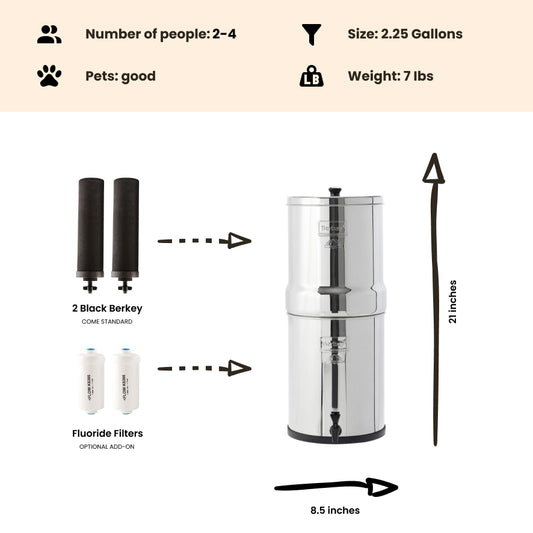
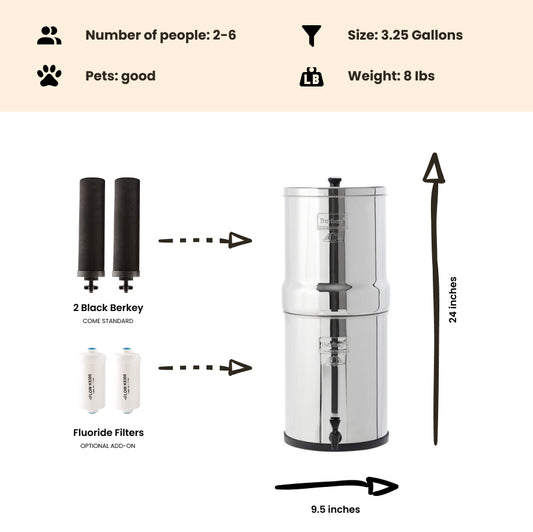
The Big Berkey (2.25-gallon capacity) handles 2-4 people comfortably. The Royal Berkey (3.25 gal) is the better fit for families of 4-6. Both ship with Black Berkey elements rated for 6,000 gallons per pair, roughly 3 to 6 years under normal use, and take Phoenix replacement elements (5,500 gal/pair) when it is time to change them.
British Berkefeld's 800-gallon pair lifespan means filter replacement roughly every 5-6 months at typical family use rates, with annual filter costs significantly higher than Berkey.
Best for families: Berkey Big or Royal - longest lifespan, lowest per-gallon cost, most size options
🔦
No-Electricity & No-Plumbing Situations
When there is no outlet or plumbing to tap into, the critical factors are: no electricity required, no installation, and proven performance documentation on treated water.
All four systems reviewed here operate without electricity. Berkey has a meaningful advantage in verified contaminant reduction depth, with 200+ contaminants tested and lab reports covering a broader spectrum of industrial chemicals and heavy metals than most competitors document. For a household that wants the largest reserve of filtered tap water on the counter, the Imperial Berkey (4.5 gal) or Crown Berkey (6 gal) provide the highest capacity per fill.
Alexapure is widely sold as a countertop system and performs well for municipal water sources, but its chlorine performance testing is documented at 200 gallons per manufacturer footnotes.
Best for no-electricity and no-plumbing homes: Berkey (large model) for depth of testing; Alexapure for the lowest upfront system price, though its 200 gallon verified filter rating means a much higher cost per gallon than Berkey
🌾
Treated Well Water & Rural Homes
Well water presents unique challenges: it often contains elevated iron, manganese, sediment, agricultural runoff, nitrates, and region-specific contaminants not found in municipal supplies. Gravity filters are appropriate as a point-of-use step on well water that already meets potability standards (tested and treated as needed) and has low sediment loads; high sediment sources will reduce filter life significantly.
For well water, prioritize systems with the longest documented filter lifespan (to offset faster clogging from sediment), publicly available lab reports showing tested reduction for heavy metals and agricultural chemicals, and cleanable filter elements. Both Black Berkey and Phoenix elements are cleanable with a Scotch-Brite pad under running water, which restores flow rate when sediment buildup occurs.
A separate sediment pre-filter (Berkey does not sell one as an accessory) is strongly recommended for high-iron or high-sediment well water to protect the primary filter elements. If your well has not been tested, have it tested by an accredited lab first; a gravity filter is not a substitute for well treatment.
Best for treated well water: Berkey with optional sediment pre-filter - cleanable elements and deep contaminant documentation
🧳
Travel & Second Homes
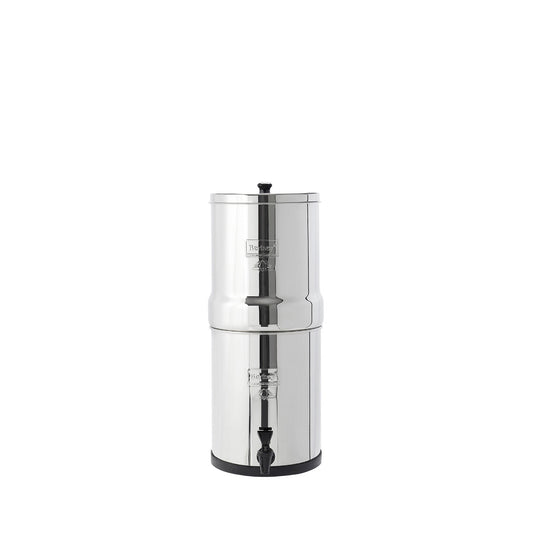
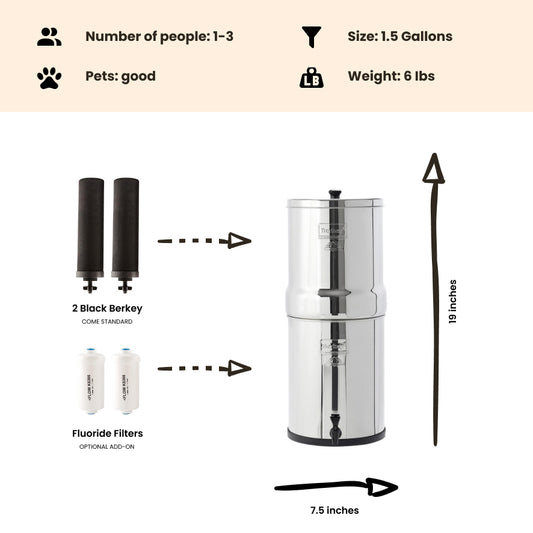
For travel, vacation rentals, RVs on a hookup, and second homes, portability and system size are the primary constraints. The Travel Berkey (1.5-gallon capacity) is the smallest full Berkey system, weighing roughly 7 lbs when empty. The Go Berkey Kit is designed for a single person on the move - a 1-quart personal gravity filter with a carrying strap.
All gravity filters reviewed here are portable in the sense that they require no power. However, Berkey's six-model lineup gives it the most options for matching system size to group size. For a couple in a rental or RV, the Travel Berkey; for a group of 8+ at a shared house, an Imperial or Crown.
British Berkefeld's upper chamber nests inside the lower chamber for transport, reducing the packed height from 23" to 15", which is a practical design advantage for vehicle transport.
Best for travel: Travel Berkey or Go Berkey Kit for portability; British Berkefeld if nesting compact design is a priority
🏢
Countertop / No-Plumbing Apartments
Gravity filters are ideal for renters, apartments, and anyone who cannot install an under-sink or plumbed system. No installation is required - just place it on a counter and fill.
For counter space-constrained apartments, consider the compact Travel Berkey (1.5 gal, stainless steel) or the Go Berkey Kit (1-quart personal system). The ProOne Traveler+ (2.25 gal) and British Berkefeld's smallest model (1.58 gal) are also designed with counter space in mind.
All gravity filter brands reviewed here require manual refilling and cannot connect to a faucet. For apartment use, a system with a stand is useful - it raises the unit off the counter, making it easier to fill glasses directly from the spigot without moving the unit to the edge.
Best for apartments: Travel Berkey for compact footprint; all systems are equally plumbing-free
Gravity Filters vs. Other Water Filter Types
Gravity filters outperform pitcher filters in contaminant reduction depth and filter lifespan, deliver comparable contaminant removal to reverse osmosis without wastewater or electricity, and require no installation compared to under-sink systems. Here is how gravity filtration compares to the most common alternatives.
Gravity Filters (Berkey)
- 200+ contaminants tested
- No electricity or plumbing
- 5,500 to 6,000-gallon filter lifespan
- ~$0.02/gallon ongoing cost
- Fully portable
- No wastewater produced
- Works anywhere there is a countertop
- Retains beneficial minerals
Reverse Osmosis (RO)
- Excellent contaminant reduction
- Requires electricity & plumbing
- Wastes 3-5 gallons per gallon filtered
- High installation cost ($300-$500+)
- Strips beneficial minerals
- Produces filtered water on demand
- Not portable; fails during power outages
Under-Sink / Faucet Filters
- Moderate contaminant reduction
- Requires plumbing connection
- Installation required (not renter-friendly)
- Faster flow rate
- Short filter lifespan (200-500 gal typical)
- Higher cost per gallon than gravity
Pitcher Filters (Brita, ZeroWater)
- Limited contaminant reduction
- NSF 42 / 53 certified models available
- Very short filter life (40-150 gal)
- High cost per gallon ($0.15-$0.50+)
- Slow flow rate
- Small capacity (1-2 quarts)
The Core Trade-Off Reverse osmosis offers on-demand filtered water and strips nearly everything, but at significant cost in installation, electricity, and wastewater. Gravity filters match RO's contaminant reduction breadth on most categories while adding portability, no-electricity operation, and zero wastewater. For households that need portability, no-plumbing operation, or renter-friendly installation, gravity filters are the stronger choice.
For a deeper comparison with pitcher filters, see our Berkey vs. Brita comparison.
Filter Lifespan and Cost Per Gallon: The Numbers That Matter
Filter lifespan is the single most important long-term cost variable in gravity filtration - and the difference between brands is significant. Black Berkey elements, which ship with every new system, lead the category at 6,000 gallons per pair. Phoenix elements, the authorized replacement, are rated at 5,500 gallons per pair - both at roughly $0.02 per gallon, compared to British Berkefeld's 800 gallons per pair at nearly 5x the per-gallon cost.
Black Berkey (included) ~$0.02 per gallon (approx.) 6,000 gal/pair
Berkey Phoenix (replacement) ~$0.02 per gallon (approx.) 5,500 gal/pair
Alexapure Pro N/A per gallon (not published; 200 gal/filter verified) 200 gal/filter (mfr. verified)
ProOne G3.0 N/A per gallon (time-based model) ~6-9 months per filter
British Berkefeld ~$0.09 per gallon (approx.) ~800 gal/pair
To put these numbers in real-world terms: a household that filters 1 gallon per day uses about 365 gallons per year. At $0.02 per gallon, Berkey Phoenix elements cost roughly $7 per year in filter replacement costs at that usage level. British Berkefeld at $0.09 per gallon costs approximately $33 per year at the same usage rate, with filters needing replacement roughly every 5-6 months for a household of four.
For the full breakdown of Berkey's contaminant testing - including downloadable lab reports covering 200+ contaminants, PFAS reduction data, and Phoenix element results - visit the Test Results page and the Phoenix filter lab results page. For third-party recognition including EWG's rating of the Travel Berkey as "Best Overall," see the Media Coverage page.
Best Gravity Water Filters for PFAS and Forever Chemical Removal
For PFAS removal specifically, Berkey leads among gravity filter brands because it has the most publicly available PFAS documentation among gravity filter brands: an EPA-accredited lab report showing PFOA reduced to below 2 ppt, EWG's independent testing of 25 PFAS compounds to non-detectable levels, and long-term Phoenix capacity testing at 1,500 liters. The critical factor when evaluating any filter for PFAS is not just whether the brand claims PFAS reduction, but whether independently verified lab data is publicly downloadable and whether testing covers the compounds regulated by the EPA's 2024 final rule. For a complete guide to PFAS in drinking water - including current EPA limits, the 2025 enforcement rollback, and detailed Berkey test data - see our PFAS and Forever Chemicals guide.
How Gravity Filtration Removes PFAS
Gravity filters reduce PFAS through two primary mechanisms: adsorption and extended contact time. Adsorption occurs when PFAS molecules bind to the surface of the filter media - typically a blend of activated carbon, ion exchange resins, and proprietary materials - and are physically held there rather than passing through into the filtered water. The second mechanism is what gives gravity filtration a meaningful advantage over pressurized systems: because water moves slowly through the filter under low pressure rather than being forced through under high pressure, PFAS molecules spend significantly more time in contact with the filter media. This extended contact time allows more complete adsorption, which is why well-designed gravity filter elements can achieve 99%+ reduction across multiple PFAS compounds despite their passive, no-electricity design.
PFAS Documentation: What Each Brand Has Actually Published
Not all gravity filter PFAS claims are equally documented. The table below compares what each brand has verified versus claimed.
→ Scroll right to see full comparison
| Brand |
PFAS Compounds Tested |
Lab Credentials |
Reports Publicly Available |
Key Limitation |
| Berkey Phoenix (replacement element) |
PFOA, PFOS, PFHxS, PFNA, PFDA at 99%+ removal; PFOA and PFOS tested through 1,500 liters |
CVR Labs and RAYNU Analytical Labs - NABL-accredited, ISO/IEC 17025:2017 certified |
Yes - downloadable PDFs |
5 core PFAS compounds tested; Black Berkey has broader compound coverage |
| Black Berkey (ships with new systems) |
PFOA reduced to below 2 ppt plus 8 additional PFAS compounds by surrogate (lab report); 25 PFAS compounds to non-detectable levels in EWG independent testing |
Independent EPA-accredited third-party lab; EWG testing at SimpleLab's accredited laboratory |
Yes - downloadable PDFs |
Included with new systems while supplies last; not sold as a standalone replacement |
| British Berkefeld / Doulton |
PFAS reduction documented; NSF/ANSI 53 certified (covers PFAS) |
NSF International certified |
Yes - published |
Filter lifespan of ~800 gal/pair means higher per-gallon cost for ongoing PFAS protection |
| ProOne G3.0 |
PFAS reduction; NSF/ANSI 53 certified (covers PFAS) |
IAPMO certified |
Yes - published |
G3.0 filter line being discontinued; verify current availability before purchasing |
| Alexapure Pro |
PFAS reduction claimed; independent lab testing |
Independent lab; not NSF certified |
Partial - performance verified to 200 gal per manufacturer footnotes |
Long-term PFAS capacity beyond 200 gallons unverified in public documentation |
Ranked: Best Gravity Filters for PFAS Removal
#1 Best PFAS Documentation (included with new systems)
Berkey with Black Berkey Elements
The most extensively documented gravity filter for PFAS: PFOA reduced to below 2 ppt (below the EPA's 4 ppt MCL) by an independent EPA-accredited lab with publicly downloadable PDFs, and 25 PFAS compounds reduced to non-detectable levels in EWG's independent testing. Ships with every new Berkey system while supplies last; not sold as a standalone replacement.
#1 Best PFAS Documentation (replacement element)
Berkey with Phoenix Elements
The authorized replacement element: 5 PFAS compounds tested at 99%+ removal. Long-term capacity testing confirms performance through 1,500 liters at 5 intervals. NABL-accredited, ISO/IEC 17025:2017 certified labs. Full downloadable lab reports at bigberkeywaterfilters.com.
#2 Best Certified Alternative
British Berkefeld / Doulton
NSF/ANSI 53 certified, which covers PFAS reduction performance. Published lab documentation. If formal NSF certification is your primary requirement for PFAS, British Berkefeld satisfies it. The trade-off is filter lifespan: at ~800 gallons per pair, the ongoing cost of PFAS protection is roughly 4-5x higher per gallon than Berkey Phoenix.
#3
ProOne G3.0
NSF/ANSI 53 certified via IAPMO - the same health effects standard that covers PFAS reduction - with published lab documentation. On PFAS credentials alone, ProOne ranks ahead of Alexapure. The key caveat: the entire G3.0 filter line is currently being discontinued per ProOne's own product pages. Verify current availability directly with ProOne before purchasing.
#4
Alexapure Pro
PFAS reduction is claimed and independently lab tested, but performance documentation is limited to the first 200 gallons per manufacturer footnotes. No NSF certification. If your primary concern is PFAS and you want long-term verified capacity data, the documentation gap is a meaningful limitation compared to the three brands ranked above it.
The PFAS Bottom Line For gravity filtration and PFAS removal, the differentiator is not whether a brand claims reduction - all four do. The differentiator is the depth and independence of the documentation: how many compounds were tested, by which labs, over what volume of water, and whether you can download the actual reports. On all four criteria, Berkey leads with the most extensive publicly available PFAS lab data in the gravity filter category.
For the full PFAS guide including EPA regulatory context, the 2025 enforcement rollback, and how gravity filtration compares to reverse osmosis for PFAS removal, see: Does Berkey Remove PFAS and Forever Chemicals?
Frequently Asked Questions About Gravity-Fed Water Filters
What is the best gravity water filter for removing PFAS and forever chemicals?
For PFAS removal, the key evaluation criteria are: number of PFAS compounds independently tested, lab accreditation, long-term capacity data, and whether full reports are publicly downloadable. On all four criteria, Berkey leads among gravity filter brands. Black Berkey elements, which ship with every new Berkey system while supplies last, reduced PFOA to below 2 ppt in EPA-accredited lab testing and reduced all 25 PFAS compounds in EWG's independent testing to non-detectable levels. The Berkey Phoenix, the authorized replacement element, has been independently tested for 5 PFAS compounds by NABL-accredited, ISO/IEC 17025:2017 certified labs, with performance confirmed through 1,500 liters of use. British Berkefeld is a strong certified alternative with NSF/ANSI 53 certification covering PFAS, though at a significantly higher ongoing filter cost per gallon.
How do gravity water filters remove PFAS from drinking water?
Gravity filters remove PFAS primarily through adsorption - PFAS molecules bind to the surface of the filter media (typically a blend of activated carbon, ion exchange resins, and proprietary materials) and are held there rather than passing through into the filtered water. The slow, gravity-driven flow rate is a key performance advantage: because water moves under low pressure rather than being forced through under high pressure as in reverse osmosis, PFAS molecules spend significantly more time in contact with the filter media. This extended contact time is why well-documented gravity filter elements can achieve 99%+ PFAS reduction despite requiring no electricity or pressurized plumbing.
What is a gravity-fed water filter?
A gravity-fed water filter is a self-contained filtration system that uses gravity to pull water downward through filter elements, removing contaminants without electricity or plumbing. Water is poured into an upper chamber, passes through the filter media at low pressure, and collects in a lower chamber for dispensing. This slow, gravity-driven process allows extended contact time between water and the filter media, which supports broad-spectrum contaminant reduction.
How does a gravity water filter work?
Gravity filters work through a two-chamber design: water in the upper chamber is pulled downward by gravity through filter elements into the lower chamber. The filter media - typically activated carbon, ceramic, or proprietary blends - captures contaminants through adsorption, mechanical filtration, and in some systems, ion exchange. The slow flow rate maximizes contact time, which is why quality gravity filters can reduce such a broad range of contaminants compared to faster-flow pressurized systems.
What is the best gravity water filter for home use?
For home use, the key factors are filter lifespan, daily capacity, ongoing cost per gallon, and availability of multiple size options to match household size. On all four criteria, Berkey leads - new systems ship with Black Berkey elements rated for 6,000 gallons per pair (Phoenix replacements are rated for 5,500) at roughly $0.02 per gallon, with six system sizes from the 1-quart Go Berkey Kit to the 6-gallon Crown. For a household of 1-4 people the Big Berkey (2.25 gal) is the most practical fit; for 4-6 people the Royal Berkey (3.25 gal); for 6+ the Imperial or Crown. British Berkefeld is worth considering if NSF 53 certification and a ceramic filter tradition are your priority, though its ~800 gallon filter lifespan per pair means significantly higher ongoing replacement costs than Berkey.
What is the best gravity water filter for a family?
For a family of four, the Big Berkey or Royal Berkey are the two most practical options. A family of four typically uses 1-2 gallons of filtered water per day for drinking and cooking, which both models can handle with overnight refills. The Black Berkey elements included with every new system are rated for 6,000 gallons per pair, roughly 3 to 6 years under normal use, and Phoenix replacement elements are rated for 5,500. For families with fluoride concerns, the optional Berkey PF-2 fluoride filter can be added to any Berkey system.
What is the best gravity water filter on the market?
Berkey is consistently ranked among the top gravity filters by independent reviewers, with the Environmental Working Group (EWG) rating the Travel Berkey "Best Overall" in its PFAS water filter guide. Berkey's advantages include the most extensive published contaminant testing (200+), the broadest model range (6 sizes), a lifetime housing warranty, and the lowest per-gallon cost among brands with publicly available lab documentation. The right choice ultimately depends on which factors matter most - filter lifespan and cost per gallon favor Berkey; NSF 53 performance certification and ceramic filter tradition favor British Berkefeld; lowest upfront cost favors Alexapure.
How long do gravity water filter elements last?
Filter element lifespan varies significantly by brand. Black Berkey elements, included with every new Berkey system, are rated for 6,000 gallons per pair, roughly 3 to 6 years under normal use; Berkey Phoenix replacement elements are rated for 5,500 gallons per pair. British Berkefeld Ultra Sterasyl ceramic elements are rated for approximately 800 gallons per pair, which translates to roughly 5-6 months at family use rates. Alexapure's product page lists filter capacity as verified for up to 200 gallons per filter. ProOne G3.0 uses a time-based model (approximately 6-9 months per filter). Longer lifespan directly reduces long-term cost and the frequency of replacements.
What is the best gravity water filter when there is no electricity or plumbing?
A gravity filter works anywhere there is a countertop because it needs no electricity or water pressure, so the useful factors are broad contaminant coverage, high capacity, and documented performance. Berkey systems check all three: they are available in sizes up to 6 gallons (Crown Berkey) and have 200+ contaminants tested with downloadable lab reports. For the largest reserve of filtered tap water per fill, the Imperial Berkey (4.5 gal) or Crown Berkey (6 gal) hold the most. The Go Berkey Kit is the most portable option for one person.
What is the best gravity water filter for well water?
For well water that has been tested and treated as needed, point-of-use filtration works best with a system that has cleanable elements (to handle sediment clogging), documented reduction of heavy metals and agricultural chemicals, and ideally the ability to add a pre-filter sediment stage. Both Black Berkey and Phoenix elements are cleanable under running water with a Scotch-Brite pad when flow slows from sediment buildup, which extends real-world element life in well water applications. Berkey's 200+ contaminant test suite includes heavy metals, nitrates, pesticides, herbicides, and VOCs commonly found in private well water. A separate sediment pre-filter is recommended for high-iron or high-turbidity well sources.
What is the best countertop water filter that requires no plumbing?
Gravity-fed filters are the most capable no-plumbing countertop option because they require no faucet connection, no electricity, and no installation of any kind. Among gravity systems, the Travel Berkey (1.5 gal) and the Go Berkey Kit (1-quart personal system) offer the smallest countertop footprints. The ProOne Traveler+ (2.25 gal) and the smallest British Berkefeld model (1.58 gal) are also designed for compact counter use. For context, countertop filters requiring a faucet connection produce faster flow but require a faucet diverter and cannot be used during power outages.
How much does a gravity water filter cost per gallon?
Cost per gallon in gravity filtration is determined by filter replacement cost divided by rated lifespan. Berkey Phoenix elements cost approximately $0.02 per gallon at 5,500 gallons per pair. Alexapure's product page lists filter capacity as verified for up to 200 gallons per filter and does not publish a per-gallon figure. British Berkefeld costs approximately $0.09 per gallon at 800 gallons per pair - roughly 4-5x more expensive in filter operating costs than Berkey. For comparison, bottled water typically costs $1-$3 per gallon, and pitcher filters cost $0.15-$0.50 per gallon in filter replacement costs.
What is the difference between a gravity water filter and a reverse osmosis system?
The primary differences are power requirements, wastewater, mineral retention, and portability. Reverse osmosis requires electricity and dedicated plumbing, wastes 3-5 gallons of water for every gallon filtered, and strips nearly all dissolved minerals from water - most RO users add a remineralization stage to restore taste and mineral content. Gravity filters require no electricity or plumbing, produce zero wastewater, and retain naturally occurring beneficial minerals. Both can reduce PFAS, heavy metals, and a broad range of chemical contaminants when properly tested and documented. Gravity filters need no electricity, are fully portable, and have no installation cost. RO systems produce filtered water on demand directly from the tap, which is their primary practical advantage over gravity systems.
Is a gravity water filter or reverse osmosis better for PFAS removal?
Both gravity filtration and reverse osmosis can effectively reduce PFAS from drinking water. The honest answer depends on what you are evaluating: removal rates, documentation depth, or practical trade-offs.
Reverse osmosis removes PFAS at 90-99% depending on membrane age, water pressure, and temperature. Performance degrades gradually as membranes age. NSF/ANSI 58 certified RO systems are independently tested for contaminant reduction including PFAS, and RO is a well-established technology with broad third-party validation. The significant trade-offs: RO requires electricity, dedicated plumbing, installation costing $200-$600+, and wastes 3-5 gallons for every gallon filtered. It also strips beneficial minerals, typically requiring a remineralization stage for palatable water.
Gravity filtration with independently tested elements achieves PFAS reduction rates at the top end of - and in documented cases exceeding - typical RO performance. The strongest gravity filter brands publish compound-specific lab reports with long-term capacity data, including testing through hundreds of gallons at multiple intervals - a level of public documentation that is not standard in the RO category. Gravity filtration requires no electricity, no plumbing, produces zero wastewater, retains beneficial minerals, and operates anywhere there is a countertop. The trade-off versus RO is flow rate: gravity systems refill manually and cannot match on-demand high-volume output from a plumbed system.
The bottom line: For households prioritizing PFAS removal without infrastructure investment, a gravity filter from a brand with publicly downloadable, compound-specific lab reports is a strong alternative to RO - in some cases with better-documented performance at a fraction of the cost and complexity. For households needing instant high-volume filtered water directly from the tap, RO may be the better fit. The right choice depends on your water use patterns, whether portability and no-plumbing operation matter, and how much weight you place on publicly verifiable lab documentation when evaluating a filter.
Is a gravity water filter good for travel and second homes?
Gravity filters are well-suited for travel, vacation rentals, RVs on a hookup, and second homes because they require no electricity, no plumbing, and can be carried in a vehicle. The Travel Berkey (1.5 gal) is the most popular Berkey model for travel, handling 1-3 people comfortably. The Go Berkey Kit is designed for a single person and is the most portable option in the Berkey lineup. For a group of 4-8 people sharing a rental, the Big Berkey provides sufficient capacity. British Berkefeld's nesting design reduces packed height for vehicle transport. All gravity systems reviewed here are intended for use with municipal or treated water sources.
Ready to Find Your Berkey System?
Compare all six Berkey models, explore Phoenix element lab reports, and see why EWG rated the Travel Berkey "Best Overall."


 By
Dan DeBaun
By
Dan DeBaun