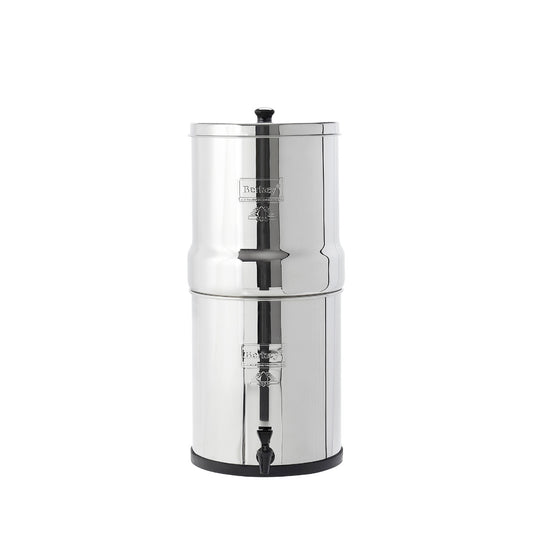
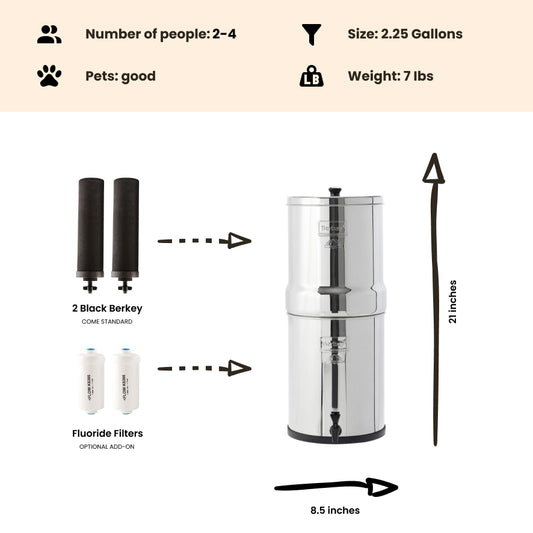
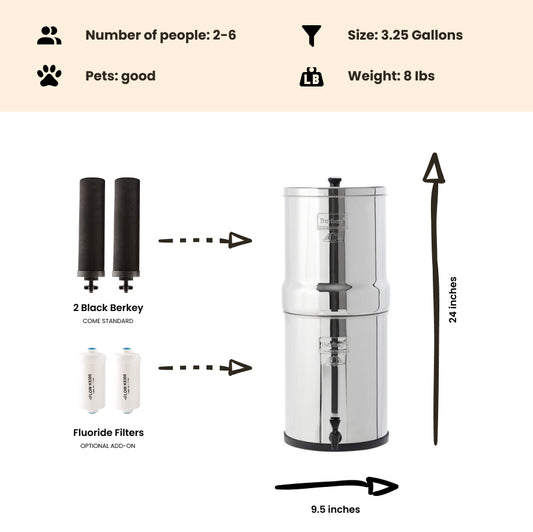
Mercury in drinking water is a toxic heavy metal that the U.S. Environmental Protection Agency limits to 0.002 mg/L, or 2 parts per billion, and a Black Berkey gravity filter removes more than 98.0% of it in independent testing. Mercury reaches water from coal combustion, mining, industrial discharge, and natural mineral deposits, and you cannot see, taste, or smell it at the levels that matter for health. This guide covers where mercury comes from, how it behaves in water, what it does to health, the legal limits, how to test for it, and the filtration methods that actually work.
How Does Mercury Get Into Drinking Water?
Mercury enters water through both human activity and natural processes. Coal-fired power plants are the largest source of mercury emissions in the United States. The mercury they release into the air settles onto land and water, where natural processes can convert it into more toxic forms.
Other major pathways include gold and metal mining, industrial and chemical manufacturing discharge, wastewater treatment effluent, and the natural weathering of mercury-bearing rock. Contaminated runoff and improperly managed waste can carry mercury into both surface water and groundwater, which is why private wells near industrial or mining activity deserve closer attention. Elevated mercury has even been traced to wastewater disposal practices, as covered in our report on elevated mercury levels in groundwater from wastewater disposal.
Is Mercury Soluble in Water?
It depends on the form of mercury. Elemental (metallic) mercury, the silvery liquid in old thermometers, is only very slightly soluble in water, and its main danger is inhaling its vapor, not drinking it. Inorganic mercury salts, such as mercuric chloride from industrial discharge, dissolve readily in water and are the form most relevant to tap and well water contamination.
Organic mercury, mainly methylmercury, is the most concerning form for human exposure. It forms when other types of mercury are converted by natural processes in water and sediment, and it dissolves and bioaccumulates up the food chain, concentrating in fish. Because the different forms behave so differently, the right response depends on which form you are dealing with and how you are exposed.
What Are the Health Effects of Mercury in Drinking Water?
Mercury is a neurotoxin, and even low-level long-term exposure can harm the nervous system, kidneys, and brain. Reported effects of chronic exposure include tremors, memory and concentration problems, changes in vision and hearing, numbness, and kidney damage.
The risk is highest for fetuses, infants, and young children, because methylmercury can interfere with brain and nervous system development. Pregnant women, nursing mothers, and small children are the populations regulators most often single out for protection, which is why the legal limit is set low.
What Are the EPA and WHO Limits for Mercury in Water?
The EPA sets a legal Maximum Contaminant Level for mercury in public drinking water of 0.002 mg/L, which is 2 parts per billion (2 ppb). The World Health Organization uses a more lenient guideline of 0.006 mg/L, or 6 ppb. Both limits apply to inorganic mercury, the form most likely to appear in drinking water.
These limits apply to public water systems. If you are on a private well, no agency tests your water for you, so the responsibility to check falls to you.
How Do You Test Your Water for Mercury?
The reliable way to test for mercury is a certified laboratory water test using EPA Method 245.1 or 245.7, because home test strips are not accurate at the low parts-per-billion levels that matter. Mail-in certified lab tests, such as those run through Tap Score by the accredited laboratory SimpleLab, report mercury alongside other heavy metals so you can see your full water profile.
If you are on municipal water, your utility's annual Consumer Confidence Report lists mercury results for the system, though it will not reflect contamination added between the plant and your tap. We keep current Berkey lab data and testing resources on our test results page.
Can a Water Filter Remove Mercury From Water?
Yes. The filtration methods independently shown to remove mercury are activated carbon adsorption, ion exchange, reverse osmosis, and distillation. Boiling does not work, and basic sediment or refrigerator filters are generally not designed for it.
Gravity-fed systems that combine activated carbon with ion exchange media are effective against the dissolved inorganic mercury found in tap and well water. That combination is what lets a properly built gravity element capture mercury without electricity, plumbing, or water pressure.
How Much Mercury Does a Berkey Filter Remove?
A Black Berkey element removes more than 98.0% of mercury in independent laboratory testing. It is the long-established Berkey gravity element, and the figure comes from accredited third-party testing, not a manufacturer estimate.
Independent lab result
A Black Berkey element reduced mercury by more than 98.0% in testing by the County of Los Angeles Environmental Toxicology Laboratory (Lab ID E1201232001, EPA Method 245.1, August 2012).
The test challenged the filter with 25 micrograms per liter of mercury, and the filtered water measured below 0.50 micrograms per liter, the laboratory's reporting limit. The greater-than-98.0% figure is the floor that the 0.50 reporting limit allows at that challenge level, not a performance ceiling, so the true reduction is likely higher than the instrument could measure.
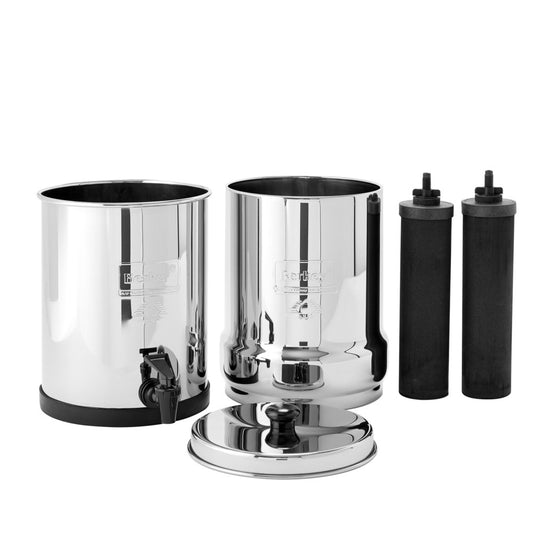
Black Berkey elements do this through a proprietary blend of media that combines microfiltration, activated carbon adsorption, and ion exchange for heavy metals. They are not a simple carbon block. You can see the full tested list on the Black Berkey complete contaminant list and the original data on our Black Berkey test results page.
The Berkey Phoenix element is the current Berkey gravity element available to order, certified to NSF/ANSI 42 and NSF/ANSI/CAN 372. It reduces mercury by more than 99.0%, to below the laboratory's detection limit, in independent testing by Atom Testing Laboratory (10 micrograms per liter challenge measured to below 0.1 micrograms per liter, April 2026). Both elements reduce mercury to non-detect, and the small difference in their reported percentages reflects different challenge concentrations and detection limits, not a difference in real performance. You can review the full tested panel on the Phoenix complete contaminant list and the Phoenix lab results page.
| Mercury-relevant spec |
Black Berkey Elements |
Berkey Phoenix Elements |
| Mercury reduction (independent lab) |
>98.0% to non-detect (LA County ETL, EPA 245.1) |
>99.0% to non-detect (Atom Testing Lab, ICPMS) |
| Filter media |
Proprietary multi-media: microfiltration, activated carbon, ion exchange |
Coconut-shell carbon block (CTC-60) |
| Certification |
Independently tested by EPA-accredited and state-certified laboratories (not NSF certified) |
NSF/ANSI 42 and NSF/ANSI/CAN 372 |
| Lifespan (per pair) |
6,000 gallons |
5,500 gallons |
| Role in the Berkey lineup |
The long-established gravity element |
The current element available to order |
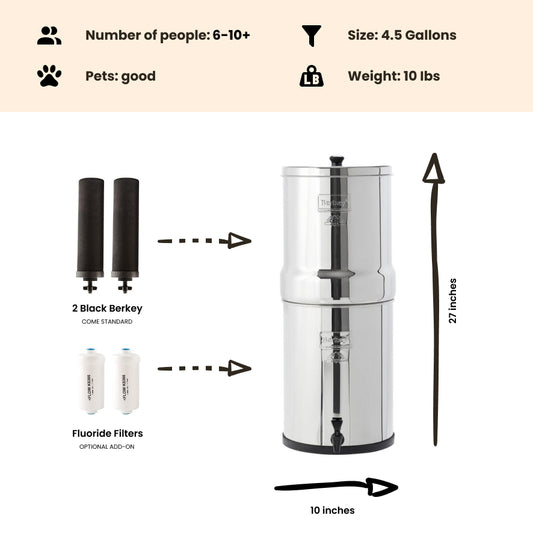
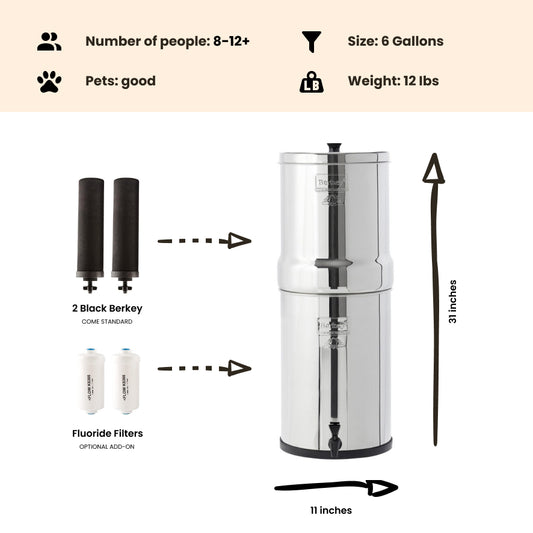
At roughly $0.02 per gallon over a Phoenix element pair's 5,500-gallon life, gravity filtration is one of the lowest-cost ways to address mercury at the tap, with no electricity or plumbing required. Both elements fit the same stainless systems, which you can browse in our Berkey systems collection, and which sit alongside our other heavy-metal solutions in the heavy metal water filter guide.
When Is a Gravity Filter Not the Right Choice for Mercury?
A gravity water filter is the right tool for dissolved mercury in drinking water, but it is not the answer to every mercury problem, and it is worth being clear about the limits.
-
Spilled or vapor mercury. A broken thermometer or fluorescent bulb releases elemental mercury vapor, which is an air-quality hazard you breathe, not a water problem. A water filter does nothing for it. Ventilate, follow local hazardous-waste cleanup guidance, and do not vacuum it.
-
Methylmercury from fish. The most common real-world mercury exposure is dietary, from eating large predatory fish like shark, swordfish, and king mackerel. No water filter changes that. The fix is dietary, following EPA and FDA fish-consumption advice, especially during pregnancy.
-
Very high or whole-house contamination. If a certified lab test shows mercury well above the 2 ppb limit, or you need every tap in the home treated, talk to a water professional about point-of-entry treatment or reverse osmosis confirmed by follow-up testing, rather than relying on a single countertop unit.
In every case, test first. A certified lab result tells you which form and how much you are dealing with, which determines the right response.
What Should You Do If You Suspect Mercury in Your Water?
Start with a certified laboratory test so you know whether mercury is present and at what level. While you wait for results, use a known-safe water source for drinking and cooking, especially for infants and pregnant women. If the test confirms mercury, install a filtration method proven to remove it, then retest after installation to confirm the result in your own water.
Berkey has been recognized for its filtration work by outlets we list on our media coverage page, and our team is available to help match a system to your water and household size.
Remove more than 98% of mercury at the tap with a gravity system that needs no power or plumbing.
Shop Berkey Systems
Frequently Asked Questions
What is methylmercury and how does it form in water?
Methylmercury is an organic form of mercury that forms when other types of mercury are converted by natural processes in water and sediment. It is the most toxic common form and bioaccumulates in fish, which is why large predatory fish carry the highest levels.
Is any level of mercury safe to drink?
Regulators treat mercury as harmful at low levels, which is why the EPA limit is just 2 parts per billion. There is no benefit to ingesting mercury, and the goal is to keep exposure as low as reasonably possible, particularly for children and pregnant women.
Does boiling water remove mercury?
No. Boiling does not remove mercury, and because some water evaporates, boiling can slightly concentrate the mercury that remains. Use a filtration method proven for mercury instead.
Does reverse osmosis remove mercury from water?
Yes. Reverse osmosis is one of the methods independently shown to remove mercury, along with activated carbon, ion exchange, and distillation. It does require plumbing, water pressure, and produces some wastewater, unlike a gravity filter.
Is mercury more common in tap water or well water?
Both can be affected. Public tap water is tested by the utility and reported annually, while private wells are not tested by any agency, so well owners near mining, industry, or heavy agriculture should test on their own.
What is the EPA limit for mercury in drinking water?
The EPA Maximum Contaminant Level for mercury is 0.002 mg/L, or 2 parts per billion. The World Health Organization guideline is higher at 0.006 mg/L, or 6 parts per billion.
Can you taste or smell mercury in water?
No. Mercury has no taste, color, or odor at the levels relevant to health, so the only way to know whether it is present is a laboratory water test.
How do you test drinking water for mercury?
Use a certified laboratory test based on EPA Method 245.1 or 245.7, such as a mail-in Tap Score kit analyzed by SimpleLab. Home test strips are not reliable at the low levels that matter for mercury.


 By
Dan DeBaun
By
Dan DeBaun