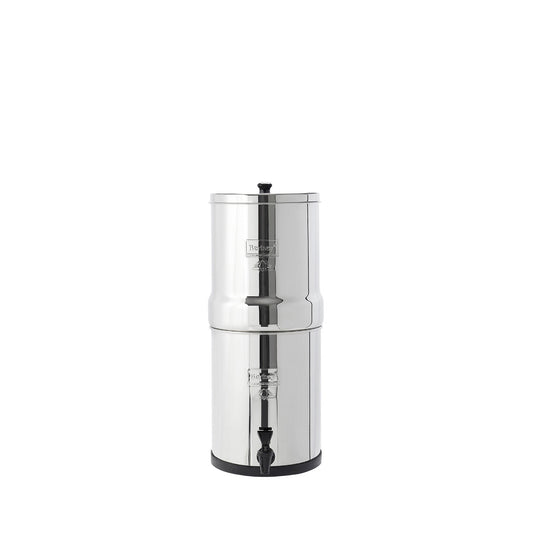
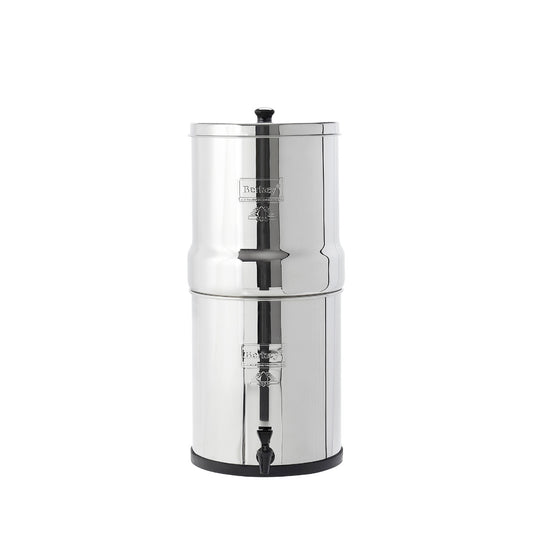
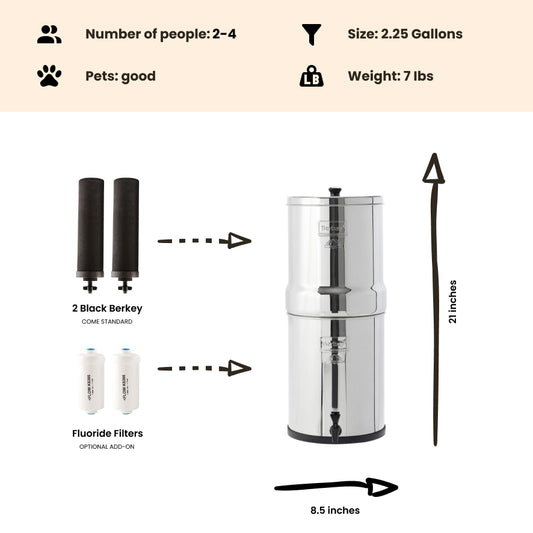
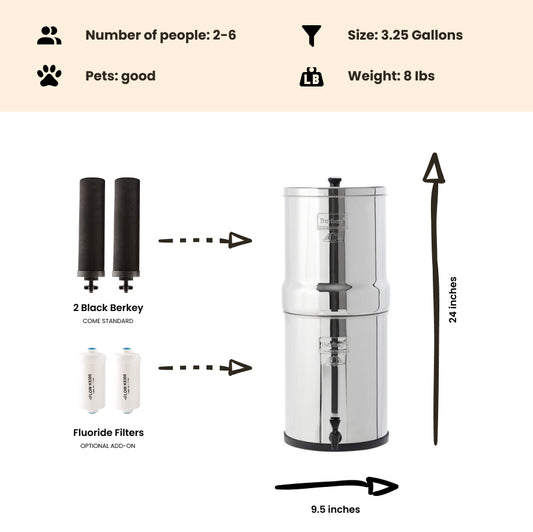
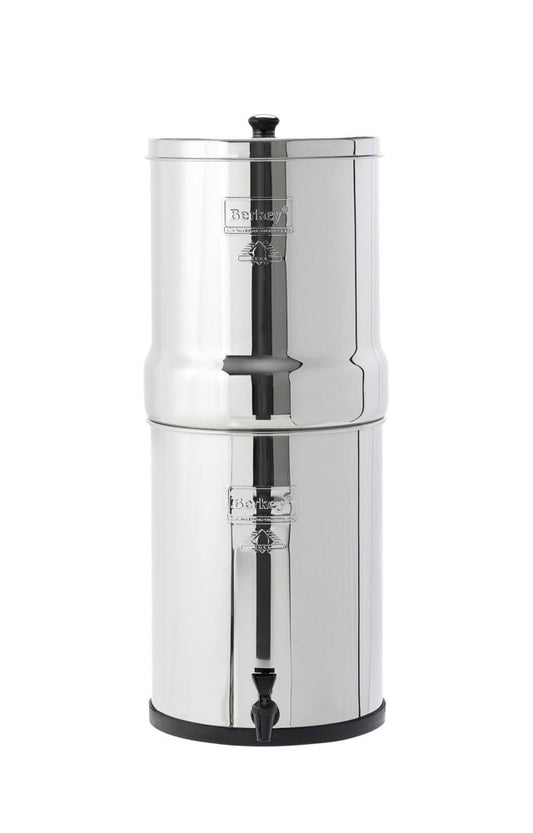
Setting up a Berkey water filter takes 10–20 minutes and requires no plumbing or electricity. Prime the gravity filter elements, install them in the upper chamber, attach the spigot to the lower chamber, stack the two chambers together, and fill the top with water. Gravity does the rest, filtered water collects in the lower chamber and dispenses through the spigot.
This guide walks you through every step: first-time setup, daily use, a maintenance schedule, and a set of extra care tips from our team for travel, filter-integrity testing, and spigot repair.
Which elements does this guide cover? Every new Berkey system ships with Black Berkey Elements while supplies last. Black Berkey Elements are not sold as standalone replacements; the authorized replacement is the Berkey Phoenix Element from the same manufacturer. Setup, priming, and care are the same for both.
How to Set Up Your Berkey Water Filter (6 Steps)
Taking the time to set up your Berkey correctly on day one ensures optimal filtration from the very first use. Follow these steps in order.
Step 1: Unbox and Inspect Your Components
Lay everything out and confirm you have all parts before starting:
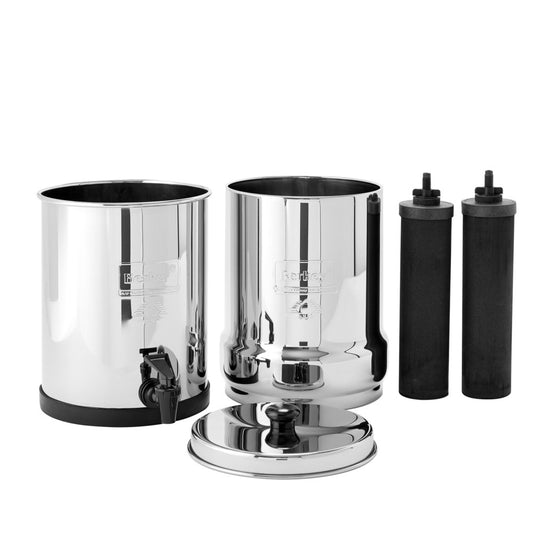
- Upper and lower stainless steel chambers
- Black Berkey gravity filter elements (or Berkey Phoenix Elements if you are installing replacements)
- Washers, wingnuts, and a priming tool (PrimeEasy Universal Primer with current elements, or the tan priming button with older stock)
-
Spigot (usually pre-packed inside the lower chamber)
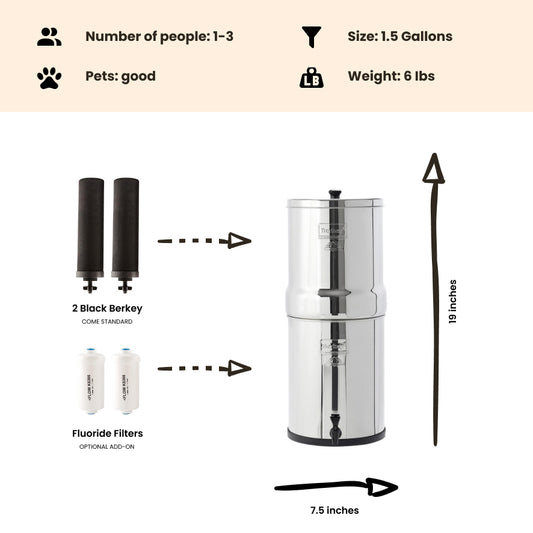
- Optional: PF-2 fluoride and arsenic reduction filters
Step 2: Wash the Chambers Before First Use
Before assembling anything, wash the upper chamber, lower chamber, lid, and spigot with warm water and mild dish soap. Rinse thoroughly. Do not use soap on the filter elements themselves, soap damages the micropores and will reduce filtration effectiveness.
Step 3: Prime the Filter Elements
Priming is the most important step, and the one most first-time users skip. Priming saturates the filter media with water, which is required before the filters can pull water through by gravity. Unprimed filters will have extremely slow or no flow, sometimes up to 10 times slower than a properly primed element.
How to prime:
- PrimeEasy Universal Primer: attach it to your faucet, insert the element stem, and turn on cold water to a gentle, steady stream.
- Tan priming button: attach it to the threaded stem, press it firmly against your faucet, and turn on cold water to a gentle, steady stream.
- Either way, hold for 30 to 60 seconds, until water beads and sweats across the entire exterior surface of the element, not just part of it.
- Repeat for each filter element individually. Priming a full pair takes about 5 to 10 minutes total.
If your water pressure is too low to prime at the tap, the PrimeEasy Universal Primer also works with a bottle of clean water. Both Black Berkey and Phoenix elements prime the same way.
Step 4: Install the Filter Elements
- Place one rubber washer on the threaded stem of each filter element.
- Insert each element down through the holes in the bottom of the upper chamber, so the filter body sits inside the chamber and the stem protrudes below.
- From underneath the upper chamber, hand-tighten a wingnut onto each filter stem until snug, do not overtighten.
- If you're using PF-2 fluoride filters, screw one onto each element stem below the upper chamber now, before stacking the chambers. Exactly 8 revolutions, no more, or you risk damaging the internal media screen. The PF-2s hang inside the lower chamber once the system is assembled.
Step 5: Install the Spigot
Insert the spigot through the pre-drilled hole in the lower chamber. Place one washer on the inside and one on the outside, then hand-tighten the nut until the spigot is snug and doesn't rotate. Turn the spigot to confirm it opens and closes smoothly before filling.
Step 6: Assemble and Run Your First Batch
Stack the upper chamber (with filters installed) onto the lower chamber. Place the lid on top. Fill the upper chamber with tap water. That's setup done. From here, treat the first fill as a break-in flush and discard it once it passes through, the first 2 to 3 flushes can look slightly cloudy from residual media dust, which is normal and separate from the setup time above (see why new Berkey water is cloudy for what to do if it does not clear). Allow 1–2 hours for a full upper chamber to filter through completely.
How to Use Your Berkey Water Filter Every Day
Once assembled, daily use is simple. Lift the lid, pour water into the upper chamber, and dispense filtered water from the spigot whenever you need it. No electricity, no plumbing, no cartridges to swap, just gravity.
Tips for Getting the Most Out of Your Berkey
-
Refill before the upper chamber is empty. You don't need to wait until it runs dry, top it off whenever it's convenient.
-
Don't overfill when the lower chamber is already partially full. Check that there's enough room in the lower chamber before pouring a full upper chamber. If not, decant some filtered water into a pitcher or bottle first, then refill the top.
-
Fill the upper chamber all the way to the top each time. This lets water contact the full length of each filter element, so the media wears down evenly and you get the full rated life out of your elements.
-
Leaving for more than 3–4 days? Empty both chambers before you go to prevent stagnant water buildup.
-
Flow rate slowing down? It's time to scrub the filter elements. See the maintenance schedule below.
Berkey Filter Maintenance Schedule
Berkey systems are low-maintenance, but regular cleaning keeps flow rate optimal and water quality high. The short version:
| Component |
Maintenance Task |
Frequency |
| Stainless steel chambers and spigot |
Wash with mild dish soap and warm water |
Monthly |
| Filter elements (Black Berkey or Phoenix) |
Scrub gently under running cold water with a Scotch-Brite pad, no soap, then re-prime |
Every 3 to 6 months, or sooner when flow slows noticeably |
| Filter elements |
Replace when flow doesn't recover after scrubbing, or at end of rated life |
Black Berkey: 6,000 gal/pair. Phoenix: 5,500 gal/pair. Roughly 3 to 6 years for most households at 1 to 3 gal/day |
| PF-2 fluoride filters (if used) |
Replace, cannot be cleaned |
Every 1,000 gallons or 12 months, whichever comes first |
For full step-by-step cleaning instructions, hard-water tips, and spigot descaling, see our guide: How to Clean Your Berkey System.
Tips From Our Team
A few extra tips from Ann, who's been part of the Big Berkey Water Filters team for over 10 years and has fielded just about every setup and care question there is.
Transporting Your Berkey
Remove the filter elements before you travel so they don't snap off the stem in transit. Wrap each element in a towel for impact protection, then place them in the lower chamber. Turn the upper chamber upside down and nest it inside the lower chamber for transport. When you arrive, reinstall the elements and you're ready to use your system again.
Testing Filter Integrity: The Red Food Coloring Test
You can check your filter elements with a red food coloring test any time you notice unusually fast filtration, an off taste, or just want to confirm a seal. Use artificial red food coloring only (Red 40 or Red 3); natural or organic food coloring passes through even correctly functioning filters and will give you a false reading.
- If you're using PF-2 fluoride/arsenic filters, remove them first. Dye that gets into the PF-2 media is very difficult to flush back out.
- Empty both chambers. Place a cup or glass under each filter element in the lower chamber so you can catch what drips from each one individually. Use a clear or white cup if you can.
- Position the upper chamber so each element drips directly into its cup.
- Add up to 1/8 teaspoon (about 10 drops) of red food coloring per gallon of your system's capacity to the upper chamber, then fill it with water.
- Let the water filter down until each cup is at least half full, then discard the remaining red water in the upper chamber.
- Check each cup. Filtered water should run clear. If you're using a clear cup, hold a piece of white paper behind it to get an accurate read.
- Clear water means that element is filtering correctly. Pink or red-tinted water means that element is compromised and should be replaced.
Fixing a Leaking Spigot
If your spigot leaks around the washers, confirm you have a washer on both sides of the stainless steel wall (black washer inside, white washer outside). Tighten the nut as much as you can by hand, then use a wrench on the nut while turning the spigot itself for a final quarter turn of extra leverage. If it still leaks, soak the washers in olive oil for about an hour. Washers can harden over time, and the oil softens them enough to seal properly again.
Long-Term Storage Before Extended Downtime
If you're storing your system for an extended period, or keeping a spare set of elements on the shelf, dry the filter elements thoroughly first before sealing them in a zip-lock or vacuum bag. That takes about 1 to 3 days in a warm, well-ventilated spot, a sunny windowsill works well. The real requirement is zero moisture before sealing, not a specific day count, so let cooler or less ventilated spaces run longer if needed. Never let a wet or damp element freeze; freezing can crack the media and will void the warranty. For the full priming and storage walkthrough, see our priming and storage guide.
Ann, Big Berkey Water Filters
Frequently Asked Questions
How long does it take to set up a Berkey water filter?
First-time setup takes approximately 10–20 minutes: assembling the system is under 10 minutes, and priming a full pair of filter elements adds about 5 to 10 minutes. The break-in flush that follows (discarding the first batch or two of filtered water) is separate from setup time. After the initial setup, daily use (filling and dispensing) takes only seconds.
How long do Berkey filter elements last?
Black Berkey elements are rated for up to 6,000 gallons per pair; Phoenix elements for up to 5,500 gallons per pair. For most households using 1 to 3 gallons of filtered water per day, that's roughly 3 to 6 years of use. If flow slows significantly and scrubbing doesn't restore it, it's time to replace the elements.
How fast does a Berkey filter water?
A Big Berkey with 2 filter elements has a maximum filtration rate of up to 3.5 gallons per hour (7 gallons per hour with 4 elements) when the upper chamber is kept topped off. In practice, if you fill it once and walk away, expect roughly 1 to 1.25 gallons in the first hour, since flow slows as the water level, and the gravity pressure behind it, drops. Most people fill the upper chamber before bed and have a full lower chamber by morning.
Does Berkey remove fluoride?
Filter elements do not significantly reduce fluoride on their own. To remove fluoride, you need to add the optional PF-2 fluoride and arsenic reduction filters, which screw onto the stems of the filter elements and hang inside the lower chamber.
Why is my Berkey filtering so slowly?
Slow flow is almost always caused by one of three things: the filter elements weren't fully primed during setup, sediment buildup on the filter surface, or air pockets in the elements. Re-prime the filters or scrub the filter surface gently under running water. If flow doesn't improve after scrubbing, the elements may need to be replaced.
How often should I clean my Berkey?
Clean the stainless steel chambers and spigot monthly with mild dish soap and water. Scrub the filter elements every 3 to 6 months, or whenever you notice a drop in flow rate. Never use soap directly on the filter elements; scrub with clean water only, then re-prime.
Can I use my Berkey with well water?
Yes. Berkey systems can filter well water effectively. However, well water with high sediment content will clog the filters faster, requiring more frequent scrubbing. If you're on a well, expect to scrub your filter elements every 4–6 weeks instead of every few months.
Ready to Start Enjoying Clean Water?
Once your Berkey is set up and running, it requires minimal attention to keep delivering clean, great-tasting water day after day. Follow the maintenance schedule above, and your system will last for years.
Have questions about your Berkey? Contact our team or browse our full resource library for more guides and tips.


 By
Dan DeBaun
By
Dan DeBaun