Fluoride exposure at elevated levels is linked to bone and joint problems, dental and skeletal fluorosis, and other health effects, and because the body doesn't easily excrete fluoride, ongoing exposure accumulates over time. Northern India, particularly the Rajasthan and Punjab regions, has some of the most severe naturally occurring fluoride contamination documented anywhere in the world, and it offers a useful real-world case study in what happens when fluoride levels run well above what's considered safe.
Quick answer: A 2007 academic study of rural habitations in Northern Rajasthan, India found groundwater fluoride levels ranging from 1.01 to 4.78 ppm, averaging 2.82 ppm, and linked these levels to widespread dental and skeletal fluorosis in the local population. For comparison, the US EPA's enforceable limit for fluoride in drinking water is 4.0 mg/L, the secondary (aesthetic) standard is 2.0 mg/L, and the HHS-recommended optimal level for water fluoridation is 0.7 mg/L. The Rajasthan average was already above the secondary standard and roughly four times the recommended optimal level, and the high end of the range exceeded even the EPA's enforceable maximum.
Fluoride Contamination in Punjab and Rajasthan
Reporting on Northern Punjab, India documented visible health effects in communities exposed to naturally occurring fluoride contamination, entering the water supply through natural geological deposits and, in some areas, compounded by chemical fertilizer runoff. The news coverage didn't include specific concentration figures, but a 2007 study from the Environmental Biology Laboratory, Post Graduate Department of Zoology at S.G.N. Khalsa (PG) College in Sri Ganganagar, India, titled "Fluoride contamination in drinking water in rural habitations of Northern Rajasthan, India," filled in that gap with hard data.
The study recorded fluoride concentrations across the sampled region ranging from 1.01 to 4.78 ppm (parts per million), with an average of 2.82 ppm. Researchers directly tied these levels to what they described as an alarming rate of dental and skeletal fluorosis in the local population, and called for immediate remediation steps to protect residents from continued exposure.
How Punjab's Fluoride Levels Compare to US Standards
The US regulates fluoride in drinking water at two different thresholds, plus a separate, non-enforceable recommendation for water systems that add fluoride intentionally. Here's how the Rajasthan study's findings stack up against each:
Scroll table to see all columns
Benchmark
Level
Rajasthan Study Comparison
HHS/CDC recommended optimal fluoridation level
0.7 mg/L
Study average (2.82 ppm) is roughly 4x this level
EPA secondary (aesthetic) standard
2.0 mg/L
Study average already exceeds this standard
EPA enforceable Maximum Contaminant Level (MCL)
4.0 mg/L
Study's high end (4.78 ppm) exceeds this legal limit
In other words, this wasn't a marginal exceedance. The average recorded level in the study already sat above what the EPA considers acceptable even for aesthetic purposes in the US, and the upper end of the range would not be legal in US drinking water at all.
Does Boiling Water Reduce Fluoride?
No, and this is a common point of confusion. Boiling water is an effective way to address certain waterborne organisms, but it does nothing to reduce fluoride, and can very slightly increase fluoride concentration, since evaporation reduces the water's volume while the dissolved fluoride stays behind. If fluoride is your concern, boiling isn't the tool for the job.
Fluoride and Infant Formula
In 2007, the American Dental Association advised parents to consider using low-fluoride water, such as bottled water labeled "de-ionized," "purified," "demineralized," or "distilled," when mixing infant formula during a baby's first year, out of concern for dental fluorosis risk during tooth development. Guidance in this area has evolved over time, so parents with current questions about infant fluoride exposure should check with their pediatrician or the CDC's current recommendations rather than relying on older guidance alone.
Reducing Fluoride From Your Own Tap Water
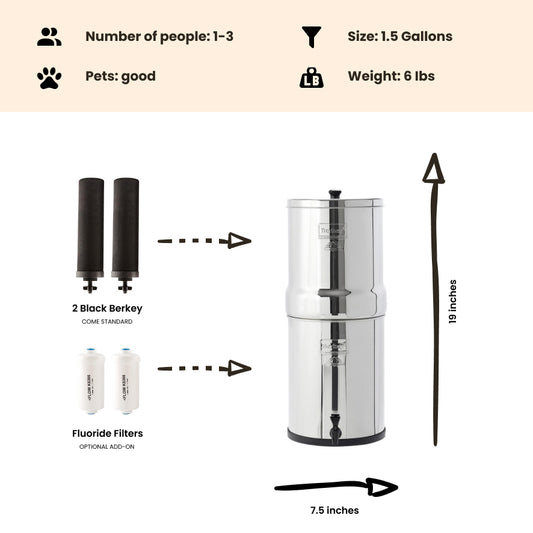
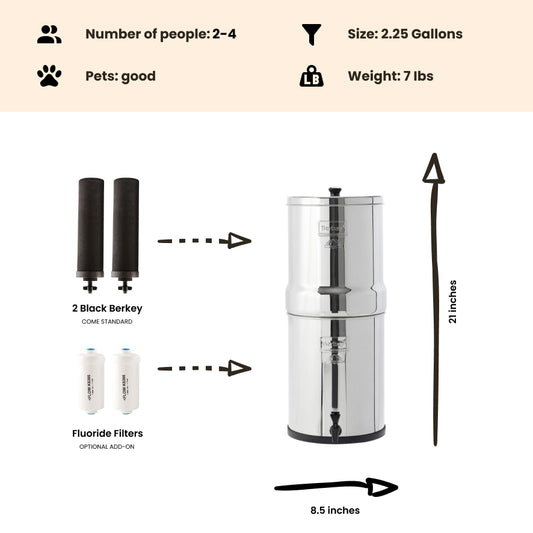
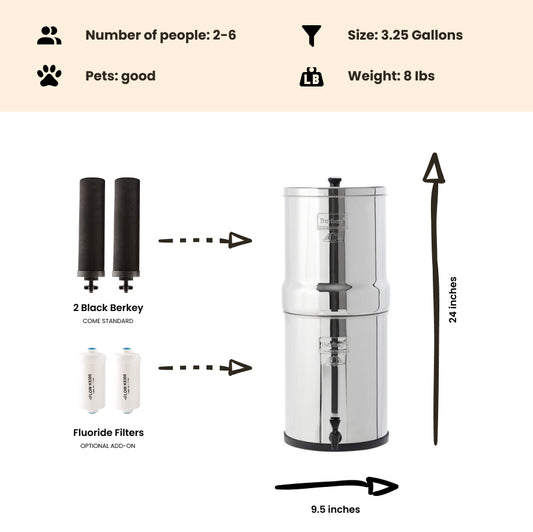
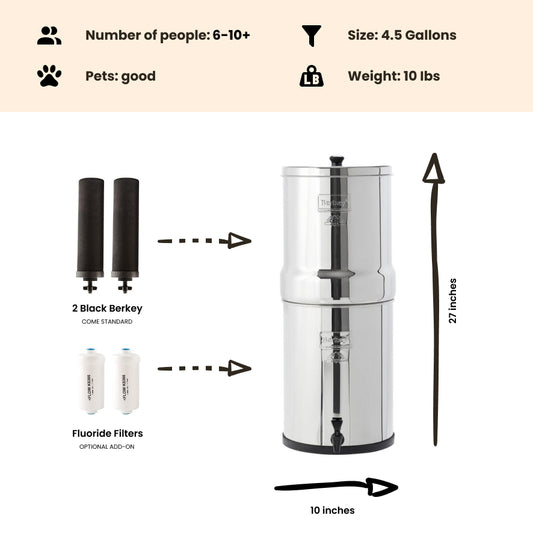
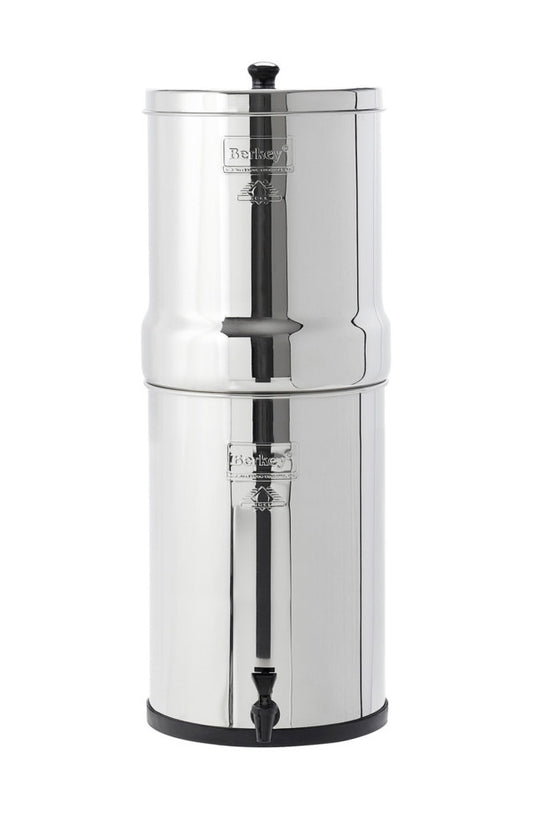
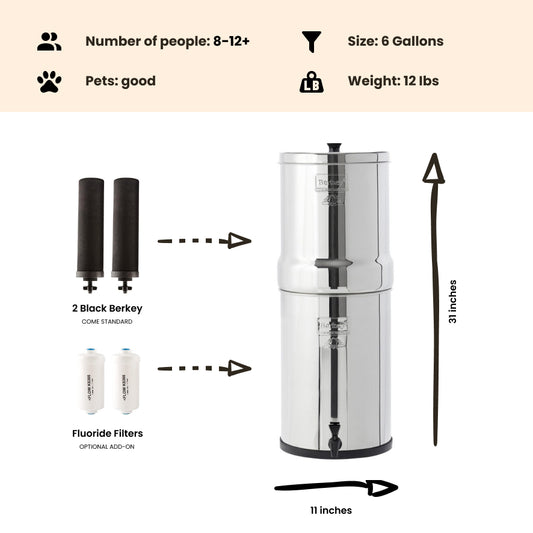
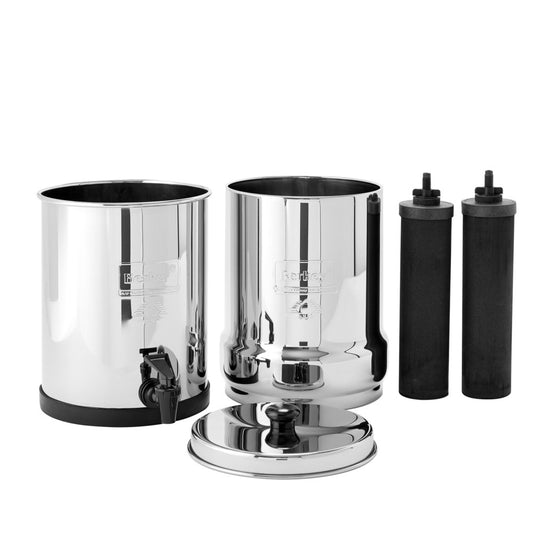
If you're on a municipal water supply, your annual Consumer Confidence Report will tell you whether your water is fluoridated and at what level. Neither Black Berkey Elements nor Phoenix Filter Elements are designed for sustained fluoride reduction on their own. For that, Berkey systems use an optional add-on, the PF-2 Fluoride and Arsenic Reduction Filter, which attaches to the upper Black Berkey or Phoenix elements and hangs down into the lower chamber, and is independently rated to reduce fluoride and arsenic by up to 99.75% under optimal conditions.
Worth knowing: The "up to 99.75%" figure reflects performance under optimal test conditions and can vary with real-world factors like influent fluoride concentration and filter age. For the full breakdown of how the two-stage filtration process works, see our detailed guide, Do Berkey Water Filters Remove Fluoride?, or view the PF-2 filter product page directly.
Frequently Asked Questions
How bad was the fluoride contamination found in the Rajasthan study?
The 2007 study recorded fluoride levels ranging from 1.01 to 4.78 ppm across rural Northern Rajasthan, averaging 2.82 ppm. That average already exceeds the EPA's secondary standard for US drinking water, and the high end of the range exceeds the EPA's enforceable legal limit.
What's the difference between the EPA's fluoride limit and the recommended fluoridation level?
The EPA's enforceable Maximum Contaminant Level (MCL) is 4.0 mg/L, the legal ceiling for any US public water system. The EPA's secondary standard is 2.0 mg/L, a non-enforceable aesthetic guideline. Separately, HHS and the CDC recommend 0.7 mg/L as the optimal level for water systems that add fluoride intentionally for dental health purposes. These are three different numbers serving three different purposes.
Does boiling water remove fluoride?
No. Boiling can address certain waterborne organisms, but it doesn't remove fluoride and can very slightly concentrate it, since water evaporates while dissolved fluoride does not.
How can I find out if my tap water contains fluoride?
Check your water utility's annual Consumer Confidence Report (CCR), usually available on their website, which lists fluoride levels along with other tested contaminants for your specific water system.
Can a Berkey system reduce fluoride?
Berkey systems can reduce fluoride when paired with the optional PF-2 Fluoride and Arsenic Reduction Filter, independently rated to reduce fluoride and arsenic by up to 99.75% under optimal conditions. Black Berkey and Phoenix Filter Elements alone are not designed for sustained fluoride reduction.
See the Full Fluoride Reduction Breakdown
Learn exactly how Black Berkey and Phoenix Elements pair with PF-2 filters to reduce fluoride and arsenic.
Dan is the owner and operator of Big Berkey Water Filters. Prior to Berkey, Dan was an asset manager for a major telecommunications company. He graduated from Rutgers with an undergraduate degree in industrial engineering, followed by an MBA in finance from Rutgers as well. Dan enjoys biohacking, exercising, meditation, beach life, and spending time with family and friends.
Purchased it as a gift for the mom as well as she liked that it. sweet top quality cool price tag and/or the mom enjoyed that. And delivered very fast. So if you require a present accelerated and you such as this compared to this is actually the a person you will want to pick!
charug2112010-07-30 06:08:01
We have already done enough harm to the environment…High time we woke up to see the damage we’ve caused. We may not be able to reduce global warming, end pollution and save endangered species single-handedly, but by choosing to live an earth-friendly lifestyle we can do a lot every day to help achieve those goals. Stand Up Take Action 2010.We need you…Globally more than 173 Million people stood up against poverty in 2009, a Guinness World Record! Let us break this record in 2010!
It is Time for You to STAND UP AGAINST POVERTY NOW! Join us on Facebook at www.facebook.com/unmcampaignINDIA Follow us on Twitter at http://twitter.com/unmcampaignIND
Bob2010-06-05 18:15:01
We shouldn't be forced to drink fluoride. I bought this <a href="https://www.bigberkeywaterfilters.com/berkey-filter-replacements-c-67/pf-2-arsenic-and-fluoride-water-filters-2-p-188" rel="nofollow">fluoride water filte</a>r last month for this very reason.


 By
Dan DeBaun
By
Dan DeBaun






Purchased it as a gift for the mom as well as she liked that it. sweet top quality cool price tag and/or the mom enjoyed that. And delivered very fast. So if you require a present accelerated and you such as this compared to this is actually the a person you will want to pick!
We have already done enough harm to the environment…High time we woke up to see the damage we’ve caused.
We may not be able to reduce global warming, end pollution and save endangered species single-handedly, but by choosing to live an earth-friendly lifestyle we can do a lot every day to help achieve those goals.
Stand Up Take Action 2010.We need you…Globally more than 173 Million people stood up against poverty in 2009, a Guinness World Record! Let us break this record in 2010!
It is Time for You to STAND UP AGAINST POVERTY NOW!
Join us on Facebook at www.facebook.com/unmcampaignINDIA
Follow us on Twitter at http://twitter.com/unmcampaignIND
We shouldn't be forced to drink fluoride. I bought this <a href="https://www.bigberkeywaterfilters.com/berkey-filter-replacements-c-67/pf-2-arsenic-and-fluoride-water-filters-2-p-188" rel="nofollow">fluoride water filte</a>r last month for this very reason.